
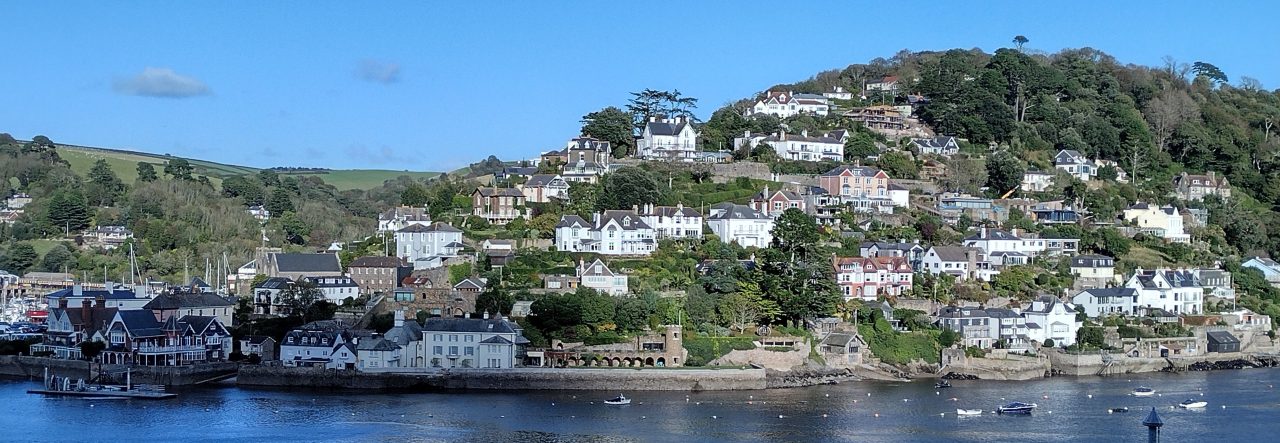
KINGSWEAR HISTORIANS
This is our first Newsletter, and we are distributing it to all members past and present, to those who have an interest in our Kingswear area, and to those living further away whom we know share our interest in local history.
The aim is:
- to summarise our recent meetings, and look ahead to the future programme
- to present ‘snippets’ of interesting local tales, hoping they will encourage someone to research the item further
- to let people know what research has been and is being done by members
- to give a forum where researchers can ask readers for information relating to their project
- to encourage members to make use of our substantial and increasing archives, including CDs of old Dartmouth Chronicles
- generally to encourage members and others to take an interest in exploring and archiving our local history.

We have now published two booklets written by members:-in 2004 The Dart Estuary Lights, Marks & Lighthouses: A Brief History; and this year
A Short History of Local Golf and the Kingswear & Dartmouth Golf Club.
Other future publications may be Wrecks and Strandings in the Dart, the Story of the Dart Harbour’s Hospital or Fever-ship, and the Shops of Old Kingswear.
We would welcome any writings, long or short, which can either be presented in a future
Newsletter or compiled into a formal booklet. For example, you might enjoy writing the history of
your house or street and those who have lived there.
You can see that we are asking you to help each other, and with the help of our archives to delve into the past with a view to making that history interesting, freely available to all and to future generations. To this end we hope to have small seminars from time to time where those interested
in researching can find help and encouragement, and exchange information. For further information about the Historians and their activities, contact David Evans, Hon Secretary, 752 777, or evans@anchorstone.fsnet.co.uk
KINGSWEAR HOUSES
The Old Vicarage, by Neil and Jean Baxter
Anyone could write a considerable pamphlet about their own house and some of it would be of interest to neighbours and fellow Kingswearians. Our house was built in 1885/6 as a vicarage, with Edward Appleton as architect, and the builders W B & H B Crocker of Torquay, costing with extras £785. It was owned by the church and occupied by the vicars of Kingswear until 1984. After being empty for a year, we bought it at auction in The Royal Dart Hotel.
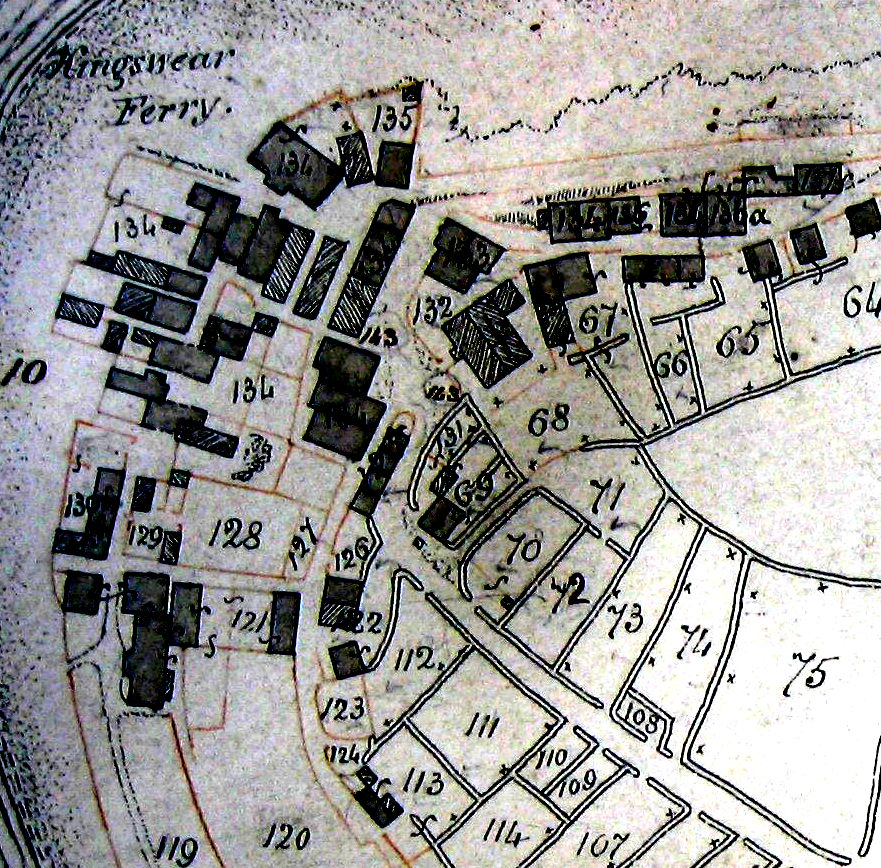
We have deeds of sale, hand-written, several on enormous sheets of vellum, from 1828 onwards for ardens, sometimes called Lavice’s gardens on Church Hill and marked 70, 71,and 72, on the ‘apportionment of tithes’ records and maps (see left).
There are ongoing records of owners (see below); e.g. in 1841 Mr Wm Wills was landowner of plot 70, cultivated by Wm Norcombe as a kitchen garden of 20 perches; plots 71 and 72, of 21 and 17 perches, were owned and cultivated by James Vosper, 71 as a kitchen garden, and 72 as a potato garden. By 1881 the three gardens had been purchased and combined to form the plot for the vicarage.
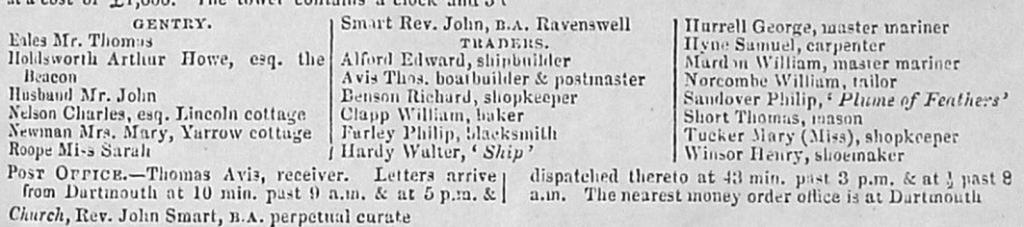
The first vicar to live in the new Vicarage was the Rev Frederick Walker and this is recorded in one of the 22 directories of Kingswear published between 1850 and 1939. These directories, published every few years, give a brief history of the village and list all the ‘gentry’ and the ‘traders’ and where they live
(see right in 1856 … that is 150 years ago!).

There are also records elsewhere of the number, sex and ages of all occupants of many of the houses. The succession of later incumbents is listed in the church up to the Rev Gould who was the last vicar to live in the Vicarage.
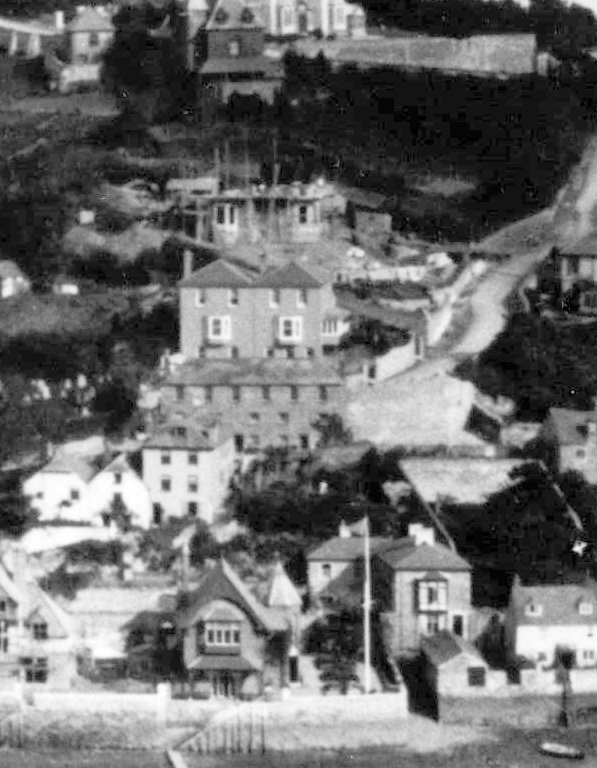
This photograph from the Historians’ archives taken in 1886 shows the Vicarage half-built. The scaffolding is there and the building is up to first floor level. We have lived in the Vicarage, now The Old Vicarage, since 1986, and have tried to maintain but not to spoil the original house while updating it sufficiently for our needs.
This is the barest outline of The Old Vicarage. Kingswear Historians are accumulating in their archives all this type of information: it is available as documents such as the apportionment tithe maps, directories, maps and photographs, and in the Dartmouth Chronicles. All the information here is available through the Kingswear Historians and their archives.
If you are interested in the history of your house or terrace or street, then the information is probably here in Kingswear. We will give you encouragement and help you in your research.
Meetings:-
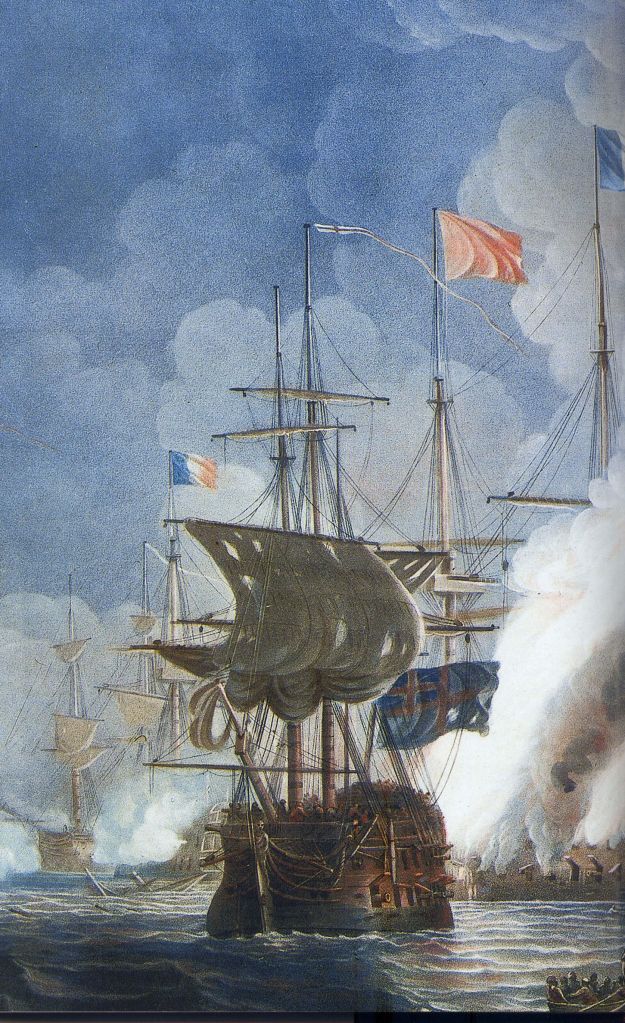
on the 18th September 2006: Torbay and the Blockade of Brest From 1793 to 1815, with only a short- lived gap from 1801 to 1803, Britain was at war with revolutionary France. During all of this time, the
Navy’s Channel Fleet was responsible for preventing the French fleet from threatening the South coast of England and thereby providing safe passage for Napoleon’s invasion barges. The story of how the Fleet accomplished this was recounted by local maritime historian Mark Rae in his talk ‘Torbay and the Blockade of Brest in the Napoleonic Era’.
The Admiral of the Channel Fleet held the Post of Honour as the guardian of the country. Although Plymouth was the main naval base, Torbay was widely used as a safe anchorage except at times of a strong Easterly wind. The ships in the fleet ranged from the First Rate 100gun three-deckers down to the fast frigates that were the ‘eyes’ of those forming the line of battle. The weight of shot by a single First Rater was larger than that fired by all of the French artillery at Waterloo.
For year after year and in every kind of weather, part of the fleet patrolled off-shore well out of sight of land whilst the frigates of the Inshore Squadron braved the hazards of rocks and currents to watch Le Goulet, the entrance to Brest harbour, for any signs of French ships attempting to leave port. Under St Vincent, who took over control of the fleet in 1800, the blockade was intensified. The time allowed as ‘pit-stops’ for ships returning to Torbay for fresh water and supplies was kept to the absolute minimum, and on anchoring ships were ordered to immediately hoist the ‘Blue Peter’ to signify departure was imminent. When, aged over 70 and forced by illness to remain ashore, St Vincent handed over direct control at sea to Cornwallis who had been in charge of the Inshore Squadron, and then set up his headquarters in Torre Abbey.
A crisis was reached in 1804 when an invasion army assembled by Napoleon near Boulogne needed only four days of clear weather for barges to transport it across to Britain. This was not possible while the Channel Fleet was in complete command of the Channel and the plan was postponed and eventually abandoned. Finally, after ten more years of war and his eventual capture after Waterloo, Napoleon was brought to Torbay on board the ‘Bellerephon’ (known by her crew as the ‘Billy Ruffian’) in August 1815. This attracted much local excitement, before his departure to Plymouth and exile to St Helena. His downfall was brought about in no small degree by ‘the long line of distant ships…’.
on the 18th September 2006: The Kingswear Torpedo Station
In the second talk, our chairman Paul Moynagh took us forward in time by 125 years to 1940 and the risk of invasion by Germany after Dunkirk.
Action was quickly taken to strengthen the defences of Dartmouth and protect the shipping in the harbour. This included the building in 1940 of a torpedo battery in Kingswear at the edge of the
sea immediately below Kingswear Court in Castle Road. It was built on top of an existing salt-water
swimming pool and camouflaged to look like a thatched boat house.
Although the use of land-based torpedo batteries dates back to the 19th century, their use in the 20th century is virtually unknown and only two others apart from the Kingswear battery are believed to have been built in the Second World War. The battery would have been manned and operated by naval personnel but it has proved difficult so far to trace details in official records. Similarly, although it appears from remains of rail tracks that there were three launching positions, the type of torpedoes used and how they would have been supplied are not yet fully clear. It would have been linked to the overall defensive system for Dartmouth harbour including the boom across the river mouth, the gun position at Dartmouth Castle and the Brownstone Battery built in 1942.
It is said that one night the wrong code for the day had been sent by mistake to all the defensive positions. A Polish destroyer attempting to enter the harbour at night was seen and challenged by the battery. Luckily, in spite of the confusion of codes, the officer in charge on-shore believed he recognised the outline of the ship and a quick call to headquarters confirmed he was correct.
The remains of the battery are part of the legacy of the war years and it is hoped that continuing research will be able to fill some of the existing gaps concerning it.
LOOKING AHEAD:-
to the 30th October 2006 in the Lower Hall at 7.30pm
‘The Kingswear – Brixham Peninsula’.
The passing centuries have all helped shape our countryside and the growth of towns and villages. Also succeeding generations have altered the shapes of fields, woods and forests; place names and building-styles have changed, tracks have become roads, and the cottage industries have been computerised.
The Kingswear – Brixham peninsula has sites of every period of British history from early stone-age to the twentieth century. This evening will be an informal review of these sites led by a retired archaeologist who is also our archivist. We will look at some details of our medieval heritage, the Saxon conquest, the Norman conquest, take a fresh look at Domesday, and talk about the origins of some of our place names. We will also look at the origins of Kingswear and St Petrox churches.
The evening will be strictly informal; do come and enjoy our ancient past. It will also be an opportunity to see some of the material now held in our archive and to report on the work being carried forward.
to the 27th November in the Main Hall at 7.30pm.
‘A Lifeboat Skipper Remembers’ by Arthur Curnow
Our last meeting in 2006 is guaranteed to be a high-light to end the year in style! Roars of laughter mark every time Arthur Curnow remembers his years with the lifeboats and this will be no exception.
Afterwards we will hold our Annual General Meeting to review progress during the past year and report on plans for 2007, on which we will need your comments and suggestions.
 Kingswear Historians