
INGSWEAR HISTORIANS
Chairman: Paul Moynagh 752 206 Secretary: David Evans 752 777
Membership Secretary: Neil Baxter 752 570
This is our second Newsletter which, like our first one last October, tries to bring together:
- reports on our recent meetings
- updates on work in progress on publications ─ copies of Lights, Marks and Lighthouses
and The Kingswear and Dartmouth Golf Club continue to sell well and work on Wrecks in
the Dart River and Estuary is well advanced - the history of another local house, ‘Killiney’, hoping it will encourage similar research by
other owners - progress in capturing on tapes the memories of some of the older Kingswear ‘veterans’
- some ‘snippets’ from past years.
But our over-riding aim remains the building of an archive for Kingswear, bringing together all available material to form a permanent record of all the many changes over the centuries, and for
research into all the many questions still waiting to be answered. Gordon Thomas gave us a flying
start three years ago with his marvellous collection of local photographs, now indexed and mounted
in folders by main subjects. Dick Parkes passed to us copies of his ‘Around Kingswear’ page in the
Herald Express – a running snapshot of life in the village which we are keeping fully up to date. At the
request of the Parish Council, we have now taken over responsibility for safe storage of all their
records, providing a new aid for research. And of course we have all that our President Don Collinson
makes available from his collection.
However, a further major advance has been the success by our archivist, Trevor Miles. He has prepared digital copies of the Dartmouth Chronicle for the years 1855-1913, creating for the first time
a record available on disc of life week by week on both sides of the Dart, and at times on or in it! The
‘ads’ alone are fascinating.
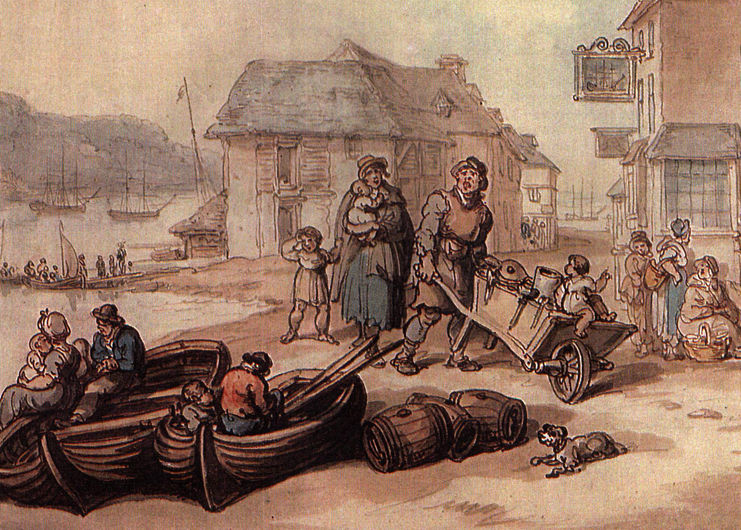
A propos of nothing except an interesting early picture. This picture, ‘The Pot Mender’, was painted by Thomas Girton about 1799. He died aged 22 years. The beach is that between the car ferry slip and Collins slip by the Yacht Club (from where the first passenger ferries ran). The chap with the barrow is the itinerant pot- mender – an important tradesman at that time. The building behind him in the distance is the Plume of Feathers, now the Royal Dart Hotel, before its third storey was added. The building with hanging sign this side of the Ferry slip is where our Post Office is now – with a good deal of artistic licence!
Kingswear Houses
Killiney, Wood Lane, by Mike and Jan Trevorrow
Our house was built in 1908 and named – we think – after the town of Killiney at the foot of the Wicklow Hills in Ireland, near to Dublin. It is half of a pair of semi-detached houses and was first bought by a well-known and liked local man, Tom Casey. You may well have seen his name on the side of one of the car ferry floats because the Caseys owned the ferry from 1877 to 1925. The Caseys were big in Kingswear since they had the dairy; they also sold bread from their van. One of the Caseys was a builder but we have not yet been able to find out whether it was he who built the house for the family.
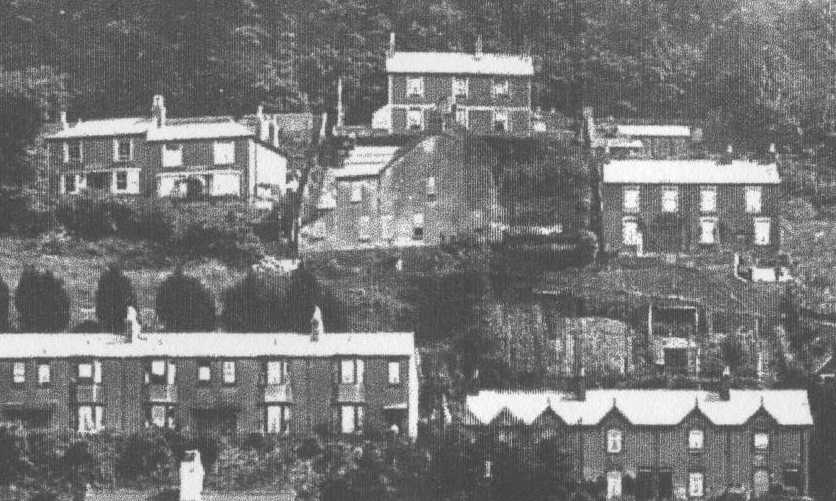
The house is very soundly constructed from semi-glazed red brick with yellow brick quoins and 4 window framings. I was very surprised to find out that it is built 5 with cavity walls at a time when most houses were still being built with solid, double-brick walls. The roof is a puzzle to us since it is of flat cement tiles with tarred underfelt underneath them. For the period of the house you would expect a Welsh slate roof and no felt, but it isn’t like that.

Using evidence from village archive photographs between the 1890s and about 1920 it is possible to plot the order in which the older houses around us were built. Using the photo of 1920, above, the side-on houses called Overhill (2) were the first to be built around 1890, then Hawarden Terrace (3) a few years later, followed in 1900 by the Beechcroft pair of semi’s (4) bordering Higher Contour Rd; semi-detached from Glenhurst (5), Killiney (1) completed the group in 1908 and couldn’t decide which road to adopt and so took both Wood Lane and Higher Contour Rd for its entrances.
Using the old Tythe Maps of this area it seems that our house was built on the plot designated 46 and as defined as a garden; more information is not yet forthcoming in parish records and the Dartmouth Chronicles, but we’re still looking.
When old Mr Casey died in the late sixties aged almost 96, his daughter Kathleen took over the house with her husband Norman Davies, who used to work at the National Provincial Bank in Dartmouth. We think it was they who built a garage and workshop over old Mr Casey’s rhubarb patch, even though they never had a car! Kathleen died; after some years Norman Davies was planning to re-marry but died before this happened, so his partner Linda, distributed the very interesting ‘Casey Collection’ to three
appreciative local sources.
David and Moira Molloy then bought the house and made many changes, but kept the lovely Edwardian railings which we are so fond of (except when they need painting). The third resident owners were a family called Kinnair. Since then Jan and I have done a lot of re-planting and some re- modelling in the garden. Now Killiney is a very flexible, useful house for our purposes.
Stone Age to Domesday and Domesday to Dissolution by Trevor Miles
On 30th November, Trevor Miles presented to a ‘standing room only’ audience in the Lower Hall the first half of a review of the development of life on the Kingswear – Brixham peninsula, from the stone axes of paleolithic man through the Bronze and Iron ages to the Romans and Saxons and the arrival of the Normans. In the second half on 29th January, he explored the coverage of the rural population and holdings as recorded in the Domesday Book, the steady continuing growth in farming in the following century and the rise of small cottage industries in the expanding villages. Finally he discussed changes in the role and influence of the Church leading up to the dissolution of the monasteries. Inevitably it was not possible to deal fully with all the many factors at work during the centuries covered but, given the interest shown in the review, it is planned to hold some further meetings to look in more detail at some of them, such as Iron Age hill forts, the Viking raids, local castles, earthworks, abbeys and parish churches.
Totnes: Ancient Royal Borough and Market Town by John Risdon
John Risdon, on 26 February, took us with an array of splendid photographs up the Dart to our neighbour, Totnes, at the navigable head of the river and its lowest fordable point. The town dates
back 1300 years to its establishment as a fortified Saxon ‘burh’, one of several at strategic points in
the Kingdom of Wessex to protect against Viking raids. There is no doubt, however, that Phoenician
merchants were making their way up the river in much earlier times to trade for tin from Dartmoor.
Following the Norman invasion, William gave control of Totnes and surrounding manors to Judhael, one of his commanders in the campaign in the South West. He quickly set about the construction of a ‘motte’, a defensive mound, with a courtyard or ‘bailey’ at its foot protected by timber defences. He also founded the church of St Mary which became the Priory of Totnes until the Reformation. Though now a Norman town, trade grew steadily throughout the medieval period providing important markets for the local area. These gradually became specialised and eventually developed into markets such as the Butter Walk and the Poultry Walk. Three wells believed to have medicinal properties – ‘the leach wells’ – also helped attract visitors as well as local users.
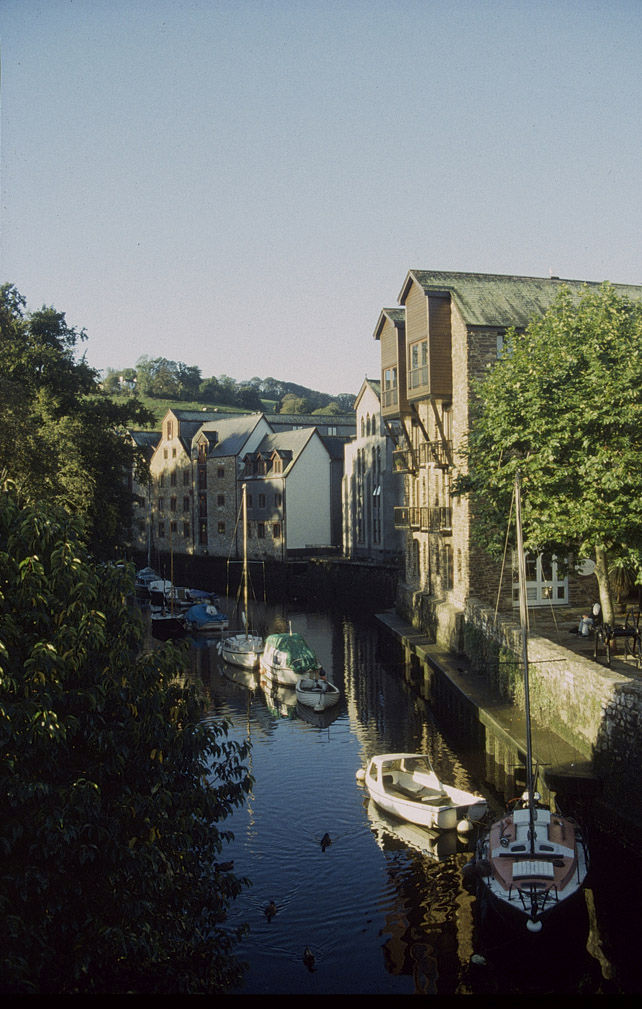
By the mid 1500s, Totnes was four times wealthier than Dartmouth, thanks mainly to its trade in woollen cloth and tin and to rapid growth in a variety of local industries. During this long period of prosperity, wealthy merchants rebuilt many of their town houses in the attractive styles as they still appear today. Ownership of the Priory land was passed after the Reformation to the Town Council and was used to construct the Guildhall. By the early 1600s, however, the ‘good times’ began to give way to a decline in trade and the ‘Merchants town’ gradually changed to a ‘Gentlemen’s town’, although it The merchant warehouses now luxury remained the main market centre for this part of South Devon. apartments
Little now remains of the six former shipbuilding yards on the banks of the river and the recent closing of the Baltic Wharf has brought to an end the long history of commercial trade on the Dart. However, the High Street, the main street through the centre of the town since Saxon times and now in the shadow of the castle, still reflects the continuing busy life of Totnes.
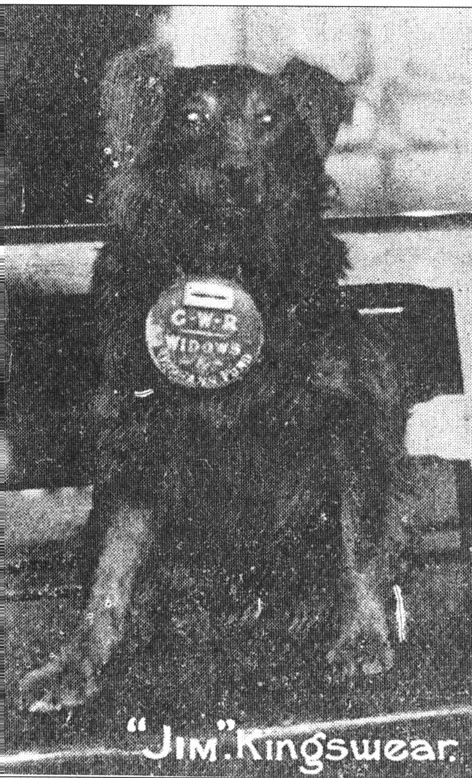
The Story of ‘Station Jim’ at Kingswear Station.
In January 1901 Jim, a handsome collie dog, was found abandoned and dejected in a railway carriage in Kingswear Station’s Waterhead Creek Sidings, so the station master Mr T Abrahams took him onto his ‘Staff’. His duties were to collect, in a small brass box fastened to his collar, contributions from passengers for the GWR’s Widows and Orphans Fund, which he did with great success. He became a general favourite with everyone, and was soon living the high life. Jim quickly learnt to distinguish the dining car from the ordinary passenger coach, the close proximity of the Royal Dart Hotel kitchens, the galleys of the steamships, and the jetties; all provided rich hunting grounds. However, in 1906 there was consternation at the terminus when, in spite of a wide search, Jim could not be found. A telegram from Captain Smith, of a Renwick, Wilton & Co Ltd collier, reported they had a stowaway aboard; Jim had boarded at Kingswear and after a good meal from the galley had curled up asleep. He was wakened by the rough waters outside the castle and was very seasick, and after a voyage to Newcastle was greatly relieved to be returned to a joyous welcome by all the railway staff back home.
His adventure did not stop Jim, a gallant Lothario, from occasionally crossing to Dartmouth on either the Lower or Railway Ferry to do a little courting, after which he plied his trade collecting contributions for GWR widows and orphans, before returning to Kingswear. His greatest moment was in 1908 when King Edward VII, on arriving at Kingswear Station on a visit to the Naval College, broke with protocol and strode over to Jim and his minder, gave him a stroke, and placed a golden guinea in his collecting box.
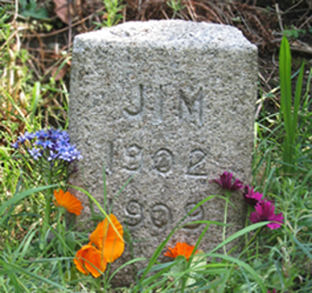
Sadly during 1909, Jim was struck by one of the new-fangled motor cars, and died shortly afterwards. There was great sorrow among both staff and villagers, and he was buried with due ceremony in the railway embankment below Fore Street, Kingswear. Today his simple grave is there for all to see.
Perhaps this short article could be printed and fixed on the platform pillar
opposite his grave, for passengers to read while awaiting the arrival of the next train.
Editor’s note: – There are lots of lovely stories and snippets such as the above which can be gleaned from the Dartmouth Chronicles of the past 150 years. The Historians have put the Dartmouth Chronicles starting 1856 in digital form which can be read easily from a computer disc or printed; they are available to all
This is Jim’s grave against the wall supporting Fore Street, . forty metres short of the buffers on Platform Two.
Across the World
When, last year, we published Chris Ryan’s booklet about Kingswear Golf Course and Club we hoped for a wide distribution but were a little surprised and delighted to receive the following letter form New Zealand. We will try to get from Mr Andrews some of ‘the gems’ to which he refers. 1278 Devon Road, RD 42 28th December 2006.
Waitara 4382
New Zealand.
Dear Historians,
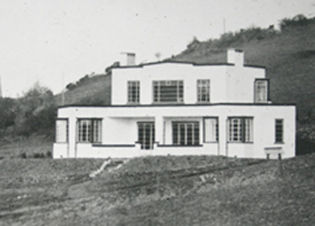
I have just been reading Chris Ryan’s book on the History of the Kingswear Golf Club and am prompted to jot down a few notes which may help to fill a gap or two. In 1938 I purchased the first of Fred Roberts’ building-plots through the agents Waycotts of Paignton; I had a house built there in which I and my family lived for 61 years. Fred Roberts later offered me the two building plots to the south of mine and I bought them along with the plot on the north side from Mr Carr who lived at Rocks. In 1944 the Admiralty requisitioned part of my property and built a huge concrete water reservoir for the supply of drinking-water to the invasion fleet of Operation Overlord and it is still there as one of the few tangible reminders of those hectic days—and many a tale it could tell.
In the early days I frequently walked up to the old club-house and sat on the balcony and admired the view. The tees and greens were still in existence, though looking a bit unkempt. After the conversion to a dwelling by Walter Varney the first residents were the Harris family when a landslide made the Hoodown Farmhouse temporarily uninhabitable. I have been wondering about the origin of the word Hoodown because I am sure that on the first Ordnance Survey map of the area the farm was shown as Higher Waterhead. I became friends with subsequent owners of the Golf House – the Jewitts, the Procters and the Sproules and of course with all the residents of the Bridge Road area. For some time I was a churchwarden at St Thomas in the days of Rev Andrew Allan My son later married Ann Harris and they eventually moved to New Zealand where I now live with them.
The original Kingswear and Dartmouth golf Clubhouse ─ 1935
Here are a few more jottings which may fill gaps in other directions. I owned the little garage and
petrol-station at Hillhead for ten years after the war and visited most of the farms in the district
servicing tractors etc.
In February 1961 I went to work at the newly opened Dart Marina, and left as manager in 1972 to take a job in New Zealand for eighteen months. I once wrote an article about those years at the Marina but did not complete it, though there may be some ‘gems’ in it if anyone is interested. You must pardon my ramblings, but at 92 I do tend to go on a bit!
Best wishes,
Frank D. Andrews
Kingswear ─ the Place-name.
Trevor Miles, our Archivist has prepared the following note.
Past scholars of our local history have concluded, following a most unscholarly line and erroneous deduction, that ‘Kingswear’ derives from an estate belonging to a Saxon king and that the name reflected the one-time presence of a fish trap or weir.
For our peninsula, no document survives which is older than Domesday – 1086. Kingswear is not mentioned in Domesday, nor is Kingston which has a 12th century derivation that has nothing to do with royalty. Background knowledge of Anglo-Saxon England leads us to expect that there was an anti-Viking military road maintained by royal decree, following the South coast of Wessex. A boat would be available to carry royal messengers and other travellers across the Dart estuary. 12th & 13th century place names (Nethway, Boohay) support the existence of this hypothetical road continuing into post-conquest times as a local route of some importance.
An ‘inn’ and a few other buildings would be built by locals near the landing place. Such a community would be within one of the manors listed in Domesday. During the 12th century, church- trained clerks, not necessarily local men, tried to spell and make sense of the names they heard people use for their homesteads. There are no silent letters in Old English. So the settlement which was pronounced in Devon as ‘kingas waya(r)’ – beside the king’s way – was written by the first clerks as Kingesweir. Thereafter ‘it is written’ and so copied and the origin forgotten – except by the inhabitants. But who in medieval society would listen to illiterate peasants?
The same settlement was also known as early as the 12th century to folks who lived elsewhere as ‘Kitte Torre’. Now kites are graceful on the wing but have unpleasant scavenging habits on the ground and use old rags, if they can find them, in their nests.
The folk of the Kinges’ Waye would hardly admit to living in a kite’s nest! But this looks like the first reference to Kittery.
STOP PRESS
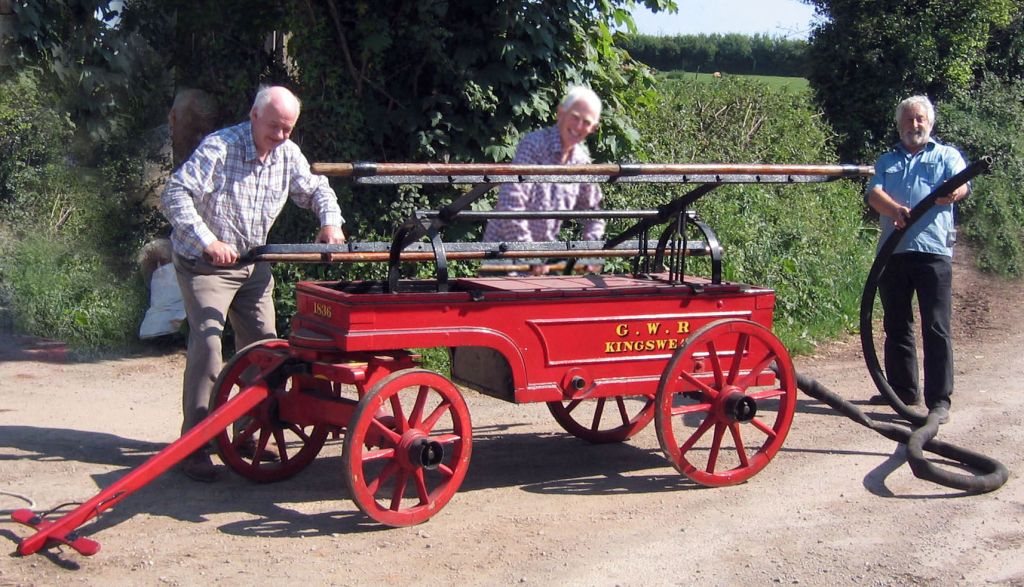
In an adventure reminiscent . of the Last of the Summer Wine, three Historians went to London Lambeth Fire Station to re-claim and return the 171 year old Fire ‘Engine’ to Kingswear. Pulled by the firemen and manually pumped, it latterly sat on Kingswear Station. Its ‘home’ before the arrival of the station is unknown, but from 1855 it was kept in a shed on the station.
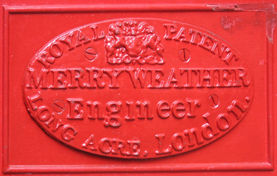
Built in 1836 under Royal Patent by Merryweather, engineers of Long Acre, London, it is now safely in Kingswear and will be displayed when the appropriate site can be secured.
We hope to show it at Kingswear’s regatta at the head of the Creek on 4/5 August.
 Kingswear Historians