
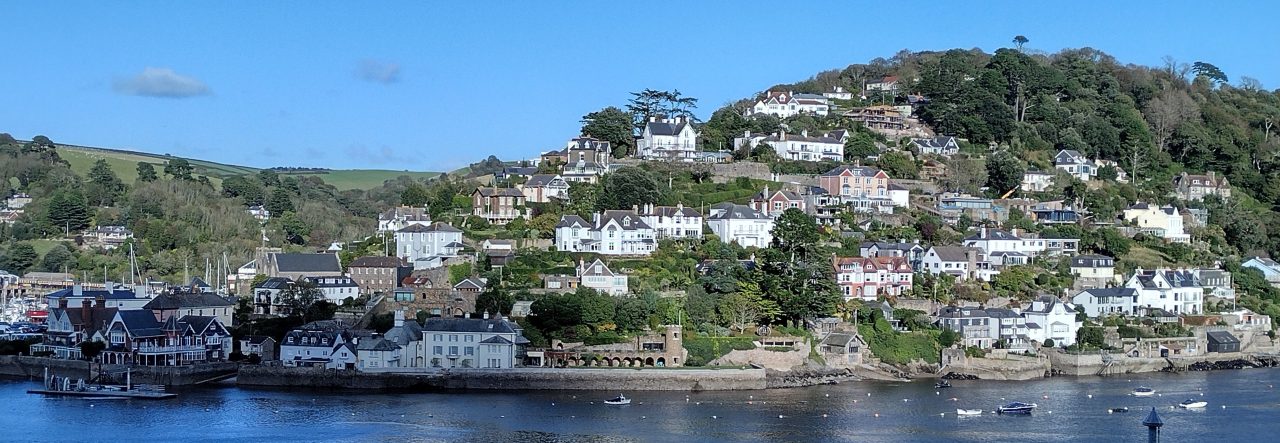
KINGSWEAR HISTORIANS
Chairman: David Evans. Secretary: Neil Baxter
Treasurer and Membership Secretary: David Williams
Kingswear’s Five Post Offices by Neil Baxter

In these days of reducing public services it is timely to review our present Post Office and its
predecessors. There have been five sites of post offices in Kingswear.
In 1850 the directories show Thomas Avis to be a chair maker, and in 1856 through 1866 boat builder and postmaster.
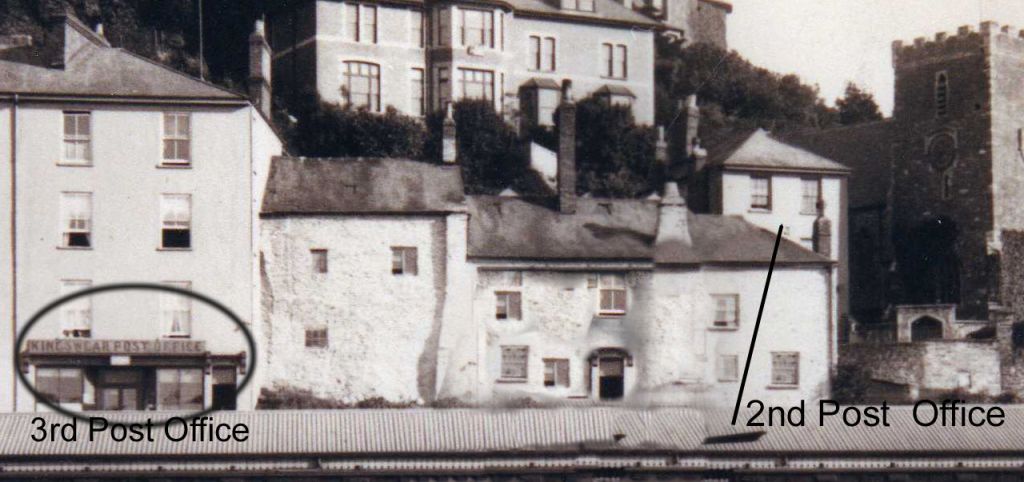
The first post office, with Thomas Avis, was on the corner of the sea wall at the south-west of our Kingswear’s First Post Office ferry slip, in Longford beyond the telephone box. There were steps there too, later used by Tom Casey for a passenger ferry.
In 1864 James Paddon was the first station master, in 1870 was also postmaster, and in 1877 pier master in addition. He with his wife was postmaster of the second post office in Dart Bank, between ‘The Ship’ and the Church; they retired to run his house Fernbank now Longfield as a lodging house. Mr Thomas Clark, baker, became postmaster in 1883.

The third post office was in Fore Street at the present gated recess between our Village Hall and The Steam Packet. In 1910 and at least to 1914 Samuel Wellington was postmaster and also had a stationer’s shop. Our directories end at this date but perhaps there are some who can follow the postmaster line further.
Mrs Holdsworth was the postmistress of the fourth post office which was in her house in The Square on the rounded corner to Priory Street and is shown clearly in several photographs.
When she retired in 1973, Mrs Till who ran the shop next door became postmistress in our present fifth
Kingswear Post Office. In 1996 Mrs Till handed on to Jude Stone, our postmistress today,.
Together with Kingswear Village Stores the post office is at the heart of our village community and well
deserves our support at this time.
Kingswear Houses
Start Bay Villa – Coombeside – Pinewoods by Paul and Imogen Moynagh
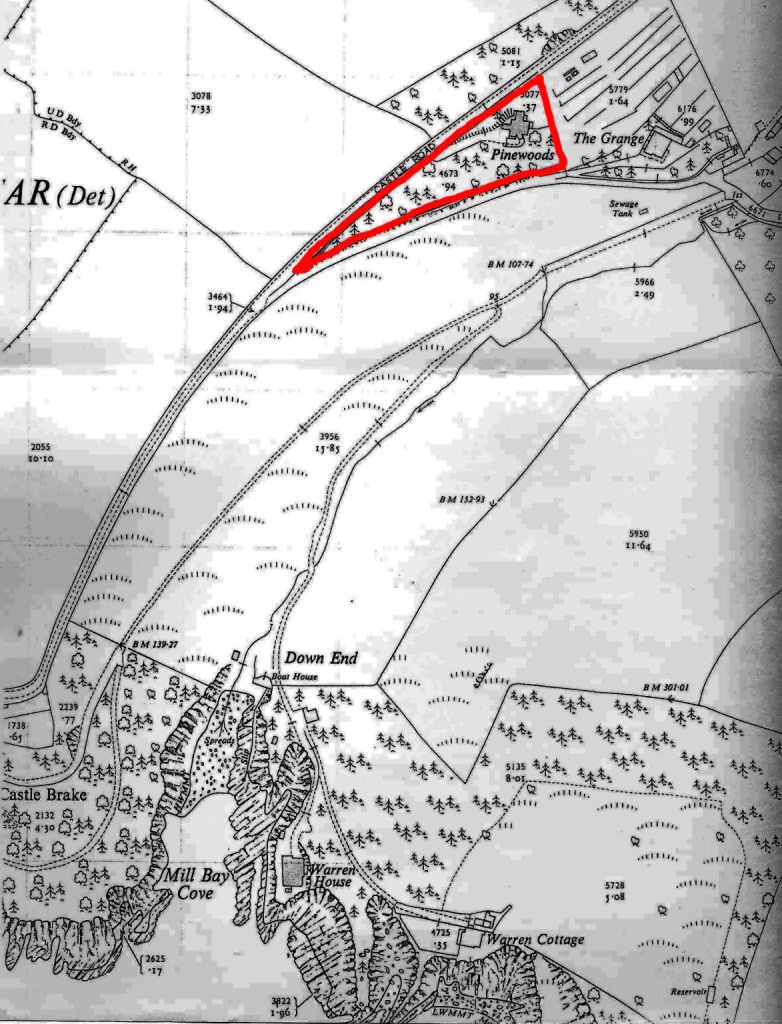
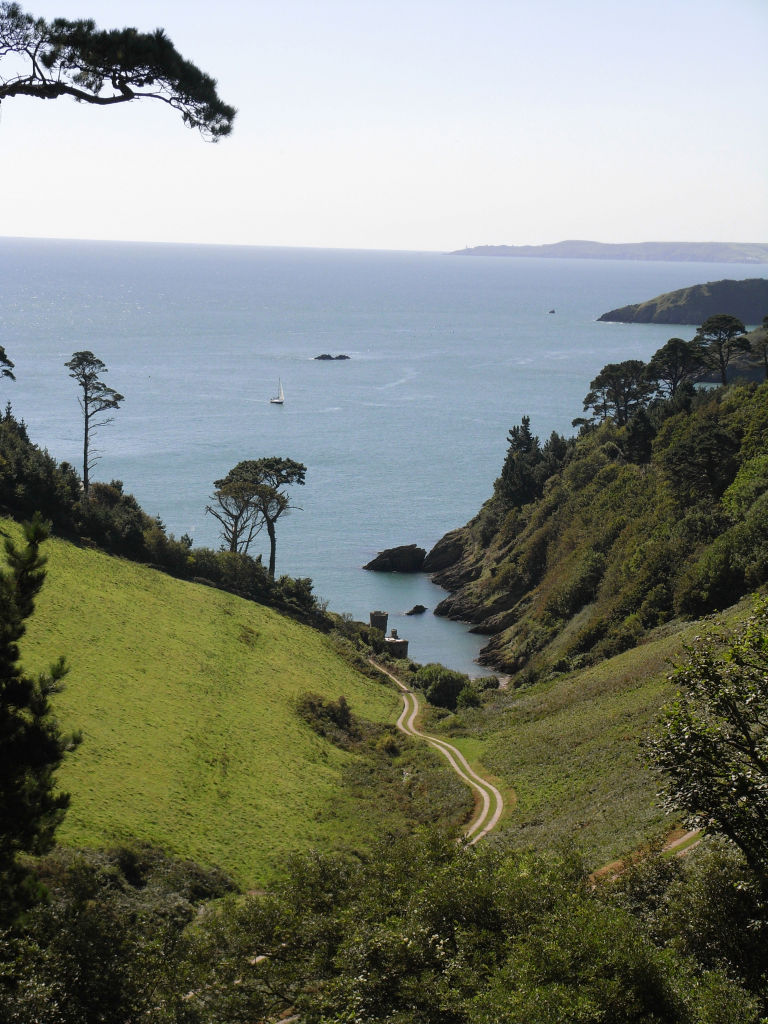
Follow the coastal path along Castle Road towards the river mouth for a mile and you come to a typical steep-sided Devon combe which falls towards the sea at Mill Bay Cove. Looking back from there half way up the valley are four houses, not all readily seen together. Nestling among trees to the left and highest is Pinewoods; lower and to its right stands The Grange, the childhood home of Herbert Jones VC; below this a cottage; and in the hollow by the stream sits Home Farm. 150 years ago none of these existed.
Brownstone, at the top of the east slope of the valley, was until then the only substantial building in the area. Owned by the Hayne/Seale-Hayne dynasty since the seventeenth century, in 1852 Brownstone was inherited by Dartmouth and Devon’s great entrepreneur, developer and benefactor, Charles Seale-Hayne MP.
Having first restored Kingswear Castle for his own residence, he built a good estate road (the continuation
of Castle Road towards Boohay, now usually called Back Lane) and from about 1864 started realising the
value of his real estate by building houses in this beautiful valley with its breathtaking views of the mouth
of the Dart and of Start Bay. Lower Brownstone (now Home Farm), Penang Villa (now The Grange), and Start Bay Villa (later named Coombeside before being renamed again as Pinewoods), were among the earliest of these. Start View Villa, later Kingscliffe (now White House), and Glenorleigh (now Kingswear Court), were others. It is said that only Seale-Hayne’s embroilment with politics and law suits distracted him View from Pinewoods from more thickly developing the area. All the properties were let, and remained in Seale-Hayne ownership until his death when in 1904 the estate
was sold off.
Dartmouth slate was quarried from beside the lane nearby to construct Start Bay Villa’s two foot thick stone walls whose thermal insulating property beats any modern cavity wall hollow. Initially probably just three bedrooms, it was enlarged around 1880, and had further extensions added in the 1920s. At some stage black painted mock Tudor timbers were added to the white painted walls; these were removed in 1987. The slate roof is graced with a number of decorated terracotta finials, a grand dragon over its porch, and a griffin with ball in beak above the dining room. As with so many Kingswear houses built on a steep slope, all three floors have an external door. The extensive lower round floor, originally the kitchen and servants quarters, has now reverted to more menial basement purposes (laundry, workshop, garden store etc, with still room enough for a billiard table). An outer hall, dining room, and lean-to sun room were added during the last century. Apart from modernisation and some internal rearrangements, there have been no recent major additions.
1865 owner Charles Seale-Hayne MP built Start Bay Villa
1889 – 1892 tenant Arthur H Enock (artist)
1904 tenant G.W. Rogers
1904 owner John Henry Hutchings
1904 owner S T Reed
1910 owner? H A Hood Daniel
1914 owner Miss Windsor, Coombeside renamed Pinewoods
1923 owner Miss Windsor
c 1939 owner Miss D K Whish
c 1943-6 tenant one of the authors of ‘Sexton Blake’ .
1947 owner Mrs Helen Mary Davidson
1959 owners Kenneth William and Nancy Jocelyn Abrey
1987 present owners Paul and Imogen Moynagh
Little is known about the early occupiers, many probably being short-term tenants, perhaps just for one summer. A tenant who lived there from 1889 to about 1892 was a widely respected artist, Arthur Henry Enock, known as ‘The Artist of the Dart’ for his atmospheric watercolours of the river. Although mostly of its higher Dartmoor reaches, some were of the tidal parts and Dartmouth. Before Coombeside, he lived at Inglewood, Lower Contour Road (once New Road).
Miss Windsor was a ‘character’ still fondly remembered by older natives. On the one hand very
definitely a ‘lady’ and driven everywhere by her chauffeur, she oversaw making Pinewoods what was
reputed to be a beautiful well cared for woodland garden. On the other hand she was a pipe-smoking,
cussing, and hard drinking woman – she and her chauffeur were once arrested in Paignton for being
drunk and disorderly. What is now Back Lane is still recalled by older villagers as Windsor’s Lane.
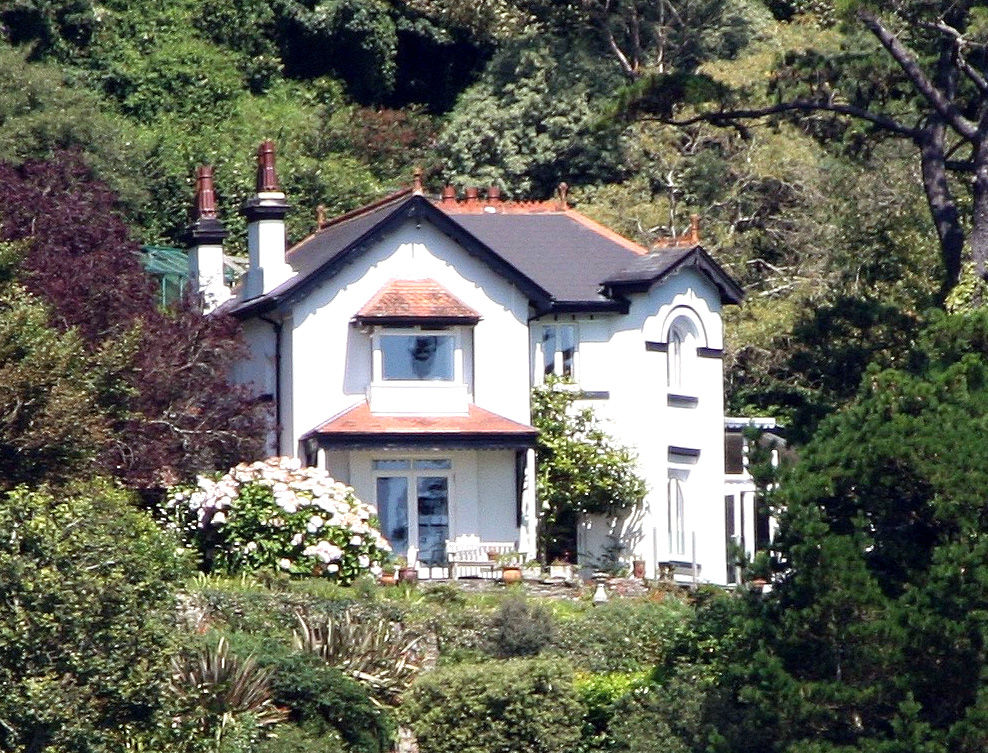
Mrs Abrey tells of a writer, name unrecalled, who rented Pinewoods in the 1940s and was one of the many contributors of Sexton Blake detective stories which were serialised, filmed and broadcast by radio over the first 70 years of the 20th century. At the end of the garden, with a grand view of the bay, are the ruins of a brick hut where he is said to have written his stories.
Kenneth Abrey was a well qualified Consulting Engineer who practised in Dartmouth. The detailed structural drawings of the house he made when he designed the central heating are more accurate than any ubsequent surveys. A keen horticulturist he grew orchids in a 50 foot heated green house which only recently had to be replaced. He died in 1986 and his widow moved the following year to a bungalow in Broadsands. A son and daughter still live in south Devon.
The 1990 great storm which decimated the trees in Warren Woods, mostly old pines, also felled most of Pinewoods’ Montereys; only six of the twenty-six we inherited in 1987 are still standing. In despair at the devastation, we were briefly tempted to revert the house name to Coombeside, but a grant prompted planting thirty replacements, most of which are now thriving.
Looking Back 150 Years to November 1857 Research by David Murphy The Dartmouth Chronicle of November 1857 was reporting: Transport for Dartmouth and Kingswear: The port was well served by maritime transport but the railway from Bristol had now reached as far as Torquay and the route had already been staked out by Mr Brunel’s engineers for the extension of the line to Paignton. However, a cautionary note had been sounded. Four shares of the Torbay and Dartmouth Railway originally purchased for £20 were now advertised for £7 10s.
For the discerning traveller by sea, there were ‘Steam Communications’. Steam ships boasting 100hp engines sailed between London and Bristol calling at Dartmouth, Falmouth and Penzance, offering the cheapest direct communications with superior accommodation for passengers, wind and weather permitting. An added bonus was that pilots and towing vessels were not necessary, so keeping the costs down.
In the Courts: Cleanliness was strongly supported by the Magistrates at the Petty Sessions in the Guild Hall. A Mr Gregory was charged with obstructing the Sanitary Inspector in his duties. No details were given, but Mr Gregory was fined 10s with costs. However, details in the case of Mr John Partridge were quite specific. He had left an amount of fish offal in the Market Place longer than was deemed necessary, constituting a public nuisance and was fined 2s 6p with costs. Public order was represented in the case of Mr Thomas Davis who was arrested for being drunk and disorderly and was fined 5s with 10s costs. It was pointed out to him that failing to pay the fine by the following Monday would result in him spending six hours in the stocks.
From ‘The Long White Cloud’
More memories from Frank Andrews in New Zealand of his years in Kingswear
1278 Devon Road.,
4th July 2007 RD 42,
Waitara,43
Dear Historians, New Zealand
I was delighted to receive your letter dated 30th June and the interesting Newsletter. Thank you very much. Your invitation to submit more “ramblings” is very tempting, but I fear my contributions will be more in the nature of trivia rather than archive material. Reg Little’s memories are probably more accurate than mine, but no doubt you will be able to sort out the wheat from the chaff — so let’s get rambling!
Invermoor aground in Old Mill Creek
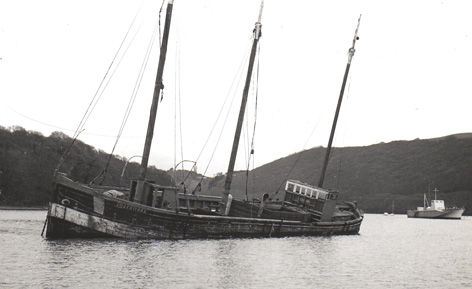
Does anyone know the full story of the schooner Invermoor of Dublin which sailed into Dartmouth around 1950 and ended up a sad wreck on the mud off Old Mill Creek? As I heard it, the ship was the centre of a romantic project to get twenty(?) people, each to contribute x thousands of pounds to fit her out and sail her to adventure in the “South Sea Islands”. Soon after the ship arrived in the river and was anchored just below Noss Point, her owner and instigator of the plan was taken ill and while he was lying in Brixham Hospital, the schooner broke adrift and was driven aground. She was never salvaged and lay
just across the river from our house; whence over the years we watched her slowly degenerate into a hulk.
She had a lovely teak wheel-house which disappeared one night. Rumour had it that it ended up as a
summer house in some Dartmouth garden!* I went aboard the wreck several times, and it was a real adventure playground for my children.
Other wrecks they used to explore were the First War M.T.B. in Lower Noss Creek and the Second War landing craft dumped on the mud just below our house. Talking of children’s adventures, how many Kingswear kids ever went through the culvert* under the railway embankment at the head of Higher Noss Creek into the little lagoon on the other side? My children used to do it often in their canoes, and I did it once. It was a question of getting the tide just right and my kids were adept at that – our house was called “Tides”!
On the subject of ships, who remembers the “Pumice Mountain” on Kingswear Quay? A Totnes builders merchant ordered a shipload of pumice from Italy for use in the manufacture of light- weight building blocks. The shipment arrived in Dartmouth Harbour but the vessel was too big to proceed up-river to Totnes so the plan was to offload the pumice into barges, using a big augur as used for the bulk transfer of wheat and other grains. Unfortunately pumice has a very high friction and it would not flow through the augur, but jammed it solid and burnt out the electric motor. After a delay of several days to rewind it, they had another try with the same result. The ship’s captain now lost patience, took the ship alongside and unloaded the whole cargo on to the quay using the ship’s own derricks and grabs, and then sailed away. So there was a huge white heap of pumice on Kingswear Quay which had to be shifted by lorries at disastrous expense to the poor merchant in Totnes.
*I understand some of the timbers were used in the construction of the bar in the Gunfield Hotel. Ed.
**The culvert is still there and I know of at least one present member of Kingswear Historians who has passed through to the inner lagoon by canoe. Ed.
Frank goes on to describe in detail the development of houses along Bridge Road and their owners. We will be including this in a later issue with any additional information provided by members.
American civil war sea battle: links with Kingswear.1864. by Neil Baxter
Alexander Shapleigh from Kittery House (now Kittery Court), Kingswear, arrived on the coast of Maine in 1635 followed two years later by his business partner Captain Francis Champernowne aboard the ship Benediction which they co-owned. The latter lived at Dartington but together they had ships which fished for cod off New England, salted, processed on the Dart and sold in Europe. Together they founded Kittery, ‘the oldest incorporated town in Maine’. In the shipyard of Kittery in 1862 the USS Kearsarge was built.
The sinking CSS Alabama in the foreground, USS Kearsarge behind and Deerhound in the background
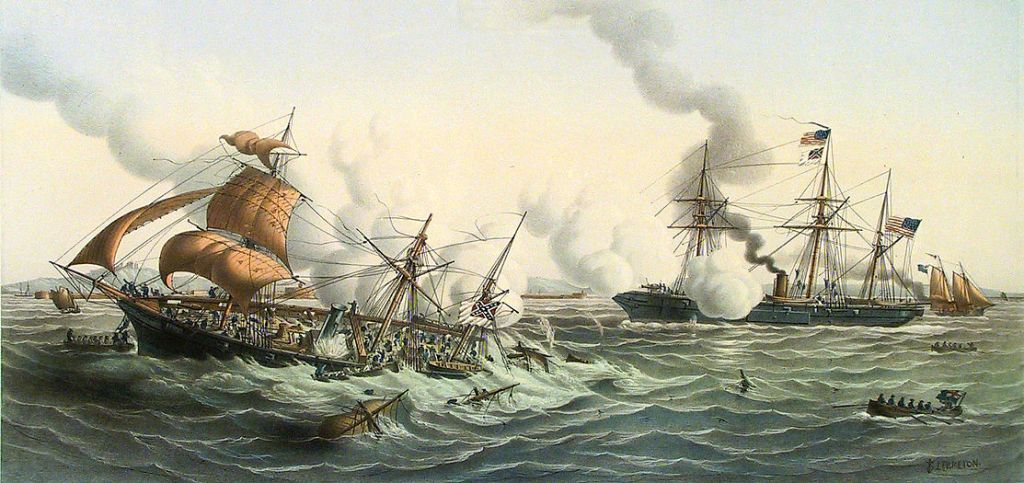
In 1861 two ships were being built in Lairds shipyard, Birkenhead. The Confederate SS Alabama, Captain Raphael Semmes, proved most successful in the following two years in capturing some sixty merchantmen and sinking a Federal warship, USS Hatteras. In June 1864 at the end of her long deployment, Alabama was in Cherbourg seeking repairs. At the same time and in the same Lairds yard the other ship, Mr John Lancaster’s private steam yacht Deerhound, was completed. He was a wealthy Lancashire man and cruised with his family under the Royal Mersey Yacht Club and RYC burgees. In June 1864 Deerhound sailed for Cherbourg from the River Dart, having picked up as crew Robert E Ferris, a Kingswear shipwright serving his apprenticeship in the local yards.
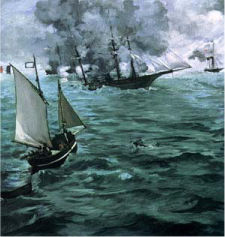
Kearsarge, Captain John A Winslow, had been hunting Alabama for two years and on June 14th entered Cherbourg. Both ships wanted a ship to ship duel and Kearsarge waited for Alabama well clear of territorial waters. On June 19th Alabama steamed out accompanied by the French iron-clad Couronne,
Deerhound and two pilot boats. There was a crowd of thousands watching from the and shore and on one of the pilot boats was the artist Edouard Manet equipped with pencils, colours, and sketchbook. Deerhound, flying the flag of the Royal Mersey Yacht Club and with family on board, remained near the scene of action while the two ships joined battle.
After about an hour’s bombardment, with several men killed and many others wounded, Alabama was beginning to sink. Among the injured was Captain Semmes, who turned his ship and tried to run back towards Cherbourg. However, when Kearsarge headed him off and the rising water stopped his engines, Semmes struck his flag. As Alabama sank, some twenty minutes after firing ceased, most of her crew were rescued by the victor and by the British yacht Deerhound. Those saved by the latter, including Semmes and most of his officers, were taken to England and thus escaped capture and imprisonment much to the annoyance of US authorities. While Kearsarge had been slow to send boats to rescue the men in the water, Deerhound had acted promptly and Captain Semmes later reported: ‘Fortunately, Edouard Manet’s painting of the battle however, the steam yacht Deerhound, owned by a gentleman of Lancashire, England (Mr. John Lancaster), who was himself on board, steamed up in the midst of my drowning men and rescued a number of both officers and men from the water. I was fortunate enough myself thus to escape to the shelter of the neutral flag, together with about forty others, all told. About this time the Kearsarge sent one and then, tardily, another boat.’
Deerhound sailed under its neutral flag for Southampton with Captain Semmes and thirteen other officers and some men, thus denying Kearsarge and the Union some of their prisoners. Alabama was left on the channel floor and Kearsarge was free to return to Kittery, Maine.
Meetings by David Evans
8th September History Day: Kingswear Through the Years
A special Open Day in the Village Hall brought together a wide range of maps, documents and
photographs reflecting the changing life of Kingswear over the years, and attracted a continuous
stream of visitors.
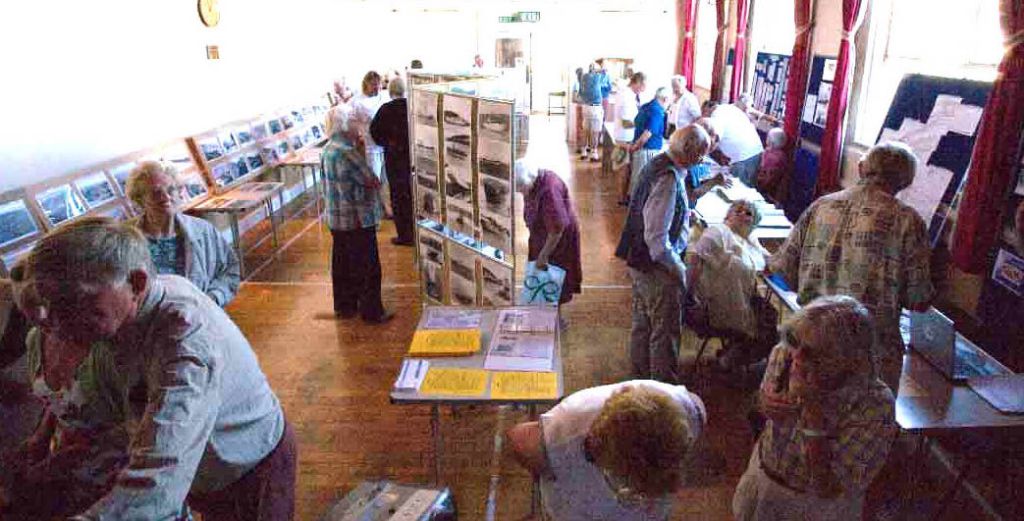
On one side of the Hall, copies of the Tithe Map and the early Ordnance Survey Maps were on
view, together with copies of prints and drawings showing stages in the development of the Village. Ongoing research by Trevor Miles and Tessa Gibson using Census and other data to build up biographies of past local people and families, was being shown all day, attracting much attention. Our President Don Collinson brought a selection of treasures from his collection including the catalogue for the sale of the Luttrell estate in 1874, while next door to him
Reg Little brought back memories with his collection of mementos from the War years. In the centre a display of photographs assembled by Gordon Thomas, of the Noss shipyards in their prime and the wide varieties of ships built over so many years, was of special interest now the future of the site is being considered. His marvellous collection of scenes of Kingswear past and present, and of both sides of the Dart was mounted along the other side of the Hall and under the front of the stage. He was in great demand throughout the day, when not meeting old friends, in helping to identify houses and dates of photographs.
8th October Keith Bowers: The Fishing Industry of Devon
Devon Sea Fisheries based in Brixham is one of twelve area Sea Fishery Committees set up in 1966 which together cover most of the coast of England and Wales up to six miles out to sea. Their Chief Fishery Officer, Keith Bowers, described how all sectors of the industry are brought together, with powers if needed to regulate fishing methods, gear and to restrict seasons. He took the audience through the make-up of the Devon industry and the main varieties of fish and shellfish caught. He outlined the changes in the design of trawlers over the years and the methods and gear now being used, both by the large beam trawlers and those fishing locally. New designs of nets were helping to regulate the size and amount of fish being caught in response to increasing regulation and the need to maintain stocks. Crabs, lobsters, scallops and mussels were all sectors with their own varying methods and markets, and with at times overlapping fishing areas needing agreement on restrictions.
He headed a team of nine responsible for enforcing all regulations in force in their area with powers to stop boats to inspect gear and catches and take necessary action if needed.
For the most part, there was little trouble but occasionally they played ‘hide and seek’ with a fisherman determined to avoid being caught.
Co-operation with other local Sea Fisheries was excellent and increasingly proposals were being put forward for discussion on more areas where regulation could meet the different needs of some sections. New problems would also emerge. It was unsure at present, for example, what the effects of the vibration of the bodies of active turbines in large wind farms would have on the fish in the areas where they are being planned.
Looking Ahead:
Monday, 8th January ‘Celts, Saxons and Vikings along the Dart.’
Our Archaeologist Trevor Miles will lead a review of some of the early ‘incomers’.
Monday, 25th February ‘The Tin Industry on Dartmoor’.
Mike Perriam will trace the history of this once major industry.
 Kingswear Historians