Spring 2011
KINGSWEAR HISTORIANS
Chairman: David Williams
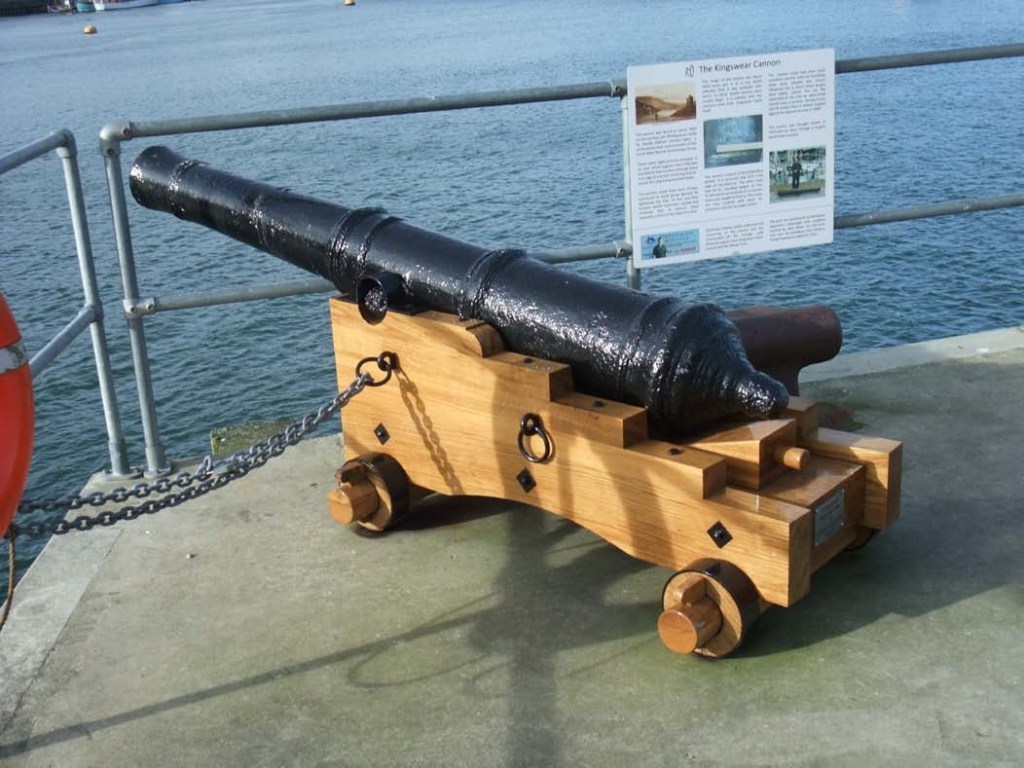
The last Newsletter described the journey that the Kingswear cannon had travelled from Tudor times into the 21st century. An enormous amount of time, effort, cost and skill went into lifting the gun from the sea bed, through years of desalination to the loving restoration that is now so apparent. In a very fitting ceremony, the cannon, on its beautifully made carriage, was officially displayed to the public late in 2010. If you have not yet seen and admired it, take a walk onto the Quayside car park!
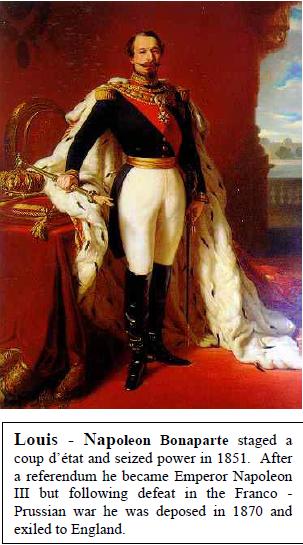
Three hundred years later, Kingswear had another unexpected guest as reported in the Dartmouth Chronicle on 15th September 1871, under their headline of The visit of Napoleon III to Kingswear . The ex-Emperor Napoleon III, who is staying at the Imperial Hotel, Torquay, arrived at Kingswear by the 2 o’clock train, on Tuesday last, the 12th inst., accompanied by Prince Murat, and his ever-faithful Physician Dr. Conneau.
After partaking of luncheon at the Dart Yacht Club Hotel they proceeded to Brookhill. His Majesty was showed over the house and grounds, and His Majesty expressed his warm appreciation of the surrounding scenery. Returning to Kingswear, the party enquired for a boat and Mr Ellis Bartlett rowed by these gentlemen about the harbour, going round H. M. S. Britannia, and several of the yachts in harbour. They landed at the ferry-slip, where several persons had collected, whose salutes Has Majesty courteously responded to. The ex-Emperor looked well in health, but stouter, and certainly looking older than when last seen by the writer, at Paris, in 1862, when in the zenith of his glory, he passed down the Champs Elysees, escorted by his magnificent Cent Gardes, and himself escorting the Sultan of Turkey and King William of Prussia, now Emperor of Germany. The contrast, under present circumstances, was most striking.
On the return of the party from Brookhill the “Conte de Pierrefond” was seated near the railway jetty, admiring the harbour before him, when his walking stick disappeared through the open woodwork of the staging into deep water below. The Western Times thus humorously alludes to this incident:—
“The ex-Emperor is here a refugee, and his stay may be protracted. He is a man of brooding mind, and is understood to be affected by omens. While standing on the jetty at Kingswear he dropped his gold headed stick into the Dart. The head of the stick is French eagle, moulded in gold, with a golden ball in its mouth —an eagle one might suppose about to take a bolus, Bon Deu, quel auspice atroce! Bonaparte had put the French eagle under water for many a long day before he crossed the Channel, and now here on the shore of the lovely Dart, when he ‘was wrapped in dismal thinking’ at the bare possibility of his return, the French eagle slipped from his grasp, the staff and symbol of his power fell into the Dart, and he had to return to Torquay without his talisman. All the efforts made to recover it were unavailing. All that night the French eagle lay at the bottom of the Dart, opposite that town where the women once beat off an assault of Frenchmen, who attacked the town while the men were away fishing. The women of Dartmouth, full of pluck, and pretty then as they are pretty now, ‘rose like one man’ and with such weapons as they could command, beat off the Frenchmen and great was the pride and joy of their husbands and sweethearts when they returned and found what had happened. Nephew Bartlett next day dived seven times before he found the stick, which he did, brought it up with him, and restored it to the nephew of the great Emperor at his Imperial Hotel, in Torquay. M. le Conte Pierrefond gave him his photograph, in compliment of the generous service he had rendered in bringing the French eagle above water once more and now it is to be seen how Bonaparte will hold it.”
His Majesty walks about the town of Torquay, drops into the shops, promenades the pier, and chats with sundry folks strolling about in perfect freedom, and almost unnoticed.
Tribble family
Tessa Gibson has been creating biographies of many of the families who have lived in Kingswear. In the first of what may become a regular feature of the Newsletter, she introduces the Tribble family:
The Tribble family seem to have worked hard to make a living in Kingswear but also did much to keep the school full of children! Here are a few of the facts that I have found out about the family. Thomas and Susan were born in Dartmouth before they moved to the village in about 1861. The census that year records that they lived in Lower Street. He was employed as a farm labourer. They had two children Susan and John. Susan, who was a dressmaker, had one illegitimate son called William George Tribble by an unknown father. She then went on to marry James Keeley. He was a gamekeeper and water bailiff and the family lived at Cemetery Lodge. It was here in 1904 that James hung himself in the morgue. He was 58. The inquest into his death occupied almost two columns in The Chronicle of June 3 1904. It seems he had become depressed at not being able to maintain the high level of work expected of him, although no witnesses felt he was falling short. Indeed he was a well-liked and respected member of the community. Susan, who found his body, was left with their son, Frederick Keeley.
William stayed in the village and went into shipbuilding He married Betsy Elford in 1883. Having eight children with at least six attending the school they had to cope with much sadness when two of the children died young. Their eldest son John moved to Plymouth but on the 1911 census could be found in the coal pits of Wales. In 1915 son William joined the Canadian Forces and was later awarded the British Service medal. Susan Ann was born in Kingswear and will be remembered by some people as a wonderful lady who lived to be 95.
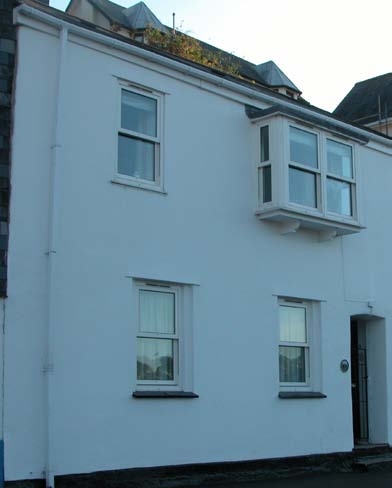
Moving down through John Randle Tribble’s line you find Thomas James c.1873-1959. He lived at 1 College View, seen above, with his wife Elizabeth Ryder. He had two daughters both well known in the village, Elsie and Alice. Elsie had a son called Lionel Frank (b1915-1930). Lionel was very sadly killed on the railway. He was thought to have epilepsy and it was assumed that he had a fit on the day he died. He was found crushed on the railway line when the 5.20 from Newton Abbot had just passed by. This awful scene was found by two young ladies on their Sunday afternoon walk. The Inquest passed a verdict of accidental death.
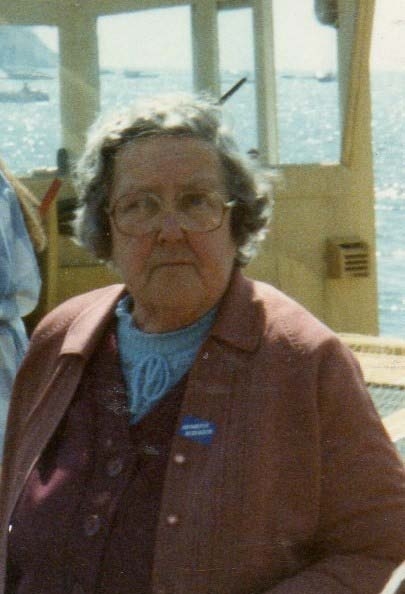
Alice, pictured here on a ferry, was a character who attended every event held in Kingswear and loved her bingo on Friday nights. She was born at 1 College View in 1906. She stayed at that address until in 1982 when she was one of the first residents to move into the Priory. This accommodation was donated by Mrs Carlow to house the elderly of the village. Alice married William Bowe and had one son Tommy. Alice died in 1989.
The Dartmouth U boat
The story that follows was related to David Murphy by Mr Lionel Fairweather of Kingswear who had lived in the village most of his life, and was Chairman of the Parish Council during WW2. He also owned one of the garages in the village.
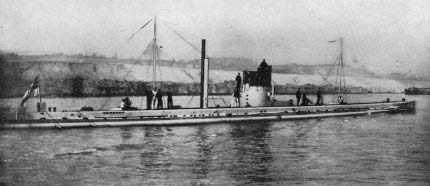
A German U boat of early WW1
The story relates to a time during the First World War when German U boats were wreaking havoc in the Channel and sinking many merchant ships. The tale explains that along the cliffs from Froward Point towards Man Sands, over a period of weeks, the skins of recently butchered sheep were found by farmers. At first it was assumed to be the work of local poachers. But then an alert mind pointed out that if it was a poacher, it would be a lot easier to put a collar and lead on the animal he was going to steal and walk it home. A damn sight easier than carrying a bloody carcass a couple of miles across fields!
That same alert mind concluded the possible connection between the sinkings in the immediate area of the Channel, no sign of the U boat and the sheepskins found within a small area along from Froward Point. On a fine calm day a spotter plane was sent up and just off the Mew Stone the outline of the German submarine could be seen. Depth charges soon put an end to it and the sheep stealing ceased forthwith. It had been a brilliant idea of the U boat commander to hide right under the enemies’ nose, but his crews taste for fresh meat had proved their undoing. All this happened over ninety years ago.
For the keen angler a favourite spot is just off the Mewstone. On the fish finder up comes the outline of a rock, its shape is the rough outline of a submarine, it is called the submarine rock. But is it just that, a rock?
Since David Murphy passed the story on to Kingswear Historians, Tessa Gibson has discovered ‘Dive South Devon’, an old book that highlights good diving spots off our coasts. Two descriptions are especially interesting.
1. The steamer Aldershot, built in 1897, was a 280ft merchantman from the Clyde and heading for Nantes. She was four miles off Dartmouth on 23 September, 1918, when a U-boat attacked, killing one man in the crew. The wreck is described as upright and on an even keel at a depth of 55m. Her bows, one of the best preserved parts of the wreck, point to the south-west.
2. ‘The Dartmouth U-boat’. In July 1981 a team from Totnes BSAC found themselves on the conning tower of a World War One U-boat at a depth of 50m southwest of the Mewstone. The submarine was covered in fishing nets and had a single stern tube, and was lying at a depth of 51 metres.
Five U-boats of World War One were lost in the Channel. They include UB-113 lost in September or October 1918 under the command of Oberleutnant U. Pilzecker. The UB-113 went into service on 25 April, 1918. Her second and last mission started on 14 September, when she went to sea with UB-111 under orders to sink merchantmen in the western approaches to the Channel.
Apart from her sinking the Aldershot nothing more was heard of UB-113 and there were no survivors or bodies. This book, however, reports that the last message from UB-113 was received on 28 September, 1918, saying that she had just torpedoed the steamer Aldershot. The same day a De Havilland D.H.6 seaplane was reported as dropping a 65lb bomb on the periscope of a submarine in the same area.
KH Meetings
Over the coming months, we hope to entice you into the Village Hall on the following Monday evenings at 7.30pm to enjoy our regular meetings. As usual there will be raffle tickets for sale and tea or coffee and biscuits will also be available.
On 28 March we will be hearing about the history of Britannia Royal Naval College. When was it built? Where was the college before? What happened during WW2?
On 25 April Alan Salsbury will be back to talk about Torbay Lifeboats, rather before the classy superfast machine currently moored at Brixham.
On 30 May David Lingard is here to unravel the history of Dartmouth Museum and describe the plethora of fascinating goodies under his care.
After coffee at each meeting expect a fascinating interlude from one of the members on a local historical topic.
The June meeting, on Monday 27, will be a guided tour of Lower Greenway Farm to understand the workings of a farm when man power was still king! As always everyone is welcome – guests are £4 each but membership is only £12 for the whole year and £20 for a couple.
KH Books.
As you know KH have produced a number of booklets on local history. Two more are heading towards publication.
In one of them, David Williams’ book describes the story of our village during WW2 and contains many stories and pictures never published before with an enormous contribution from the locals of that time, as well as the workings of the WI, ARP and Parish Council. It hopes to produce a permanent record of that challenging era. As it is much larger than any previous book from KH it will be about three times more expensive to produce. We ask if any member or villager would be prepared to offer some sponsorship towards these costs. A donation of £5 or £10 or £50 or whatever would help enormously. Sponsors names, if so wished, would be listed in the book but not the amount of their donations. Please contact David on 752716, by email or by leaving your donation at the Post Office. Thank you very much indeed.
The archive room houses many documents as well as wonderful old photographs of Kingswear and its buildings. What we are short of is a collection of photographs of Kingswear people. What did the Councillors of old look like? And what about past Vicars and other dignitaries? And are there any pictures of the Women’s Institutes events or other village gatherings? Have you any old albums you could search through or perhaps an old tin chest in the attic? We would love to hear from you!!
Perhaps not everyone has been onto the station platform recently, but the Kingswear Historians are now prominently displayed in this poster. Our thanks go to Michael Stevens for his assembling of this information board and to Andrew Pooley of the Railway for his enthusiasm and support.
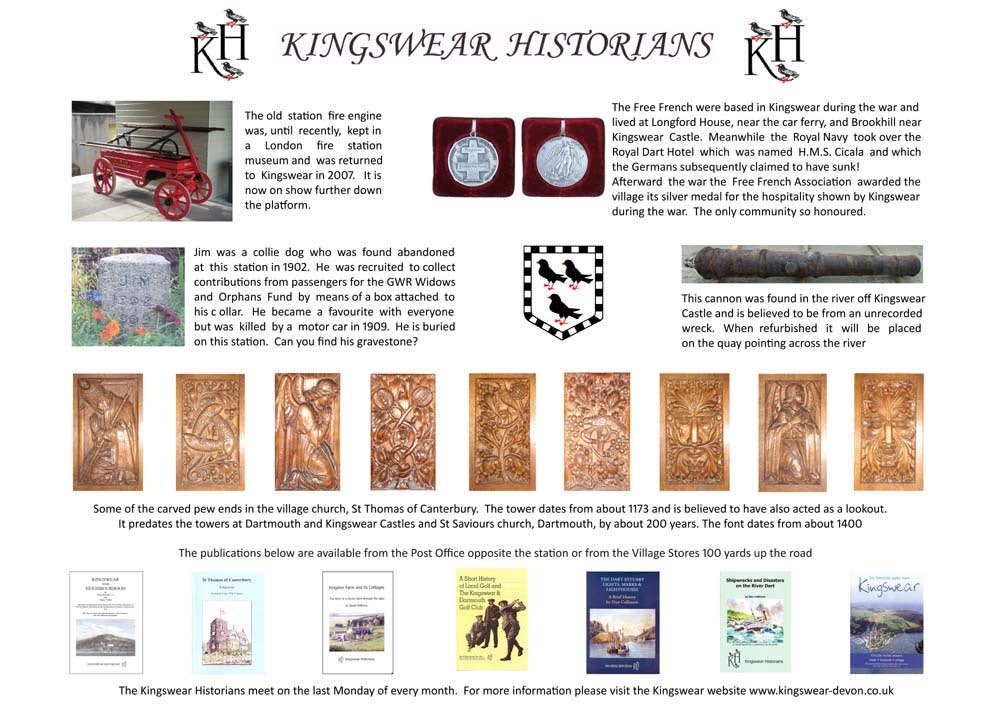
Did you know that you can access Kingswear Historians on the Kingswear website on http://www.kingswearhistorians.com? There you can find our programme for 2023/4 as well as copies of all the past Newsletters and a variety of historical notes on matters of local interest What do you think about the Kingswear Historians Newsletters? Do you like the format? Have you any items that could be included in future editions.
 Kingswear Historians