
KINGSWEAR HISTORIANS
Chairman: Mike Trevorrow .
Secretary: Michael Stevens
Smuggling in the Dart

Custom duties date back to the time of the Magna Carta when the King, by Royal Prerogative, regulated all the commercial activities in his realm. Later sovereigns, including Edward I, passed statues controlling the goods subject to duties and the amounts to be levied. Over the centuries a bureaucracy developed which by 1678 had produced a customs establishment in each port. At Dartmouth there were a collector, surveyor, two waiters and searchers and four boatmen. In addition Brixham, Salcombe and Torquay each had a waiter and searcher, making a total of eleven. The imposition of these duties, and the consequent desire of local seafaring men to avoid paying them, led to the development of smuggling. It was after the Smuggling Act of 1736, when it became a crime to import certain items that the trade really took off. The high cliffs and sheltered coves of Devon made it an ideal landing place and soon many hundreds seafarers and landsmen took part in bringing ashore cargoes of wine and spirits; there are also records of large quantities of tea and tobacco being landed. Money attracted these smugglers in to what could be a dangerous occupation as many ships were wrecked and lives lost, but the rewards were great, with a cargo being worth anything from £2,000 to £10,000 – a far cry from the pay for working on the land of £20 per annum.
From tnd tobacco to fine silks, spices and alcohol items were hidden in chests with false bottoms, sewn into clothing or disguised inside everyday objects. Each man would have a particular job. Hoverers would wait off shore to be contacted by the locals when it was safe to come back on land. Small time smugglers with single seat boats known as tubmen would transport the illegal items to the tub carrier or shore porter who, under the cover of darkness and swinging a lamp known as a funt to light his way, would take the contraband and distribute it to specific buyers on land. Gang members, referred to as duffers, would help to carry the goods between one place and another in an attempt to avoid getting caught.
A relatively safe method of getting the goods ashore was the occupation known as “Sinking and Creeping”. In this the smugglers lashed two kegs of brandy together tightly, but with a certain amount of lashing between them and weighted by a suitable heavy sinker. When fairly near home the tubs were put overboard on a bearing that had been arranged with the shore helpers and these gentlemen went fishing with grapnels and a few fishing lines to make the job look legitimate. The Revenue men soon worked out was happening so they started to do their own creeping.
Intimidation was a tactic employed by smugglers. In 1732 the Plymouth Tide Surveyor who supervised the land guard was murdered. Two men were hung in chains for the crime. High cliffs seem to have been a particular hazard for the Customs men. In 1787 Henry Mugford, the waiter and searcher at Brixham, ‘fell over a cliff’ and was drowned. Ten years later, Richard Cullin met his death under similar circumstances.
Swift, backed by a Brixham Sloop, was involved in a running battle with two Revenue cutters, Alarm and Spider at Paignton Sands in 1783. The smugglers had the best of the fight which involved gunfire and serious injuries. Swift’s crew succeeded in landing 9000 gallons of spirits and four tons of tea. They came close to destroying the Revenue cutters but they were saved by help from the shore.
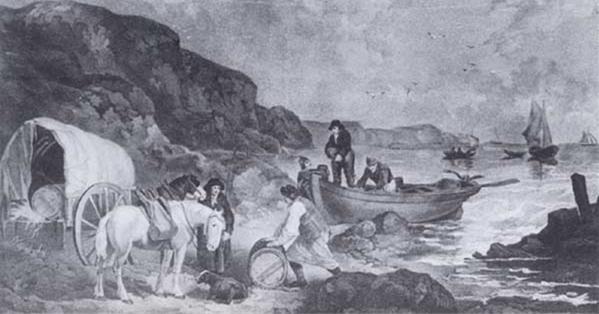
On another occasion, when there was a cholera epidemic, some Brixham smugglers drove their cargo up the beach in a hearse, accompanied by a large company of mourners following the cortege drawn by horses with muffled hoofs. No corpse was there to mourn, but the tobacco and French brandy in the coffin might have helped to cheer up ‘the mourners’.
The fight against smuggling continues. When the Brixham trawler Good Hope (BM231) picked up drugs off Start Point from a yacht from Morocco, she was tracked by HM Customs Cutter Venturous in an operation known as Operation Bacardi. The Good Hope landed £1.5 million of cannabis at Brixham Harbour at 4.20 am on 19 August 1990. The men were later picked up at the Granada Services at Exeter. They were all finally sentenced at Exeter Crown Court in December 1991.
Snippets from the Parish Council Minutes
The Parish Council was formed under the local Government Act of 1894 – “The Parish Council Act”, the election was held on the 19th December 1894 and 19 people stood for the ten places. Top of the poll was George Casey of The Priory with 07 votes. Thomas Avis was also returned with 92 votes just behind the local vicar the Rev. Frederick Walker. The first agenda concerned the “Great Western Railway Company which were preparing a Parliamentary Bill to take over part of the creek and the Council decided to try to come to a friendly agreement on the matter instead of opposing the Bill from the outset. The Chairman subsequently met representatives of the railway and asked for a landing place on the jetty near the pontoon, a footbridge across the line to the river and a footbridge across the creek to Hoodown ferry.
In November 1898 the Post Office proposed that the last collection of post be at 8.15pm so that it could catch the train leaving at 8.30pm.
In July 1902 it was reported that people were bathing on Lighthouse Beach without bathing drawers on. “This was very indecent and a great nuisance to females”. The police constable was dispatched to investigate but did not catch anyone. It was decided that it was probably visitors who were responsible. There were more reports of nude bathing in 1905.
At that time the Kingswear Cemetery had a mortuary and in May 1901 the Clerk had to write to the neighbouring parishes pointing out “that in the case of a body found drowned in the waters adjacent to their foreshore they will have to bury the body if the Parish Council allows the body to be taken to the Kingswear mortuary for the inquest”.
In September 1902 the Council decided to install some street lighting and received bids from the Acetylene Light Company and the Urban Electric Light Company of Dartmouth. The latter offer was favoured and 17 lamps of 25 candlepower each were ordered. The following year the Brixham Gas Works applied for permission to supply gas to Kingswear presumably for street lighting but this was declined. If anyone wonders why Kingswear does not have a gas supply – blame the Parish Council (of 1903).
The Council received the income from the Peter’s and Kelly’s charities, which produced £1 each every year. In 1907 2s-0d was given to 20 poor residents, 10 men and 10 women, including all five residents of the Alms Houses.
As they were required to insure their employees under the new Compensation Act the Parish Council reduced its part time employees to one full time person. He was paid 18s per week with the Council paying house rent, rates and taxes and also providing his tools. His time was divided two days on the water supply, two days rubbish collection and two days on cemetery and other parish council tasks. A separate person was employed on the road contract for Totnes Rural District Council and others to man the fire engine. The fire ladder owned by the Parish Council was to be kept in the Trust Room.
In 1908 the Kingswear Parish Council agreed to the postman’s request that one evening delivery each week be dropped so that he could have a half day holiday, however the Post Office itself would not allow it. In 1910 the Kingswear Post Office opening hours were shortened to 8am to 8pm.
The Kingswear childhood of Col. H Jones VC.
Herbert (H) Jones VC preferred to be known as H.
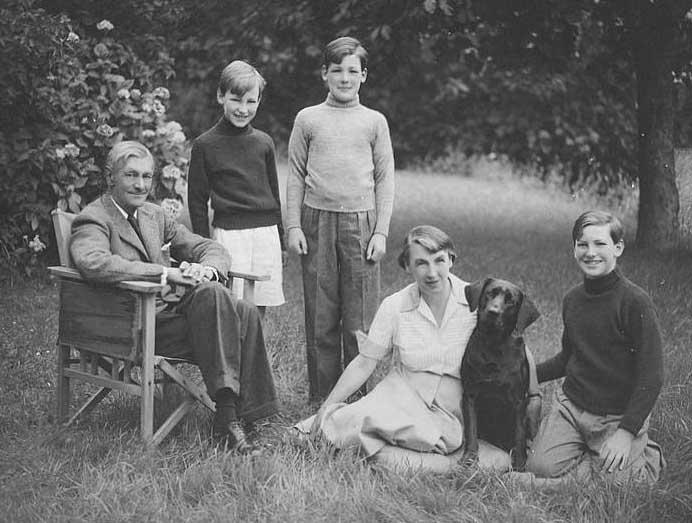
His father, also named Herbert, was a wealthy American while his mother, Olwen, came from North Wales of a more modest background. H was born in London on the 14th May 1940, two weeks before the family moved into The Grange in Kingswear. Herbert the elder was too old for military service (he was 52 in 1940) and was anyway still an American citizen, so he was not called up. However Herbert senior became a member of the local Home Guard. He owned two 2.2 rifles, which he obtained from America, and which were used by them for practice. As he was the only one to have a car he used this to transport the Home Guard around the area for which he would have been granted as extra allocation of wartime petrol coupons. Mrs Jones was a member of the Kingswear Women’s Institute, joining in October 1941, and regularly attended the village church, St. Thomas of Canterbury. One of her friends was Norah Wiggins in Foxhole in Beacon Road.
H had two brothers: Tim (born 11 February 1942) and Bill (born 16 February 1945). The photograph above shows Mr and Mrs Herbert Jones with Bill, Tim, their dog Jimmy and H (kneeling). Because their father was not in the Armed Forces, the family enjoyed his presence throughout the war when many other fathers were away.
Some of the older residents maintain that there was quite a class divide between those with large houses facing southwest, the river and benefiting from the afternoon sun and those in smaller houses of more modest means who lived round the corner facing north and Waterhead Creek. H’s father Herbert Jones was a great anglophile and was granted British nationality in June 1947. He wanted the very best for his children and so his went to a private school, Tower House School, across the river at Townstal Pathfields in Dartmouth. Herbert’s open top Austin 8 tourer (the same one as had been roped in for Home Guard use) took the two older Jones boys across on the ferry to the school. Sometimes the car was driven by Herbert himself and some times by his chauffer Colin Armstrong. Transport was provided for other local children going to the same school.
It is not surprising that some locals would have seen the Jones family as distant, particularly as the elder Herbert was somewhat retiring by nature. However in their quiet way they did quite a lot for the village. When the roadway at Inverdart fell away in about 1950 and no local firm was prepared to rebuild it, it was Herbert Jones the elder who led and coordinated the arrangements to get a national firm, Costains, to do the work.
From an early age H was determined and strong willed. He was keen to do well and to succeed, at first as a result of a lack of experience, this energy was sometimes misdirected and this could and did lead him into trouble on occasions.H reached the age of 17 in 1957 and his interest then spread to cars. As a result of the possibility of petrol rationing consequent upon the closure of the Suez Canal in 1956, learner drivers were allowed to drive unsupervised, including in a red American Jeep that his father had acquired. H’s driving in the early stage was remarkable more for his enthusiasm than his skill and this led to a number of accidents, fortunately none of which were very serious.
The fact that his father was very ill at the time and his mother was concentrating on looking after him meant that he probably didn’t get the level of parental control that was required of a lively teenager. H took great pleasure in driving a 1930s Bentley that he had inherited from his father. On another occasion, H was involved in an incident where the Bentley came into contact with a bus from Hillhead to Kingswear and the Bentley came off worst.
After Sandhurst, H served in Cyprus, Plymouth, British Guiana, Aldershot, Northern Ireland, Germany and other places around the world. He married Sara in 1964 and they had two children David and Rupert. The family moved around the country and the world as H’s postings changed. But for H and for his family The Grange, where his mother had continued to live, was always their long term home. They came back there on many of his leaves and that was where the focus was. He even brought his Platoon and later his Company down to Kingswear to train. His intention was always that The Grange should be his permanent home on retirement from the Army.
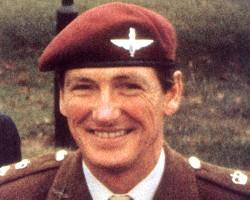

The 1972 census shows H Jones staying with his mother Olwin Jones at The Grange presumably on leave from army. Unfortunately his long term ambitions were never realised because he was killed on the 28th May 1982 at Goose Green in the Falkland Islands and was awarded the VC posthumously.
Local Families
Tessa Gibson is making a study of local families who once lived in Kingswear. This issue we report on Philip Heal.
Philip Heal and his family were a prominent in the village. He was born in Brixham in about 1845 and moved to Higher Street in Kingswear after his marriage to a local girl Mary Jane Binham in 1864. His first son Philip Henry was born in Kingswear in 1865 and two years later Frederick William was born in 1867 but died a year later. Then there was Frederick Charles in 1869 followed three more sons and two daughters.
Mary Jane died in 1880 and Philip remarried in 1881 to Mary Ann Matthews and went on to have two more sons who included Charles born in April 1882. Now the family lived at Brookhill Cottage where Philip was employed as a gardener. He was buried in Kingswear cemetery in 1938.
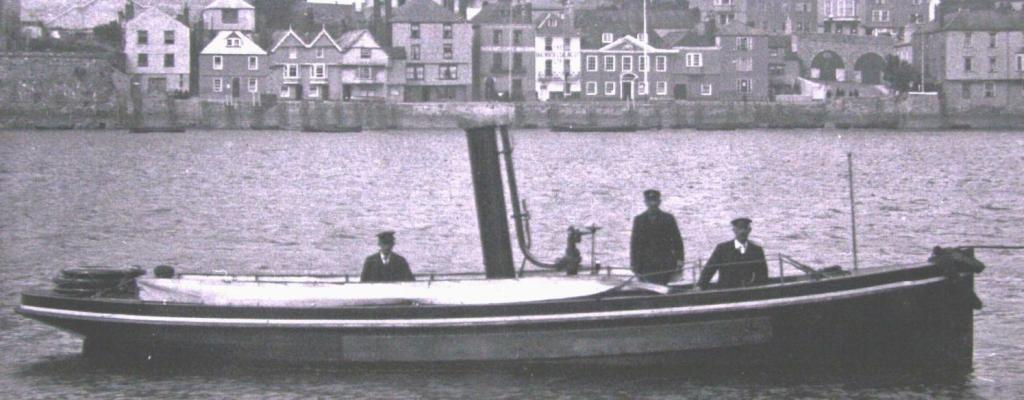
Son Frederick married Elizabeth and they had three children but unfortunately they lost the only son Alfred in tragic circumstance when he drowned while playing on Lincoln Steps (now known as Toft Quay) aged 4 years and four months. At this time Frederick was working for Nathaniel Baker at Butts Hill Kingswear. Later Frederick became a partner in the lower ferry with Tom Casey. They immediately ordered a new tug to be built by Philip shipyard. She was named Hauley. This name is still used today. Frederick was listed as ferry leasee in Kelly’s directory from 1906 but ended in 1925 when their lease was not renewed by the GWR. There was great sadness that Casey and Heal were not running the ferry anymore.
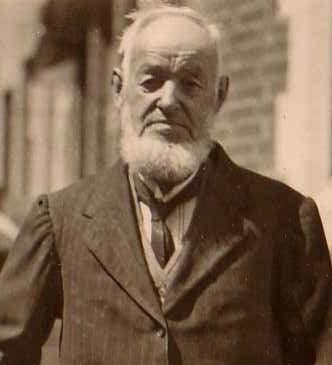
Brother Charles became the local postmaster and barber at The Square and had been known while shaving a gentleman to suddenly leave his customer half shaved and go to Kingswear Court or other big houses to deliver a telegram. Customers got fed up with waiting and would finish the job themselves. He also found time to be the church verger.
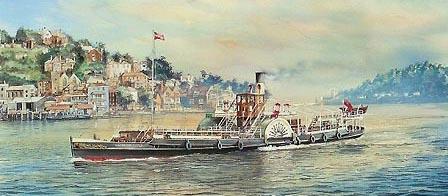
Kingswear Castle Returns Home
The Steamship paddle steamer has returned to her home river after running summer trips on the River Medway. She was built by Philip & Sons in 1924 at their Noss Yard, Kingswear for use by the Great Western Railway with her sister ships the Compton Castle and the Totnes Castle. She was chartered to the United States during World War II and used for carrying stores and personnel on the Dart.
She was withdrawn from service in 1965 to become the first purchase of the Paddle Steamer Preservation Society which brought her back into service after a great deal of restoration.
In 1986 she won the National Steam Heritage Award and in 1995 won first in the Scania Transport Trust Awards. In 1999 she was included on the national Historic Ships Committee Core Collection list of ship of Pre- eminent National Significance and has been in much demand for television and other filming including BBC production of Great Expectations. She also had many famous visitors over the years including Sir Harry Secombe, Pierce Brosnan and Prince Edward.
Length 113.75 ft. (34.67 m) LOA, Beam 17.43ft (5.31 m); Draught 3.43ft (1.05 m)
Kingswear Historians
The Historians exist to study and publish the history of the Kingswear area. Membership is £12 per person or £20 per couple. Visit us on the Kingswear website www.kingswearhistorians.com
Volunteers wanted: Don Collinson is donating 30 years of Kingswear research material to the Historians and we need help in sorting it out into subject headings.
Volunteers wanted: We need to reorganise the Archive Room in the Lower Hall to better store our material. This will probably mean removing some of the redundant furniture and installing more shelving. Your assistance would be appreciated.
We are seeking permission from the Steam Railway to open up access to the wartime pill box which is on their land to include it in a heritage walk about the village.
One of our declared aims as local historians is to research local places, events and people and to publish the researched material in the form of pamphlets, booklets or books. Items currently under preparation are
‘Dartmouth/Kingswear privateers and pirates’, ‘the three Kingswear pubs’, ‘pleasure boats on the Dart’ and ‘the Armada and the Dart’.
There are other ideas for investigation which we would love members – or indeed non-members – to research so if you would like to have a go at creating a local pamphlet or booklet, to have your name down for posterity, please get in touch with us and we’d be delighted to help you if we can.
Talks are held in the Village Hall at 7.30 pm on the last Monday in the month. Non members pay £4.Those planned so far are:
30 September Lighthouses – a talk by Gordon Partridge, former lighthouse man.
8 October The Greenway Frieze by Alan Forster
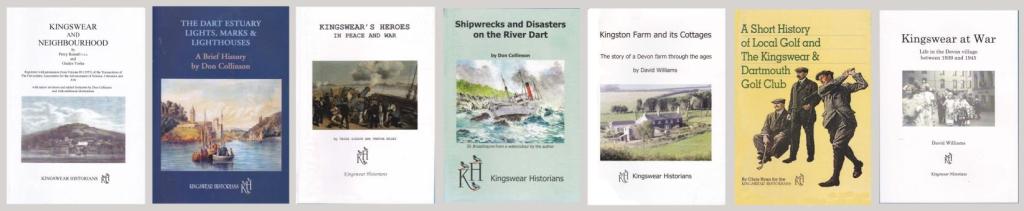
The following books are published by the Historians, price £5 except Kingswear at War £8. If interested please contact Michael Stevens on michael@monopulse.plus.com.
 Kingswear Historians