
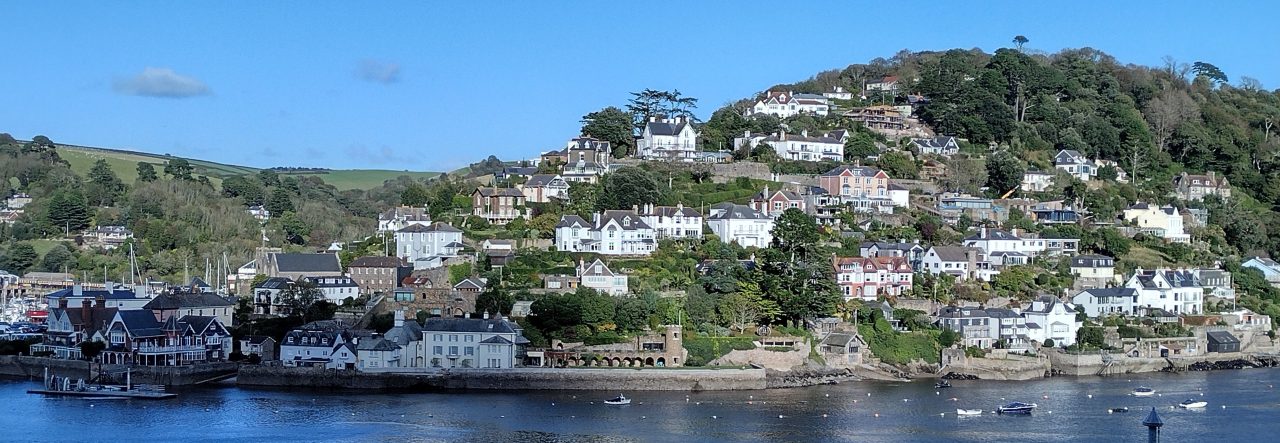
The village church is named St Thomas of Canterbury. Much or the original church was demolished and re-built, but the original tower remains. The history of the tower is the subject of a separate article which you will find HERE.
The Church of St Thomas of Canterbury stands in a slightly elevated position at the junction of Higher Street and Church Hill close to the railway station and the Dartmouth Lower Ferry and overlooks the River Dart. The church is a grade II listed building.
A church has stood on the present site since about 1170 on land owned by the de Vasci family after the Norman Conquest. Hugh Watkins, in his article “The foundation and early history of Dartmouth and Kingswear Church”, stated that the earliest deeds relating to the church were drawn up about 1173 and are in Totnes Priory.
The church was dedicated to St Thomas of Canterbury and this is thought to have originated because of the wave of piety which followed Thomas’ death in Canterbury Cathedral in 1170. Thomas Becket was canonized in 1173 so the naming of the church must date from after 1173. In its early days the church came under the sphere of influence of Totnes Priory and the church’s priests were monks from the priory. In 1196 Willelmus Willelnusrywera formed Torre Abbey and Walterus de Vasci, son of Willelmus, gave the remaining part of the lands at Kingswear to the Abbey. Totnes Priory’s holding was also transferred. A deed in the Cartulary dated 1253 shows that Torre Abbey then owned Kingswear church.
It is believed by some that throughout the following centuries the church was much utilised by continental pilgrims who used Kingswear as a landing place on the pilgrimage to Canterbury to see the tomb of St Thomas.
After the dissolution of the monastries Kingswear Church became part of the parish of Brixham (1539).
In 1847, with the village of Kingswear expanding, funds were granted to rebuild the church with the work being overseen by Exeter architect J. Hayward. The church was demolished except for the original 12th-century tower with the rest of the church reconstructed in local limestone with freestone dressing. Hayward used the same Decorated style and the same design as the old church, but on a slightly reduced scale.
A Church Recording Project is underway and a group of local residents, under the leadership of the experienced Church Archivist, Ken Scott, is recording the following aspects of the church:
- Woodwork.
- Textiles (including Vestments)..
- Metalwork.
- Glasswork.
- Stonework.
- Monuments and Inscriptions.
The carved wooden pulpit dates from 1921 and was given as a memorial to the late Bishop William Boyd Carpenter KCVO, Bishop of Rippon, who had a home here. He frequently preached and worshipped in Kingswear Church and officiated when his daughter married a local clergyman. It was made by the respected Devon furniture maker, Herbert Read. The oak seating comes from the same year and was donated by Lady Leonard and the carved choir stalls were donated by her husband Sir Thomas Leonard. A fuller description of the pulpiy is available HERE.
 Kingswear Historians