Mike Trevorrow
We‘ve got three now, one’s moved, one’s new, but we have actually had a ferry across The Dart since early on in the fourteenth century (first mentioned in 1365 and probably much earlier than that, but unremarked or recorded).
Now Dartmouth is by far the bigger of the two communities of Kingswear and Dartmouth but in the thirteen hundreds this was not particularly so. It is likely that the politics of the landowners were more favourable to development over in Dartmouth, although the Kingswear side had much to offer in terms of roads to Exeter, Brixham, etc..
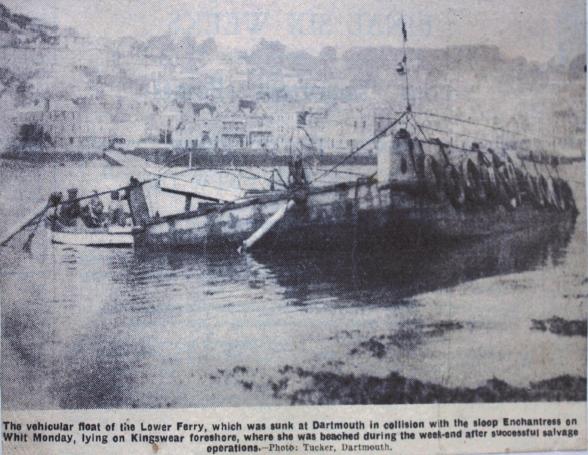
The Lower Ferry seems to have been the earliest and for much of its life it was a ferry boat rowed from Kingswear slip (as now) over to the present southerly slip in Dartmouth, or at least nearby on the other side of the ‘Island House’. Another, larger horse ferry existed, leaving for most of its life from the slip at Hoodown, just north of Waterhead Creek. During the 18thC and 19thC this was powered by two men with ‘sweeps’ and was capable of carrying a cart and two horses. The site at Hoodown was better for vehicular access to the platform; it was also the site of some sort of ferry from very early times indeed. In a busy river, mishaps are bound to occur and they have on a number of occasions, one of note was the collision of an old platform ferry with the ex-naval sloop Enchantress on Whit Monday in 1935.
Change came in 1857 when The Dartmouth and Torbay Railway was authorised to set-up a steam ferry to carry its passengers from Kingswear (Kingswear Station was opened in 1864) to the landing at Dartmouth which was a pontoon close to where the Station Restaurant is now sited. The ownership of the railway changed several times and the steam boats used by the companies also changed. Perseverance was the first, and she proved unsuccessful, was briefly replaced by Louisa and New-comin. Dolphin came next as the proper replacement for Perseverance and she proved good at her job because she was used by the various companies for the next forty years.
The Mew was possibly the most popular and long-serving of the steamers, she managed 48 years’ service, including several re-fits to cope with the development of motor vehicles, extra comfort demanded by passengers, and the ravages of time. She went to the service of the Dunkirk evacuation in WW2 but was rejected for her unsuitability for landing on beaches. She was brought out of service in 1954 to great acclamations and celebrations.
The ‘Passenger Ferry’ as we have come to know it, has always had the responsibility of carrying general passengers, apart from the rail passengers, ever since its inception in 1857.
The Higher Ferry or ‘Floating Bridge’ as it is called by some was another 19thC candidate. 1828 saw the first design for a floating bridge after the suspension bridge of earlier that same year had been rejected. James Meadows Rendel’s design was taken-up and built in 1829 with a two boiler four horse-power engine at its centre. Propulsion was by means of two cast iron chains attached to large granite blocks on either shore. It was not a financial success however and was replaced in 1836 by a two-horse-drawn vehicle with the horses in a treadmill. They were said to be ‘blind’, but this may not have been literal, their vision could have been much restricted, we do not really know.
After a disastrous storm in 1855 the float was sunk and then deemed unworthy of salvage so a new one was built in 1856 and this used horses until 1867. This is where Philip and Son enter the fray by building the first of a series of their ferries, this time steam, which ferried the service until the last one was taken out of service in 2009.
Interestingly the 1867 steam ferry could cross the river in the same time as the 2009 one – three minutes.
 Kingswear Historians