

From the 18th to 20th Century

Custom duties date back to the time of the Magna Carta when the King, by Royal Prerogative, regulated all the commercial activities in his realm. Later sovereigns, including Edward I, passed statues controlling the goods subject to duties and the amounts to be levied. Over the centuries a bureaucracy developed which by 1678 had produced a customs establishment in each port. At Dartmouth there were a collector, surveyor, two waiters and searchers and four boatmen. In addition Brixham, Salcombe and Torquay each had a waiter and searcher, making a total of eleven. The imposition of these duties, and the consequent desire of local seafaring men to avoid paying them, led to the development of smuggling. It was after the Smuggling Act of 1736, when it became a crime to import certain items that the trade really took off. The high cliffs and sheltered coves of Devon made it an ideal landing place and soon many hundreds seafarers and landsmen took part in bringing ashore cargoes of wine and spirits; there are also records of large quantities of tea and tobacco being landed. Money attracted these smugglers in to what could be a dangerous occupation as many ships were wrecked and lives lost, but the rewards were great, with a cargo being worth anything from £2,000 to £10,000 – a far cry from the pay for working on the land of £20 per annum.
From tea and tobacco to fine silks, spices and alcohol items were hidden in chests with false bottoms, sewn into clothing or disguised inside everyday objects. Each man would have a particular job. Hoverers would wait off shore to be contacted by the locals when it was safe to come back on land. Small time smugglers with single seat boats known as tubmen would transport the illegal items to the tub carrier or shore porter who, under the cover of darkness and swinging a lamp known as a funt to light his way, would take the contraband and distribute it to specific buyers on land. Gang members, referred to as duffers, would help to carry the goods between one place and another in an attempt to avoid getting caught.
A relatively safe method of getting the goods ashore was the occupation known as “Sinking and Creeping”. In this the smugglers lashed two kegs of brandy together tightly, but with a certain amount of lashing between them and weighted by a suitable heavy sinker. When fairly near home the tubs were put overboard on a bearing that had been arranged with the shore helpers and these gentlemen went fishing with grapnels and a few fishing lines to make the job look legitimate. The Revenue men soon worked out was happening so they started to do their own creeping.
Intimidation was a tactic employed by smugglers. In 1732 the Plymouth Tide Surveyor who supervised the land guard was murdered. Two men were hung in chains for the crime. High cliffs seem to have been a particular hazard for the Customs men. In 1787 Henry Mugford, the waiter and searcher at Brixham, ‘fell over a cliff’ and was drowned. Ten years later, Richard Cullin met his death under similar circumstances.
Swift, backed by a Brixham Sloop, was involved in a running battle with two Revenue cutters, Alarm and Spider at Paignton Sands in 1783. The smugglers had the best of the fight which involved gunfire and serious injuries. Swift’s crew succeeded in landing 9000 gallons of spirits and four tons of tea. They came close to destroying the Revenue cutters but they were saved by help from the shore.
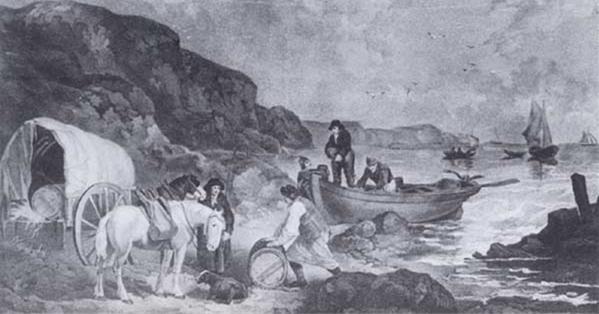
On another occasion, when there was a cholera epidemic, some Brixham smugglers drove their cargo up the beach in a hearse, accompanied by a large company of mourners following the cortege drawn by horses with muffled hoofs. No corpse was there to mourn, but the tobacco and French brandy in the coffin might have helped to cheer up ‘the mourners’.
The fight against smuggling continues. When the Brixham trawler Good Hope (BM231) picked up drugs off Start Point from a yacht from Morocco, she was tracked by HM Customs Cutter Venturous in an operation known as Operation Bacardi. The Good Hope landed £1.5 million of cannabis at Brixham Harbour at 4.20 am on 19 August 1990. The men were later picked up at the Granada Services at Exeter. They were all finally sentenced at Exeter Crown Court in December 1991.
 Kingswear Historians