American Civil War sea battle: links with Kingswear
by Neil Baxter
Alexander Shapleigh from Kittery House (now Kittery Court), Kingswear, arrived on the coast of Maine in 1635 followed two years later by his business partner Captain Francis Champernowne aboard the ship Benediction which they co-owned. The latter lived at Dartington but together they had ships which fished for cod off New England, salted, processed on the Dart and sold in Europe. Together they founded Kittery, ‘the oldest incorporated town in Maine’. In the shipyard of Kittery in 1862 the USS Kearsarge was built.
The sinking CSS Alabama in the foreground, USS Kearsarge behind and Deerhound in the background
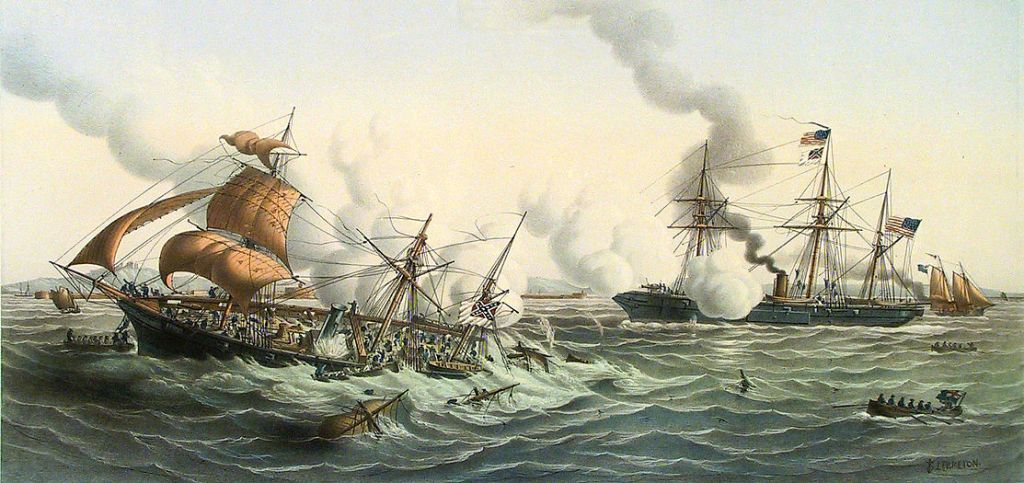
In 1861 two ships were being built in Lairds shipyard, Birkenhead. The Confederate SS Alabama, Captain Raphael Semmes, proved most successful in the following two years in capturing some sixty merchantmen and sinking a Federal warship, USS Hatteras. In June 1864 at the end of her long deployment, Alabama was in Cherbourg seeking repairs. At the same time and in the same Lairds yard the other ship, Mr John Lancaster’s private steam yacht Deerhound, was completed. He was a wealthy Lancashire man and cruised with his family under the Royal Mersey Yacht Club and RYC burgees. In June 1864 Deerhound sailed for Cherbourg from the River Dart, having picked up as crew Robert E Ferris, a Kingswear shipwright serving his apprenticeship in the local yards.
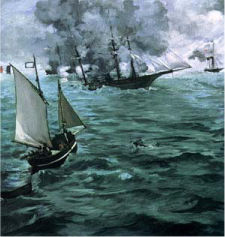
Kearsarge, Captain John A Winslow, had been hunting Alabama for two years and on June 14th entered Cherbourg. Both ships wanted a ship to ship duel and Kearsarge waited for Alabama well clear of territorial waters. On June 19th Alabama steamed out accompanied by the French iron-clad Couronne,
Deerhound and two pilot boats. There was a crowd of thousands watching from the and shore and on one of the pilot boats was the artist Edouard Manet equipped with pencils, colours, and sketchbook. Deerhound, flying the flag of the Royal Mersey Yacht Club and with family on board, remained near the scene of action while the two ships joined battle.
After about an hour’s bombardment, with several men killed and many others wounded, Alabama was beginning to sink. Among the injured was Captain Semmes, who turned his ship and tried to run back towards Cherbourg. However, when Kearsarge headed him off and the rising water stopped his engines, Semmes struck his flag. As Alabama sank, some twenty minutes after firing ceased, most of her crew were rescued by the victor and by the British yacht Deerhound. Those saved by the latter, including Semmes and most of his officers, were taken to England and thus escaped capture and imprisonment much to the annoyance of US authorities. While Kearsarge had been slow to send boats to rescue the men in the water, Deerhound had acted promptly and Captain Semmes later reported: ‘Fortunately, Edouard Manet’s painting of the battle however, the steam yacht Deerhound, owned by a gentleman of Lancashire, England (Mr. John Lancaster), who was himself on board, steamed up in the midst of my drowning men and rescued a number of both officers and men from the water. I was fortunate enough myself thus to escape to the shelter of the neutral flag, together with about forty others, all told. About this time the Kearsarge sent one and then, tardily, another boat.’
Deerhound sailed under its neutral flag for Southampton with Captain Semmes and thirteen other officers and some men, thus denying Kearsarge and the Union some of their prisoners. Alabama was left on the channel floor and Kearsarge was free to return to Kittery, Maine.
 Kingswear Historians