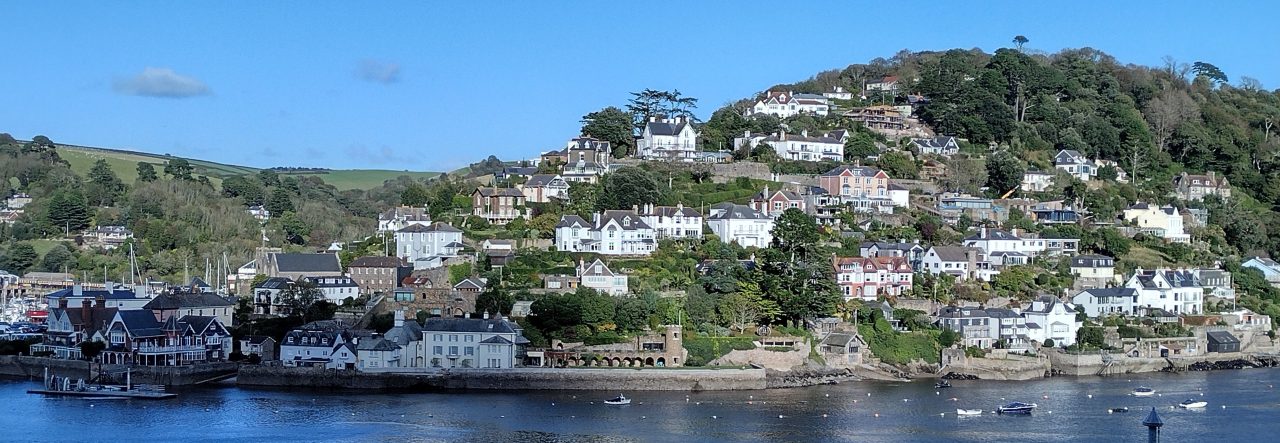
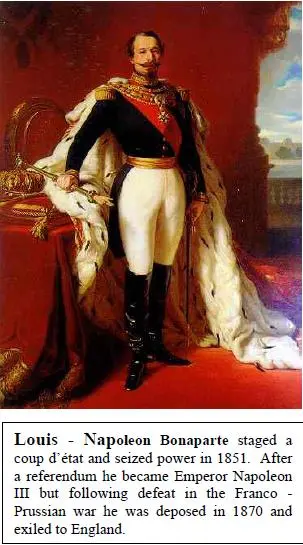
Kingswear had an unexpected guest in 1831 as reported in the Dartmouth Chronicle on 15th September 1871, under their headline of “The visit of Napoleon III to Kingswear“. The ex-Emperor Napoleon III, who is staying at the Imperial Hotel, Torquay, arrived at Kingswear by the 2 o’clock train, on Tuesday last, the 12th inst., accompanied by Prince Murat, and his ever-faithful Physician Dr. Conneau.
After partaking of luncheon at the Dart Yacht Club Hotel they proceeded to Brookhill. His Majesty was showed over the house and grounds, and His Majesty expressed his warm appreciation of the surrounding scenery. Returning to Kingswear, the party enquired for a boat and Mr Ellis Bartlett rowed by these gentlemen about the harbour, going round H. M. S. Britannia, and several of the yachts in harbour. They landed at the ferry-slip, where several persons had collected, whose salutes Has Majesty courteously responded to. The ex-Emperor looked well in health, but stouter, and certainly looking older than when last seen by the writer, at Paris, in 1862, when in the zenith of his glory, he passed down the Champs Elysees, escorted by his magnificent Cent Gardes, and himself escorting the Sultan of Turkey and King William of Prussia, now Emperor of Germany. The contrast, under present circumstances, was most striking.
On the return of the party from Brookhill the “Conte de Pierrefond” was seated near the railway jetty, admiring the harbour before him, when his walking stick disappeared through the open woodwork of the staging into deep water below. The Western Times thus humorously alludes to this incident:—
“The ex-Emperor is here a refugee, and his stay may be protracted. He is a man of brooding mind, and is understood to be affected by omens. While standing on the jetty at Kingswear he dropped his gold headed stick into the Dart. The head of the stick is French eagle, moulded in gold, with a golden ball in its mouth —an eagle one might suppose about to take a bolus, Bon Deu, quel auspice atroce! Bonaparte had put the French eagle under water for many a long day before he crossed the Channel, and now here on the shore of the lovely Dart, when he ‘was wrapped in dismal thinking’ at the bare possibility of his return, the French eagle slipped from his grasp, the staff and symbol of his power fell into the Dart, and he had to return to Torquay without his talisman. All the efforts made to recover it were unavailing. All that night the French eagle lay at the bottom of the Dart, opposite that town where the women once beat off an assault of Frenchmen, who attacked the town while the men were away fishing. The women of Dartmouth, full of pluck, and pretty then as they are pretty now, ‘rose like one man’ and with such weapons as they could command, beat off the Frenchmen and great was the pride and joy of their husbands and sweethearts when they returned and found what had happened. Nephew Bartlett next day dived seven times before he found the stick, which he did, brought it up with him, and restored it to the nephew of the great Emperor at his Imperial Hotel, in Torquay. M. le Conte Pierrefond gave him his photograph, in compliment of the generous service he had rendered in bringing the French eagle above water once more and now it is to be seen how Bonaparte will hold it.”
His Majesty walks about the town of Torquay, drops into the shops, promenades the pier, and chats with sundry folks strolling about in perfect freedom, and almost unnoticed.
 Kingswear Historians