
Then I Bought a Boat
For some time I had been thinking it would be nice to own a boat, and with this in mind I would keep my eyes open. It was only then I discovered boats for sale were few and far between. You might think that in a place like Dartmouth there would be plenty of boats available for sale, not so; for some reason, they were scarce indeed, probably something to do with the war and private boat building not yet being in full swing.
Imagine my excitement when my friend Mike Gibson, told me he knew where there might be a boat for sale. His school friend Mike Barrett (I will call him M.B) owned a boat and was thinking of selling it. M.B lived in Dartmouth and went to a boarding school in Exeter. I questioned Mike, what type of boat was it? Where was it kept? Did it have an engine? How big was it? How much did he want for it? Mike seemed to have anticipated these questions and told me the boat was a clinker built dinghy, eleven feet long with an outboard motor, it was moored in the boat float (harbour) at Dartmouth, and the price was £35.
I told my Dad all about it and he was warm to the idea, I had saved my paper delivery money, so there seemed no reason why I should not go ahead and have a look at it. We met MB at the boat float, and with introductions among us complete, M.B then, showed us his boat. It was floating in about three feet of water and secured at both ends, with a bowline tied to a ring in the harbour wall, the stern line disappearing into the water to a mooring in the mud. To me, it looked a treat, perfect, just what I was looking for. I was eager to see the outboard motor which I was told, was at M.B’s house at the top of Dartmouth.
The motor, an ancient ‘Seagull,’ was precariously clamped to the side of a water tub, which was full, the idea being, to start the motor and prove to every ones satisfaction that it worked. I must confess I had my doubts about embarking on such an action, on the grounds it all looked so “Heath Robinson”, and downright dangerous. To start the engine, a strong cord winds automatically around the flywheel, a sharp strong pull should do the trick. To my amazement, two or three tugs and the motor roared into life, thoroughly soaking those present. Hilarious laughter all round signalled everyone’s delight at the result, there was no reason to delay matters, a deal was struck, the boat and engine were mine
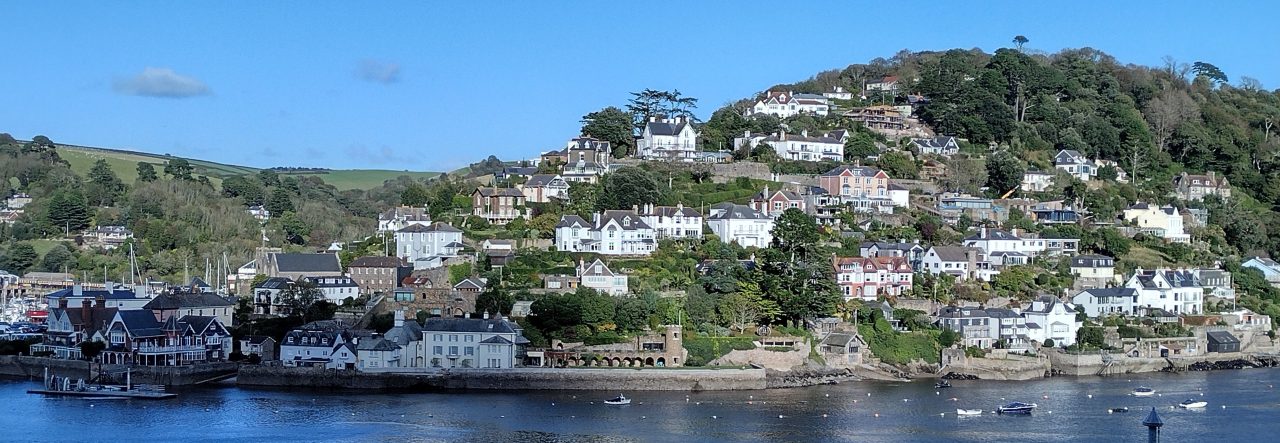
At this time, I was still living in Dartmouth and had given little thought to where I would keep it, I suppose subconsciously, I had already made the decision to keep the boat in the creek at Kingswear. After all, this is where I spent most of my time. The creek was an ideal place to start with, until I could come up with something better in the river itself. Looking back, I am surprised how ignorant I was of the way things were done; for instance, I assumed it would be OK keep my boat in the creek, just because everyone else did, it never occurred to me someone owned the land and permission had to be sought and possibly a fee paid. I had never heard of harbour fees or mooring rights. Such is the blessed ignorance of youth. In no time at all the boat was in it’s new home, the engine was kept in the shed at home and whenever needed, was carried down to the river.
I had not had the boat very long, when an old neighbour of ours from the Midlands, called in to see us. He was in the area for a weeks’ holiday. His name was Pete and he was very handy with things mechanical. I took him out for a trip around the harbour and gave him a go at the controls. He asked me if the engine had got a reverse gear? I told him I didn’t think so, and had really not thought about it. When we returned to my house, in no time at all, he had stripped down the engine and gear mechanism. Straight away, he pointed out the problem, a piece of metal on the reverse gear shift; had been worn away and was not making contact. He thought it could be remedied fairly easily. I hoped this was true, because a reverse gear really would be useful. We took it to Fairweather’s garage but they couldn’t help, and suggested we took it to the blacksmiths in Dartmouth. This we did, we found his place near to the cinema. Adjusting our eyes to the gloom, we stepped inside this time warp; it was like a picture in a history book. We explained our problem to a man in shirtsleeves (Mr Middleton) and heavy leather apron, tied in the middle with string, he seemed confident he could fix it. I watched with great interest as he went to work, using tools positively ancient. We could not help but admire his skill, as he fashioned and braised new metal to old; soon declaring it was the best he could do; we thanked him and went our way. Sadly, when we tried it out, the metal again wore away; it was just not hard enough to withstand the harsh treatment the design called for. I carried on without a reverse gear; I did not even miss it! As for the Blacksmith’s shop; like the cinema, there is no trace.
Mr Penwarden was, the chief goods clerk at the railway station, where I had just started work, we had immediately become firm friends. He had been a boat owner for many years; he too kept his boat in the creek. He knew what I was up to and we had many a long chat, giving me lots of tips and advice, his help over the time I had a boat, was to prove invaluable. It was late in the year, and I planned that, soon I would lay the boat up and give it a thorough going over.
At the onset of winter, in the time honoured manner, the boat was heaved out of the water, turned on its’ back and chocked up with timbers. In the short days ahead I slowly became aware that I was gaining in confidence and becoming part of the local boat scene. Seeking advice here and there, sometimes just talking, I began to learn the jargon and ways of doing things. The first thing I noticed, was the keel really needed caulking, because when the engine was working hard the vibration was such, water would seep into the boat. It really needed sealing with caulk string, I decided I was not sufficiently experienced or expert to carry this work out, so compromised by applying a thick coat of bitumen, supplied courtesy of the ‘packers’ (Permanent Way men on the railway!). Everything else looked straight forward, just scrape! scrape! scrape! until all traces of varnish and paint were removed, both inside and out. When this was done, sand down sufficiently smooth to start painting and applying varnish. Easier said than done, it was well into the new year before I could start the final coat of varnish. Winter gave way to spring and my boat was ready, well almost, there was one final thing to do. I had long since decided to name it ‘SEA FEVER’. And to finish the job off, paint the name on the stern seat board. I gave much thought to the design, and took great care over choice of colours and type of paint to be used. I was well satisfied with the end result.
Things were going well, my boat now resplendent, bobbing in the water just waiting to be taken out. The creek was certainly a good place to keep a boat, but there was however, one problem…..it was tidal! This meant you could only take a boat in or out according to the state of the tide. You can imagine this caused a lot of problems and inconvenience, when planning your day. To get over this problem, I had to find a place to moor my boat in the river proper, which was also tidal, but could be overcome by using running moorings. I consulted my friend Pen and as if by magic, he had arranged a mooring by the footbridge, which crossed the railway lines. Underneath the bridge, was a tiny brick built shelter, about the size of a military sentry box, I used this to house my outboard motor. Pen also acquired all the necessary mooring equipment, such as pulleys, hundreds of feet of rope and an anchor weight. Above all this, he gave me access to his great store of knowledge. It was surprising how quickly I became skilled at preparing and handling the boat, either rowing or with power, I enjoyed both, If I was not going far, I would row, but if I intended going any distance I would use the motor.
One summer’s evening I was messing about in the creek, the tide was fully in and the translucent green water dead calm. I started to row and was surprised how quickly I was moving; I decided to see how fast I could go. In true regatta style I headed for the railway bridge, (which I would have to go under, in order, to get out and into the river) I was putting on a fine display of rowing, I could see people watching me from high up in their gardens, and this spurred me on to greater efforts, my rate of strokes increased! At this point I had completely forgotten to check my bearings, to see if I was still on course for the bridge. The next thing I knew there was an almighty crash and I was catapulted in a heap into the bow of the boat. I had hit the bridge wall! Badly shaken, I came round just in time to see both oars floating serenely away to the middle of the creek. I then looked up to see if the people were still watching, they were! I have never felt so embarrassed; it served me right for showing off. Surprisingly, the boat was not damaged neither was I, except for my bruised ego.
This was 1953, coronation year. The new Royal Yacht Britannia sailed into Dartmouth, with the equally new Queen, and moored in the middle of the river. One evening, my dad and me and the dog, went out to have a closer look, we found ourselves among a few other assorted craft doing the same thing. We got quite close, what a beautiful ship, it was gleaming, we could see the reflection of our boat as we passed by. As we a circled, quite close, we could see the ships barge come alongside to take someone ashore, it really was an impressive sight. That someone was Prince Philip on his way to the Royal Yacht Club, as he went by, my dad waved to him, Philip ignored him. My dad never thought much of him after that.
A day on Lighthouse Beach found us fishing with my boat. John Memory was with my brother and me, I was fishing from the shore whilst the other two were messing about; they would come to me on the beach when I signalled that I wanted my bait taking out and dropped in a certain spot. The boat came stern in to the beach and I carefully handed John the baited treble hook, with the instructions to proceed, at which the boat pulled away. The line on my reel was gradually pulled off the spool to the point where I shouted to John to let go, and drop the baited hook into the water. There came no response and the line continued to pull off the reel, I shouted again, and a panic ridden voice yelled back that the hook was stuck in his hand and he couldn’t let go! The momentum of the boat continued and soon all the line was spent; what was I to do? There was only one thing, I waded out as far as I could and threw the rod into the water, where it sailed on for a few more yards. My imagination was working overtime, what had been John’s injuries? How badly was his hand torn? Truth to tell, I don’t remember, I do know he never went to hospital so it couldn’t have been too serious. It is a long time since I have seen John Memory, I wonder if he still remembers the incident?
It was round about this time; I invited an old friend to stay with me for a holiday. His name was Bob, and he came from my hometown in the Midlands. Bob had the same interests as me and was eager to explore the area for sea birds eggs. I decided to take him to a place where I knew there was a colony of rare seabirds. Arrangements were made, and after loading up the boat with rope, we set off. After an uneventful journey of about an hour, we found ourselves at Scabbacombe; it is a secluded sandy bay, hemmed in by high cliffs. It was on these cliffs the seabirds nested. We dragged the boat up the beach to safety, and unloaded.
Each laden with huge coils of rope, we must have looked like himalayan sherpas as we staggered up the steep grass slopes to the top; It was a hot day, and soon we were sweltering; we needed several breaks on our way to the top to regain our breath. Finally we made it, and collapsed in a heap of rope, exhausted! The idea was to throw the rope over and down the cliff side so we could climb down to the nests. Looking around, we could see it was not going to be as easy we thought! From a distance the cliffs looked almost sheer, but this view was deceptive and was not the case. Also, the going was made more difficult because the whole area was knee deep in fern and bracken and brambles. Scraggy trees like old men, bent by the prevailing wind, forever pointing inland, barred our way. It was almost impossible to detect where the edge of the cliff actually began. We decided to secure one end of the rope round a tree, and try and throw the rope down.
This was far more difficult than it sounds, and in the heat of sun very tiring. When we finally managed it, we found the rope was not aligned in the right position and needed manoeuvring over the nests. Getting in the boat, I rowed out to the base of the cliff and tied the end of the dangling rope to the back of the boat, I then, rowed away from the rocks, hoping the rope would tighten sufficiently for Bob (who was still at the top) to manoeuvre the rope in the direction of signals given by me. This system worked a treat; we now had the rope in exactly the right place.
Instead of climbing down from the top as planned, we would now have to climb up from the bottom. It was now well after midday, and Bob joined me on the rocks below. We examined the next phase; the eggs were on a ledge about twenty or thirty feet up, under an overhang, almost like a cave entrance. This meant the rope was vertical, and Bob would have to shin up. With me at the bottom, pulling the rope hard towards the rock face, Bob shinned up to the height of the ledge, only to find he could not reach the eggs, his arms were just not long enough. It was no use; Bob could not hang on any longer and came down. It looked as though we would be going home empty handed; so near, yet so far! Then I had an idea, what we needed, was something on a stick to scoop the eggs off the ledge without breaking them, I knew just the thing, a child’s fishing net.
We decided to walk back to Kingswear to get the fishing net, which I knew my dad sold in his shop. It was a six mile round journey, and it was the middle of the afternoon when we got back to the beach. We found everything just as we had left it; there was not another soul to be seen. Armed with a child’s cane fishing net, Bob once more shinned up the rope to the ledge, this time there was no problem; the net worked just as I thought it would, Bob never lost a single egg. After succeeding in our main task Bob decided to have a further look round, I think he had spotted some guillemots further over to our left, here the cliff were rather steep and crumbly. I was messing around in the boat below watching Bob pick his way to where the Guillemots were nesting, every now and then his feet would dislodge a shower of loose rocks into the sea below, I became fearful that he would fall, I remember shouting instructions that if he lost his footing, then he should jump into the water and I would pick him up. Luckily he did not. It was time to go home.
We pushed the boat out into the water and both scrambled aboard; it was Bob’s job to keep the boat head on into the waves, whilst I started the engine to get the boat under way. The boat was being thrust back on to the beach by the force of the waves it was proving difficult to get sufficient depth of water under the boat for Bob to start rowing. Something was not right, something had changed since we came in the morning; it must be the tide. Not only had the tide had turned, but the wind had got up as well. This we had not noticed whilst busy on the shore, but now it was only too obvious. The boat was bobbing like a cork and Bob was having difficulty rowing, just as the boat lurched an oar went skidding off into the surf, I grabbed the remaining oar and splashed after it, I lunged out and somehow managed to grab the floating oar back on to the boat. It was obvious that I had to get the motor started quickly. Trying to keep my balance I wrenched the pulley to start the engine, to my horror flames started to lick around the fuel tank, I could see that the fuel cap had come off and a spark from the plug had ignited the fumes. Frantically I picked up the first thing I could see which was a cloth used for keeping the seat dry; luckily, the cloth was soaking wet with water we had taken over the side, I threw it over the engine, the flames died and went out. I replaced the fuel cap and thoroughly wiped the engine dry, I pulled on the cord again and this time the engine started, I half expected to see flames appear, but there were none, I opened the throttle, and the boat butted its’ way off the beach, we were on our way.
I pointed the boat towards home, there were white caps on the crests of the waves, which were hitting the boat with a thud; the wind was fresh, coming off the sea. The motor was by now beating out a steady rhythm and we relaxed and settled down. This was the first time I had ventured out of the river into the open sea, and it gave just a tiny taste of how fickle it could be. It is nearly fifty years ago and I can see with astonishing clarity, Bob lying in the bow soaking up the sun. With the red rocky outcrop of the Mew Stone on our left and Brownstone Battery on our right, I knew we were half way home. A flawless blue sky, cotton wool clouds, and the steady droning of the motor made us feel drowsy and content. What a day!
As I have already mentioned, that occasion was only one of a handful of trips made into the open sea, most of the time being spent within the confines of the river and estuary. One fine evening I was anchored near Kingswear Castle, fishing by myself. There were few boats about and I was enjoying the solitude. All of a sudden, only a few feet away, a huge tail came out of the water and started thrashing about, beating the water creating quite a commotion. I have never moved so quickly in my life, I threw down my rod, pulled up the anchor, and started the motor all in record time; throttle wide open I sped off, not looking behind me. Back on land, I told and retold my story to anyone who would listen, only to be stared incomprehensibly. That is, until one chap nodded knowingly and said “ah yes, that would be a Thresher Shark” and went on to give me a definitive lecture on the subject. How glad I was I met that man, if I hadn’t, I would have doubted seeing it myself.
In June 1956, I was due to be called up for my National Service, this meant I could no longer look after my boat and would have to sell it. I had messed about in my own boat for over three years and it had given me enormous pleasure. Coming from a Midland industrial town, I had started out completely ignorant of things nautical, water or boats; I had come a long way since then. I have since wondered, what the boat’s history was? The outboard motor was an ancient ‘Seagull’, and of very simple design; when and who it was manufactured by I have no idea; similarly the boat. If I was to hazard a guess I would say both were of 1930’s vintage; simply because this is the era it evoked in me. For the life of me I cannot recall what happened to it, or to whom, I sold it. I can only hope it gave it’s new owner as much pleasure as it did me.
By Ian Giles
 Kingswear Historians