
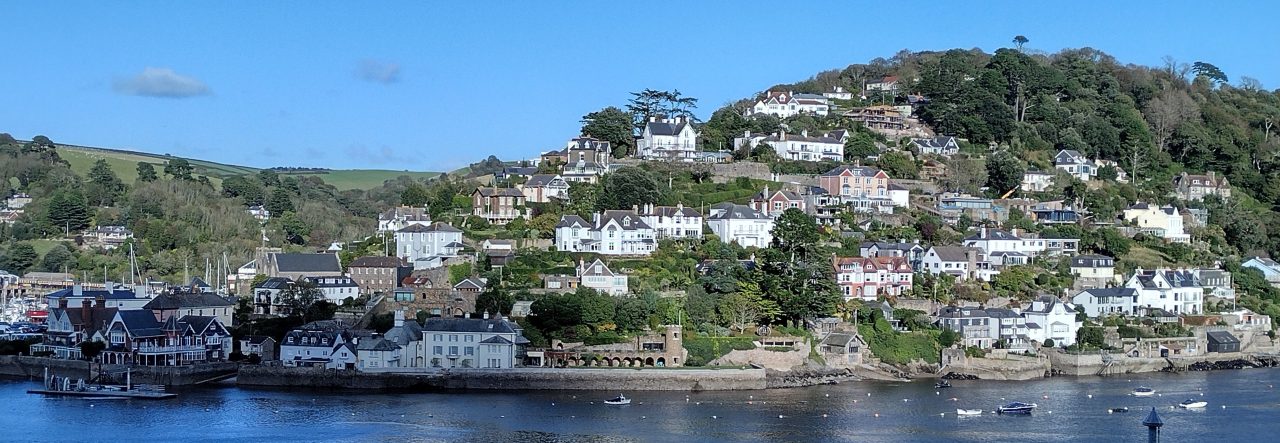
Meet Mike and Vic by Ian Giles – Ian introduces us to some of his friends and describes the places he visited and the fun he had as a teenager in Kingswear including visits to Lighthouse Beach !
In putting this information together to share on-line I have proof-read these articles by Ian Giles and in this one and others there is reference to the Villagers enjoyment of Lighthouse Beach – eg ‘Lighthouse’ was a pleasant suntrap, sheltered at the bottom of steep red cliffs, and situated in the river, it was very popular with local people, especially in the summer, when families would spend a whole afternoon and take their tea.
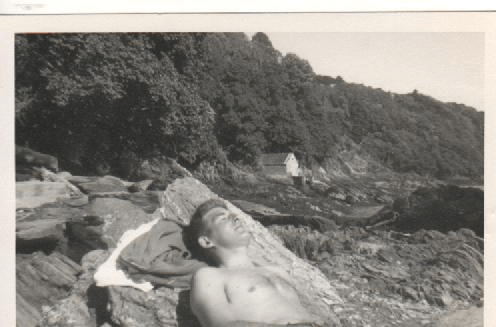
Ian Giles at Lighthouse Beach – you can compare boathouse then and now C1964
I am aware of the dispute between the Southwick family in Kingswear and the local people over the use of the beach which has a right of way from Beacon Lane down to the beach. It is perfectly clear to me that the beach would have been used by the locals for hundreds of years but this is at least proof that back in the 1950s the beach was being enjoyed by the local people of Kingswear.
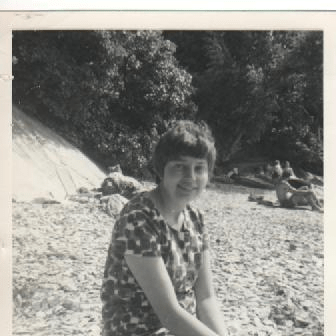
Pauline Giles on Lighthouse Beach c1964 (Ian Giles draws attention to other people enjoying the beach….!!)
It would be nice to think that this evidence could be considered by the current enquiry and that the beach can be given back to the locals to use. For me – and I am talking about me not anyone else in my family – I just wish I was back living in Kingswear and cause as much mischief as possible to defend the rights of normally people from the greed of others.
Meet Mike and Vics by Ian Giles
It’s strange how the mind’s eye, like the finest of cameras, can capture and retain a moment in time; for ever. I close my eyes and see such a moment. A summer’s day, everywhere blue, deliciously warm and for a fourteen year old living by the sea, a day glad to be alive. It was on such a day that I met Mike and Vics.
Emerging out of the shadow of the archway, which leads into the Kingswear Railway Station yard, were two boys walking in my direction. My attention was drawn to the fair-headed boy dressed in white shirt and khaki shorts. His flapping white shirt contrasting with a windblown tan. The other boy dressed in jacket, tie, and school cap. They spotted me.
As they approached, the boy in the school cap surprised me by asking to confirm a statement of fact by asking “Your Dad has bought the shop in the Square has’nt he?” I agreed it was true and from that surprising start words flowed easily. The boy’s name was Alan Vicary known to all as Vics. He went on to tell how he had been friendly with the previous shop owner’s son, a lad called Billy Noble. It transpired the Nobles had decided to sell the shop and return to their native North East (Newcastle I think) for reasons I can no longer remember.
Vic’s companion, was Mike Ellis. His blue eyes set in a fresh face made him look impish and boyish. He lived with his Mum and Dad in a tiny cottage perched way up a wooded hillside in Kingswear Devon. He had a younger brother Chris, who later was to follow in his brother’s footsteps and joined the navy. Dad worked on the railway and seemed a solitary figure. Mrs Ellis was a familiar figure in the village, head down scurrying to and fro.
Vics returned to the conversation, my gaze fell on this young man who somehow didn’t manage to look as young as his fourteen years. He was definitely overdressed on this gorgeous summer’s day, his well rounded frame showing no sign of the outdoor life I guessed he must lead. He had recently moved home across the river to Dartmouth where his father was an insurance agent. He must have taken after his father who was a big chap, a chip off the old block. That such diverse characters as Mike and Vics were bosom pals was a mystery to me.
From that moment standing in the afternoon sunshine, we became firm friends. I learnt that Mike went to a Roman Catholic boarding school in Exeter and was on his summer holidays. It was at about this time he was due to join the navy to be an Artificer, for which, he would have to go to a naval establishment at Fareham in Hampshire. His father, like many others in this area, had been at some time, a naval man, and wanted Mike to make a career at sea and join the navy; I got the impression that Mike was not too fond of his way of life at school and was looking forward to his new life in the navy.
Vics was still at school and clearly had no intentions of joining the navy or any other disciplined force for that matter. I’m sure he would not mind me saying that he was not fond of physical activity, whenever we went sunbathing and swimming Vics would remain firmly anchored to the beach, preferably in the shade. For no matter how hot the weather he steadfastly refused to remove any items of dress. The love of his life was railways. It was no use expecting Vic’s company on a Saturday afternoon, summer or winter, for Saturdays were reserved specially for Newton Abbot railway station. In later years, when steam locomotives had long since vanished, I too became interested in railways, especially from an historical standpoint. It was then I bitterly regretted not accompanying him (on the odd occasion) as Newton Abbot on a Saturday afternoon was a very interesting place for a railway buff.
Mike was the athletic type, this you could tell. A great sense of humour and leg pulling made him very much a joker. He knew no fear, his displays of disregard for danger many. The time soon came to leave us to join his establishment at Fareham. We only saw him when he came home at the end of each term, exactly the same as when he was at school. He cut a very handsome figure in his officer style uniform, which he seldom wore during the holidays, much preferring a sloppy shirt and jeans.
I saw Vics almost everyday, he went to school in Torquay by train. I would watch out for him in the afternoon when we would arrange to meet later in the evening. We would walk anywhere and everywhere winter and summer alike, accompanied by my ever faithful dog, Raq. It was on these walks that I began to discover and explore the locality to which I had recently moved. It took a little while to adjust to my new surroundings, but gradually I counted myself lucky my parents had chosen such an agreeable place.
I lived in the village of Kingswear in Devon, in a cottage at Alma Place, which was near the church. Nearly all the village was built on a mound of a steep hill, flights of steps were everywhere, and our house was no exception; on leaving my front door, if I turned left I would have to climb steps or if I turned right I would go down them. I turn left and climb a flight of about a dozen steps, turn right at the top and I am on the road that will lead me in the direction of the mouth of the river. Five minutes along this road, I stop and comfortably lean on a wall, from which, I stand and admire the panoramic view of Kingswear and Dartmouth Castles guarding the entrance to the river and harbour. Down below is a small stony, rocky beach, known as Lighthouse Beach, this is where the local people come for a swim or to sunbathe. My friends and I have spent many a pleasant hour here, swimming, or fishing.
I remember the day Mike, Vics and I were on the beach. Mike was a few feet away in his swimming trunks standing ankle deep in the water; pointing across the river; he asked if I would go with him to the other side, which I estimated to be a good three quarters of a mile. I declined on the grounds the tide was coming in too fast and anyway I doubted whether I was a strong enough swimmer. So Mike set off by himself; swimming at an angle to the oncoming tide, hoping no doubt, that as his journey progressed, the tide would compensate and he would finish in the right place when reaching the other side. However….. as he neared the half way mark, it was clear he had underestimated the force of the incoming tide and was drifting away to the right. I was not unduly worried, at least he could go with the flow and end up in Dartmouth if the worst came to the worst. Eventually he made landfall, some way between Warfleet creek and Dartmouth. We didn’t give much thought as to how he would get back and returned to relaxing in the sun, at least I did, Vics retired to the shade. Much later, lying on the beach, I became dreamily aware of a shadow blocking the sun from my face, shielding my eyes I could make out someone was standing over me, it was Mike! I asked him how he had got back? He told me he had walked into Dartmouth, all the way from Warfleet creek, caught the ferry, and walked back to Lighthouse. When we asked if he felt embarrassed walking through town in only his swimming trunks he just shrugged and smiled. Typical Mike!
Many times we would walk this road to the mouth of the river Dart. It would take us through tree-lined lanes, which in summer; formed a canopy of leaves through which to walk. For about a mile, the road mirrors the twist and turns of the river below, and then forks; branch to the right and soon the road deteriorates into a cart track, a gate bars our path bearing the all too familiar stark message, “Strictly Private”. Through the gate the eye traces the natural contours of a steep sided valley, with a stream at the bottom, which flows over a shingle beach into the sea proper. This is Millbay. Nestling at the head of the valley is a cluster of buildings, a large house called the Grange, a farm, and a gardener’s cottage. This is where my farmer friends Jim and Mary Maker live, next door, in the gardener’s cottage live the Gibsons whose son Mike is also a friend.
Walking down the lane toward the cosy stone buildings, a Massey Ferguson tractor approaches, crouched over the wheel is the familiar bulky figure of Jim Maker, close behind, his sheep dog playing dare with the trailer’s wheels. A casually raised hand accompanies a leathery smile as I step aside, and let him pass in a cloud of swirling dust. In the farmyard, ducks are heading for the sound of a sparkling stream, dancing its’ way down the valley to the open sea; a crusty manure heap, with chickens fussily scratching around its dusty base, a beady eyed cock warning me to keep my distance. Swallows zoom from sunlight to gloom through the half door of the barn. It is a timeless scene.
Sat at the at the kitchen table, drinking tea, I am also transported back in time, looking around I sense things have not changed much in a hundred years. I wish I could describe here every detail of that scene, alas, my ‘infallible’ memory is no more and not up to the job, save to say I have an abiding memory of a chicken sharing my table. The friendly hospitality of the Makers when visiting, always gave a warm feeling.
On my left, as I leave the yard, an ancient stone bridge crosses the stream. From this bridge I can see the orchard where we would sometimes, in the evenings, sit in the fork of a plum tree and gorge on succulent Victoria plums. I follow the now tumbling stream down the valley, to the beach and open sea. The coastline is mainly, steep cliffs clad with ancient pine, the rocky shoreline, punctuated by sandy cove or beach. The most satisfying part of all this is, hardly a soul is around for miles, save the odd farm and cottage. Quite often I would go alone, save the dog, who would not give me any peace until I agreed to take him. Perhaps the best time go on this walk was winter during a fierce westerly gale. Perched on the cliff top among the swaying pine trees, seated on a cushion of pine needles, a Raven, blacker than the sky, wheeling and balancing on the howling wind; watching the grey green sea, explode on the rocks below. Over my shoulder my dog, rooting among the graves, of long ago fallen trees.
One day, we walked along the cliff tops along this route to the headland known as Brownstone Point. Here at the beginning of the Second World War a coastal defence gun battery was built. In essence it was a small but complete army camp whose purpose was to defend the approaches to Dartmouth Harbour and surrounding coastline, against enemy shipping and invasion. Mike knew of its existence and had visited it several times. He led the way and gave us a grand tour of the installation. The place was deserted except for a caretaker whose job included keeping such as us lads out! Mike warned us to keep a sharp look out for him, if he showed up, run like hell!
The camp was remarkably intact, as if it’s former occupants had only left yesterday. To me it was a fascinating place, observation point, ammunition stores, two six inch guns polished and shining, barbed wire everywhere! Nissen huts hidden among the trees; still habitable. I half expected to see silent, uniformed figures going about their daily life. To be posted to this camp must have seemed like heaven, I wonder how many former lucky soldiers, are still with us today?
The War Department decommissioned the camp in the mid nineteen fifties. To-day hundreds if not thousands of walkers have passed this place, as it is part of the South Devon coastal footpath, back then all of this area was private and out of bounds. Some summers ago my wife and I walked through the old camp, which is surprisingly intact but neglected and overgrown, though I understand the National Trust try and keep it reasonably tidy.
Another favourite place of mine was Scabbacombe and Mansands. These being isolated beaches on the stretch of coast between Kingswear and Brixham. A whole afternoon was needed to walk this area, which we did many times. It was on such a walk that I witnessed first hand, Mike’s courage. It was on the beach between Mansands and Scabbercombe.
This stretch of beach is cut off from the other two beaches by promontories of cliffs, which rise to heights of up to a hundred feet or so. In order to get to Scabbercombe beach I had to climb the cliff, which barred my way. I chose a route which seemed not too difficult and started climbing. I steadily gained height to a point about 40 ft high. With some distance to go I detected the climb was getting more difficult. Slowly but surely I was getting into a situation where I could not go up or down, I was clinging to the cliff side by hand and foot, rapidly becoming tired and weak with holding on. I was in trouble! I could not hang on much longer! I considered jumping down to the beach below where Mike and Vics were playing about. It looked a long way down, surely if I jumped I would most likely be injured, a broken ankle at least or maybe worse. I instinctively shouted to the two below that I was stuck and couldn’t hang on much longer. I fully expected they would laugh and reply with some stupid remark. Not so, Mike immediately set off climbing toward me and in a surprisingly short time was at my feet. He could see I was shaken and scared, he calmly talked me into lowering myself down to a ledge where I could rest my arms and gather myself. I do not know how long I crouched on that ledge but eventually I gathered sufficient confidence to obey his instructions and eventually climb down to the beach below.
A popular feature of life during this period was a regular visit to the cinema at Dartmouth. Usually there were two or three programmes a week so it was not unusual to visit the cinema at least twice or even three times. The Hollywood dream factory was still working flat out to keep pace with demand as television was still in its infancy. Being a young teenager my heroes were such stars as Bert Lancaster, Robert Mitchum, Kirk Douglas, Alan Ladd to name just a few. The sex icons of the day were Marylyn Monroe, Jane Russell, Lana Turner, Sophia Loren and many more.
Mike asked if I wanted to see the film Carmen Jones, which was showing that week. When asked what it was about he explained it was a musical based on the opera Carmen, “You mean there’s singing”? Such a question reflecting my knowledge of classical music! On the basis I had nothing better to do I agreed to go with him. The film had such an impact on me that I have seen the film time and time again. Needless to say my favourite opera is Carmen.
Some of the best films ever, were made during this time, I cannot recall explicit sex, sadistic violence or foul language ever being shown; I feel privileged to have witnessed them. I cannot help comparing these films with the present day, where these ingredients are obligatory. Needless to say I have not been to the cinema in many a year. I enjoyed our regular visits to the cinema, made more so by travelling over to Dartmouth and back by ferry, the return journey being made around ten thirty or thereabouts, sometimes accompanied by moonlight reflections. Sadly, evidence of Dartmouth’s cinema, no longer exists
We would “go over” to Dartmouth and spend a Saturday morning leisurely wandering around. I liked to browse in WH Smiths by the boat float (harbour). I had a keen interest in birds and was lucky in finding a copy of ‘Popular Hand Book of British Birds’, which dealt with every aspect of the subject, a real treasure indeed! The book was first published in 1952 and I still have it today, albeit in well used condition. In recent years I have been on the lookout for a copy to replace it, lo and behold, the other day I found (in the next village to where I live) exactly that, a copy in excellent condition, the only other copy I have ever seen since that day in Dartmouth’s WH Smith. Another place I can remember going is a little shop to the rear of Walls garage, where they sold records and we could play the latest hit. The lady in charge was Connie Philips, whom we knew, as she lived in Kingswear. We tested her patience to the limit asking her to play every pop record in the chart that particular week. This was before the explosion of Elvis Presley and Rock and Roll, the singing stars of the day were people like, Max Bygraves with “Tulips from Amsterdam”, Rosemary Clooney with “This Old House,” David Whitfield with ” Cara Mia Mine” and Alma Cogan. With “Dreamboat.” All tame stuff compared with what was coming, Elvis Presley, Fats Domino, Little Richard, Jerry Lee Lewis, Buddy Holly and many more.
I cannot recall if the records were 78 rpm or 45’s I think there was a transition from one to the other at around this time.
Walking was a pastime I enjoyed, whether just around the village or across the river in Dartmouth’s streets, but best of all it was the coast I most preferred. A walk that stands out in my memory; is when we walked the cliff tops from Mansands to Brixham. Walking past the Redoubt Hotel and the entrance to Fountain Violet Farm, we left the village behind. Soon a gate appeared in the hedge, which Mike climbed over saying something about a football field, we scrambled over the gate trying to keep up with him, Mike was still going on about years ago, a Kingswear side played rugby here. This was news to me, I had never heard of a Kingswear rugby team. It didn’t look like a rugby field to me; all I could see was a crop of growing turnips. Following Mikes’ footsteps I could see he was heading toward a corrugated shack leaning drunkenly against the hedge. He opened an unlocked door, and I followed him inside. A surprising site met my eyes, there, strewn about, were what appeared to be a set of rugby strip; shirts, shorts, zinc bath, towels as though waiting for the teams to arrive, even two deflated, somewhat mouldy rugby balls lay nearby. Outside, the goalposts lay in the overgrown grass. Looking about me, I had the same feelings as when looking round the old army camp at Brownstone Battery. We kicked a deflated ball about, and left.
We continued on our way, it was not however, a ghostly sort of day. It was very windy with low storm clouds scudding in from the sea, the occasional flurry of rain stinging our faces. The road eventually peters out well before reaching the sea; a rough cart track now twists its way down to a low lying sandy beach, not known to many people in those days. As the crow flies I would estimate Brixham to be about six miles from here, but we were not crows, we would be walking the cliffs. Up and down, along the beaches and coves, all the time fighting the howling gale. My dog, covering ten times more ground than we, looking very bedraggled, enjoying every single minute. It was late afternoon when we reached the streets of Brixham, it was already getting dark and the shops and streets were lit, we would catch a bus back to Kingswear. Pooling our money, we just scraped enough for our fare; I cannot recall if I had to pay for the dog. We sat on the back seat wet, tired out and hungry, but happy!
Vics and me often went fishing, sometimes from the floating pontoons, where the railway ferry tied up or from the jetty nearby. The baits we would use being either prawn, or rag worm. Vics introduced me to a way of catching prawn I had not seen before. A piece of netting was stitched around the rim of a bicycle wheel with a rope attached, the method of operation being to heave the whole lot in to the water, (usually at low tide) then, when all the rope was paid out, haul it as fast as you could; if you were lucky a catch of prawns would be in the net, If not, a net full of seaweed and stones was the result. This method was quite successful in the early days but later on, the prawns seemed to have completely disappeared. Pollution no doubt! We dug for worms in the (Kingswear) creek, a messy smelly job; if we were feeling lazy we would buy them from the tackle shop in Dartmouth for a few pence. By far the best bait was peeler crab, this being a crab, which has just shed it’s shell and is soft and tender, trouble was, they were not very plentiful and hard to find.
In the dark nights of winter, silhouetted against the pontoon’s dull lights, a small group of us – Jim Breeze from the railway, Frank Craven an exiled Brummie-Coach Driver and my friend Alan Vicary could be seen fishing; we could see our floats by the aid of this light and sometimes you could actually see the fish swimming around the baited hook. Pollack, wrasse, conger eel and the occasional bass could be caught here. One black stormy night, I hooked a huge conger eel, it took ages to reel to the surface, I tried to lift it out but it was just too heavy, in the pontoon’s faint light it looked awesome, I cut the line and it’s huge head slowly sank out of sight. Ugh!
If we had a supply of peeler crabs we would go to ‘lighthouse beach’ and fish for bass. ‘Lighthouse’ was a pleasant suntrap, sheltered at the bottom of steep red cliffs, and situated in the river, it was very popular with local people, especially in the summer, when families would spend a whole afternoon and take their tea. In winter we would have the place to ourselves; and this was the time to fish for bass. To be honest, I never had much success in catching bass; in the whole time I was at Kingswear, I doubt if I caught more than a handful. There was a chap from Brixham, who owned a fishing tackle shop; came fishing on this beach and he used to catch fish up to eight pounds, I would watch him from the road perched high above, he was an expert, and a joy to watch. His advantage was, he had a regular supply of peeler crabs from a bait dealer at Starcross, and this made all the difference.
Life was sweet, and we continued to live our trouble free lives, enjoying simple pleasures and pastimes which the youth of today would find difficult to understand. The grey years of the 1940’s and early ’50’s were a thing of the past; life for a teenager with money in his pocket was good. As for us three; we were about to become two, Mike’s apprenticeship was nearing it’s end, in a short time he would be a qualified artificer, and going to sea; we would only see him when he returned to England. So we said our farewells to Mike and wished him well; we also said farewell to the years of our adolescence youth, for we were growing up!
By Ian Giles
 Kingswear Historians
