The Dartmouth and Kingswear Steam Laundry was established sometime in the latter part of the 1800s. It was in operation during the period that “The Britannia” and “The Hindustan” were training ships for the Royal Navy – carrying out the training of officers, prior to the building of the Naval College.
In the early 1900s there was a notice on the wall stating “Contractors to the Royal Yacht, Victoria & Albert, HMS Britannia and the Royal Naval College only”.
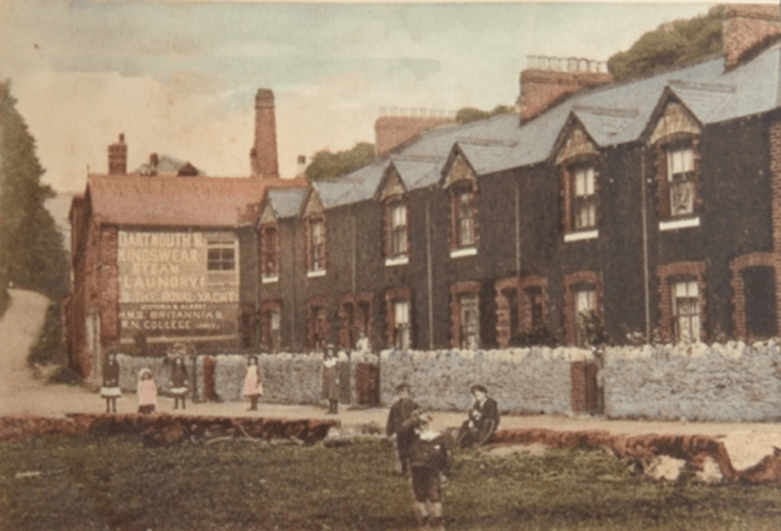
Kingswear Laundry in the late 1800s
At the entrance to the Laundry, up to the time it was demolished, there was a large lion and unicorn coat of arms saying “By Appointment”.
The Laundry was owned by a Mr Mitchelmore, and was managed by the Bell family, my brother’s wife Rosamond’s grandparents. They lived in a house between No.1 Waterhead Cottages and The Laundry. The also had the two bedrooms of No.1. The power for the laundry at that time came from a steam engine, which had a high brick chimney. The water supply came from a stream, down from “Oversteps” to the cemetery. This had originally been the leat to the water mill. A large square reservoir was dredged out halfway up Waterhead brake with overshoots and overflows to control the water level. Incidentally, the same pool below the cemetery also supplied the water for the railway station via a pipe along the creek and water tower, which stood below where the banjo is now – alongside the railway cattle pens. This also supplied the railway engines near the turntable. All the machinery in the laundry was driven by overhead shafts and pulleys, which ran the washing machines, calendars and spin dryers. During my childhood I remember the brick chimney being demolished and replaced with a tubular steel chimney during the college holidays.
Every morning at about 7am, some 25 ladies young and old (Laundry Maids) came across the ferry, past the carriage cleaners at work who had started at 4.30am and much banter would ensue. The girls would sometimes sing as they went along the road. When they arrived at the Laundry, everything was ready for them to commence work as the Quant brothers – Harry and Jack – had caught the first ferry and been at work for an hour and a half already. The girls would work till 6pm and even later if it was a very busy time. At this time we could almost tell which day of the week it was by the colour of the creek – Mondays very soapy, Tuesdays a little clearer, Wednesdays blue rinse until it was clear by the end of the week.
Cyril Bell, the son of the family who had managed the Laundry in the early 1900s, drove the lorry, which collected all the dirty laundry. It contained baskets and bags. He visited the navel establishments at Plymouth and, during the war, the hotels in Paignton and Torquay, which had been taken over for officers’ flight training. If he had any spare time he used to work in the Laundry.
During the war there was also laundry done for the American Navy, and the water supply began to be inadequate. One weekend, the Americans sent a bulldozer to Kingswear to deepen the reservoir. This was not much appreciated by the dip chicks and other waterfowl that lived there, especially when the bulldozer got stuck and another and a crane had to be provided to extricate it (information from John Issac).
The Royal Navy always used brown sugar. Cyril Bell used to collect the sacks on his rounds and returned them to the laundry. (Jamaica paid their taxes in rum and sugar in lieu of cash, we understood). Cyril and the Quant brothers used to shake out the sacks and share out the considerable amount of sugar which was left in them. Sugar was tightly rationed in the war. One day they were engaged in shaking the sacks and Mr Michelmore came in. They had to tell him what was in progress. Mr Mitchelmore said he wanted to be “in” on it. John Isaac was sent out to the garage to get a sack which was known to have been polluted by rats. They waited until Mr Mitchelmore came and shook it out in front of him. When he saw the rat droppings he was horrified. Cyril and the Quants said “Its quite alright, its easy to pick the droppings out”. They were delighted when he lost interest in sugar sharing!
Just before D Day, a batch of duffel coats was sent to the laundry for washing. John Isaac who was involved told me that some of them were blood stained. These coats remained in the Laundry for several years unclaimed as the ship they came from had been sent on other duties. In 1946 or thereabouts some of these duffel coats began to leak out into the village. They were all wool and would have been very expensive to buy. In the 1947 blizzard, some of the coats found their way to the Teacher Training College in Salisbury where my fiancée, Sheila, now my wife, was studying. They were died in various colours and were greatly appreciated in that very bad winter. Indeed, they are still remembered at the annual college reunions!
Up until the mid 1940s, above the Mill leat, were well-tended allotments which nearly reached the road above, by Castella. Opposite the cemetery, at the top end, was a dump where cars and other scrap was deposited.
Until the 1974 boundary changes, all Waterhead was in the Parish of Brixham – including Waterhead House (Mrs Clifford) and Longfield (Mr Wilton). The boundary of Kingswear followed the stream through the creek and up through Wilton’s field. I well remember Bill Todd telling me how they used to beat the bounds. He was the chairman of Kingswear Parish Council at one time and was a member of an old Kingswear family.
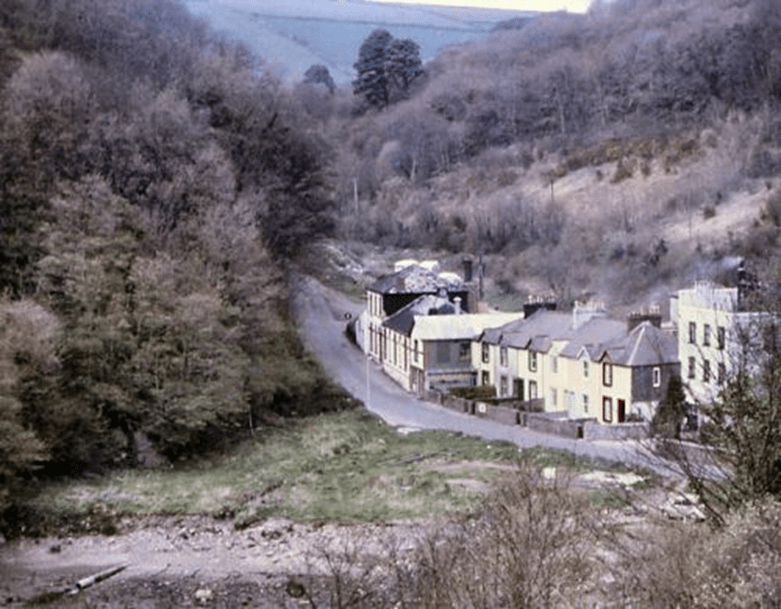
During the early 1970s, the Laundry, after losing the Admiralty contract, and Naval cutbacks, ceased to be viable, even though they tried for a while to get hotel contracts. It was closed down, later to become a housing estate. Luckily most of the employees were nearing retirement.
Noted compiled by Reg & Sheila Little 2003
 Kingswear Historians

