
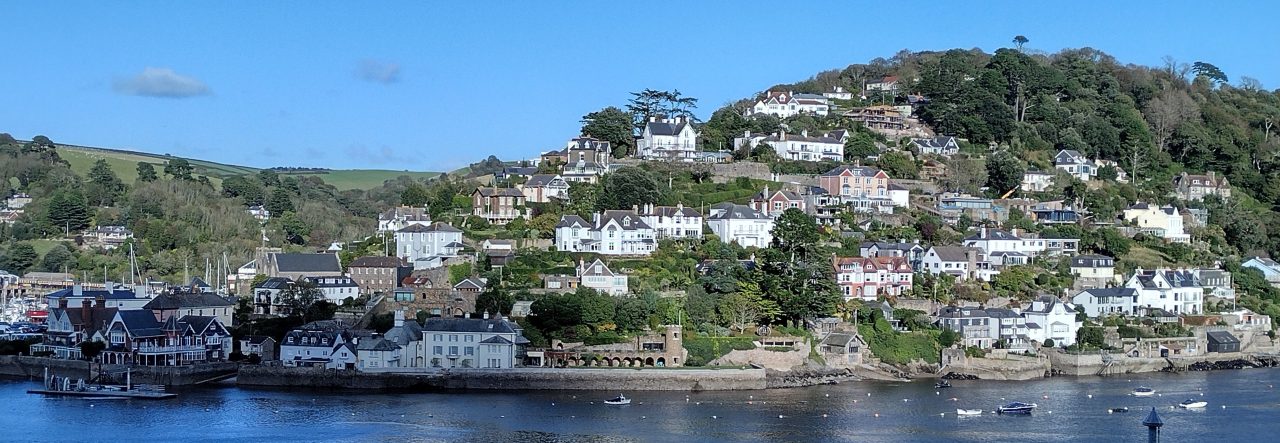
(Taken from the National Trust article by David Williams)
Reg Little, who has lived in Kingswear for almost all his life, recalls that:
“when I was thirteen I went round delivering meat for Mr Scoble, the local butcher, on a bike with a basket (like Granville in Open All Hours). On my way to Brownstone Farm I saw big caravan trailers that were manned by RAF personnel. Sometime later the trailers had gone and there was a gate and sentries on guard at the entrance to the lane. It was impossible to get closer to see what was happening there until buildings appeared and aerials were in place. I know that the Kingswear Home Guard performed exercises out there. There were also a number of Nissen huts and in the middle a big rotating dish aerial on a tower above it and a blast wall surrounding it. One of the hut walls had a beautiful mural painted on it.”
Reg continues “I started work at age 14 in September 1941, for the urban Electrical Supply Co in Dartmouth. When I went home to Kingswear for lunch one day I was told to stay there afterwards and I would be met by other staff from the Board and some RAF personnel. We were taken up to a field where a loose barrage balloon had wrapped its cables around the overhead lines. We had to clear the cables, before reconnecting the line which supplied the AME (Air Ministry Experimental Station as it was called by the Electricity Authority)
The next episode was after an unexploded bomb skipped Brownstone Road between Boohay Farm and Coleton Fishacre, landing near Kingston Farm cottages. The bomb dropped during one afternoon while I was working. When I arrived home that evening, my mother had been given a message that at 7pm I would be picked up to search the fields in the area as I was a full member of the Civil Defence. The planes usually carried 4 bombs and only 1 appeared to have been dropped. We searched but nothing was found. It was after this that the RAF regiment arrived with armoured cars.”
After one of the raids another local lad, Terry, was up near the radar site and remembers large amounts of silver paper strips in the hedges, presumably dropped by the German planes to try to deceive the radar system.
After the Radar unit was dismantled in the 1950s the area went into disrepair, the nissen huts were vandalised and eventually demolished. Reg Little has long campaigned for better historical recognition of the radar site. The fruits of his efforts are now becoming apparent with a notice at Coleton Camp car park, and more information at the visitor centre at the Brownstone Battery at Froward Point.
Update:
Hegarty, C. + Knight, S. + Sims, R., 2013-2014, South Devon Coast Rapid Coastal Zone Assessment Survey National Mapping Programme Project (Interpretation). SDV351146.
A radar station of Second World War date is visible as a range of structures and earthwork pits and banks on aerial photographs of 1946 onwards, to the northeast of Coleton Barton Cottages. The site occupies a single triangular shaped field accessed via the northwest and southwest corners and covers a total area of approximately 1.4 hectares. Two embanked structures representing possible transmitter and receiver blocks are located to the southwest and northeast of the site, respectively. The possible receiver block to the southwest is associated with a Chain Home Low aerial. A range of structures, including nissen huts and pitched and flat roofed buildings are located across the site and which were likely used for accommodation, storage and administration. A possible operations block, with associated aerial visible on the roof of the structure, is also visible as a structure at SX909512. Other features include two possible transmitter masts visible as structures and circular earth-worked pit and bank gun pit to the northwest of the site and a rectangular shaped earthwork pit towards the centre of the site. Aerial photographs of 1950 to 1989 show that the former radar station remains largely unchanged and visible as a range of structures and earthwork pits and banks, although a number of smaller structures have been removed. By 1992, the former radar station has been completely cleared and levelled.
 Kingswear Historians