
Preface
We used to go to France each year, usually via Cherbourg. Reg’s first trip to Cherbourg was in 1936 on a Sunday day trip from Kingswear Jetty, on the “St Helier”.
In June 2003, we spent five days in Cherbourg. Having grown up in Kingswear while the Free French were here 1942 – 1945, we called at the Naval Academy to see if we could gain any information regarding this period. We were referred to the Marine Records Office. We were very surprised to be given the information which is included in this folder. We thought it would be of great interest to Kingswear people and those who have moved to Kingswear since the war.
Sheila’s mother was in Jersey during the Great War and spoke good French so was able to converse with the Free French crews. Reg went to Leon Coquerel’s (Captain of the Free French Tug – “The Aube”) cremation in Le Havre and took a letter of condolence from Kingswear Parish Council.
Reg & Sheila Little
Kingswear History Remembered
See photo below of Ernest Meurville, Phillippe Auboyneau, Andre Colas & Charles de Gaulle on the MTB 94 off Weymouth on 18th January 1943

Free French in Kingswear – 1942 – 1945
Translation by Sheila Little of pages 367 and 368 of Tome 2 from the Archive Department of the Naval War Records Offices in Cherbourg; being Admiral Cazanove’s account of his time in Kingswear in 1942 – 1944.
The Base at Dartmouth
The war presented various ups and downs in an otherwise well regulated life. A base for the ships was established in the Dart estuary and the coastal forces took over The Station Hotel at Kingswear (Royal Dart Hotel).
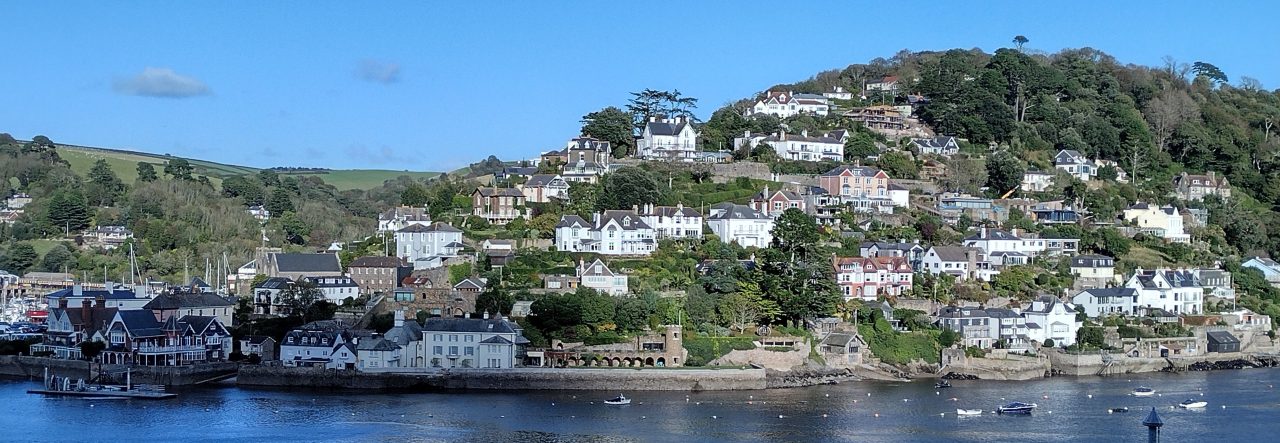
Kingswear faces Dartmouth on the opposite side of the river. The French officers were billeted at Longford, “a delicious little hotel surrounded with bushes”. It had large bay windows and the terrace overlooking the waters of The Dart. From there could be seen the boats surrounding the supply ship, Belfort. They were clustered like chicks around a mother hen. The Free French sailors made good housekeeping with the British sailors at the base. During the day, ships were frequently alongside the jetty and the torpedo sheds quay (Hoodown); work was done on the torpedoes and tubes and tanks were filled with fuel. They were in the charge of a master engineer mechanic whom they consulted about all difficulties.
As for the French crews, they were housed at Brookhill, 20 minutes (walk) from the village near the mouth of the Dart. Brookhill was a large house, lost in the midst of a 3km long park, full of ancient trees. At the door, a sailor mounted guard beside a Free French flag – the cross of Lorraine. In front of the house a beautiful terrace and carved balcony faced the river; many beautiful parasol pine trees giving the impression of scenery in many parts of France. In spring, banks of flowers bloomed throughout the garden, and the multicoloured blooms brightened the rooms of the officers and men.
The Routine
We were night-birds. Darkness protected us during the chase, and gave us the element of surprise.
In winter we used to set off at slow speed in the afternoon; an hour or two before sunset, we arrived as night was falling off the north coast of Brittany. When we re-entered the base, dawn was breaking over the mouth of the River Dart.
At this time in Dartmouth, as in other parts of Great Britain, one didn’t see much of women, but there were WRNS (Women’s Royal Naval Service or “wrens” as they were known) in their blue uniforms, who had plenty to do with all their duties, mounting guard, sending and receiving signals etc. There were others who served breakfast, helped with repairs and cleaning and with first aid for minor injuries. (The Priory was their sick bay).
Like night-birds, we slept during the day and woke up at night to coincide with the movements of the enemy. Leisure time was sacred to music (Ah ! Bach, Beethoven and Mozart were the favourites of the Free French). We also studied, rode horseback (Neptune knows why sailors always love to ride horses), took trips on bicycles to neighbouring parts and visited hotels on the other side of the river.
The times of enforced leisure – when we were not passing time learning about engines and radar – made for very long days. In spring we were not operational for some hours each night.
Then we slept on an opal sea the sound of the engines silenced in the middle of the channel. Then might begin the pursuit and the chase, or we might be en route for a rendezvous ignored by the enemy. Quite often a convoy guarded the transport of troops, material for munitions; we would receive important signals about the route and the speed.
Night has fallen: we are on watch; we get back on the route; there is darkness and uncertainty; we approach the coast and can hear the noises of the countryside and smell the wood-smoke – France!
Suddenly in a whisper the voice of the Captain, bending low over the men “enemy at 800 metres to starboard”. End of the watch end of the silence! End of the night, with a roar of engines, tremendously strong, firing and explosions. Our torpedo found its mark in the enemy shipping passing by.
On our return, the sun was already bathing the Devon coast, and casting a touch of gold on the hair of our constant wrens!
It was a time of youth, of hope, and of war.
But where are the waves of yesterday?
Note
The Free French mixed well with local people and were popular. Several married local girls one of whom is Iris Crisp who married Pierre Cabellic. They live in Douarnanez, and we have visited them several times. Pierre tells us of the annual re-unions of the Free French, officers and men, that are held there. These accounts and photos are being added to “Growing up in Wartime Kingswear” as they are relevant to an historic time.
 Kingswear Historians