

The story that follows was related to David Murphy by Mr Lionel Fairweather of Kingswear who had lived in the village most of his life, and was Chairman of the Parish Council during WW2. He also owned one of the garages in the village.
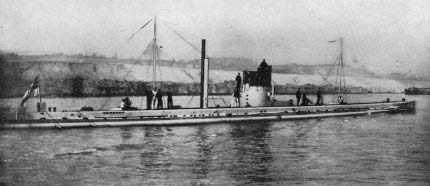
A German U boat of early WW1
The story relates to a time during the First World War when German U boats were wreaking havoc in the Channel and sinking many merchant ships. The tale explains that along the cliffs from Froward Point towards Man Sands, over a period of weeks, the skins of recently butchered sheep were found by farmers. At first it was assumed to be the work of local poachers. But then an alert mind pointed out that if it was a poacher, it would be a lot easier to put a collar and lead on the animal he was going to steal and walk it home. A damn sight easier than carrying a bloody carcass a couple of miles across fields!
That same alert mind concluded the possible connection between the sinkings in the immediate area of the Channel, no sign of the U boat and the sheepskins found within a small area along from Froward Point. On a fine calm day a spotter plane was sent up and just off the Mew Stone the outline of the German submarine could be seen. Depth charges soon put an end to it and the sheep stealing ceased forthwith. It had been a brilliant idea of the U boat commander to hide right under the enemies’ nose, but his crews taste for fresh meat had proved their undoing. All this happened over ninety years ago.
For the keen angler a favourite spot is just off the Mewstone. On the fish finder up comes the outline of a rock, its shape is the rough outline of a submarine, it is called the submarine rock. But is it just that, a rock?
Since David Murphy passed the story on to Kingswear Historians, Tessa Gibson has discovered ‘Dive South Devon’, an old book that highlights good diving spots off our coasts. Two descriptions are especially interesting.
1. The steamer Aldershot, built in 1897, was a 280ft merchantman from the Clyde and heading for Nantes. She was four miles off Dartmouth on 23 September, 1918, when a U-boat attacked, killing one man in the crew. The wreck is described as upright and on an even keel at a depth of 55m. Her bows, one of the best preserved parts of the wreck, point to the south-west.
2. ‘The Dartmouth U-boat’. In July 1981 a team from Totnes BSAC found themselves on the conning tower of a World War One U-boat at a depth of 50m southwest of the Mewstone. The submarine was covered in fishing nets and had a single stern tube, and was lying at a depth of 51 metres.
Five U-boats of World War One were lost in the Channel. They include UB-113 lost in September or October 1918 under the command of Oberleutnant U. Pilzecker. The UB-113 went into service on 25 April, 1918. Her second and last mission started on 14 September, when she went to sea with UB-111 under orders to sink merchantmen in the western approaches to the Channel.
Apart from her sinking the Aldershot nothing more was heard of UB-113 and there were no survivors or bodies. This book, however, reports that the last message from UB-113 was received on 28 September, 1918, saying that she had just torpedoed the steamer Aldershot. The same day a De Havilland D.H.6 seaplane was reported as dropping a 65lb bomb on the periscope of a submarine in the same area.
 Kingswear Historians