
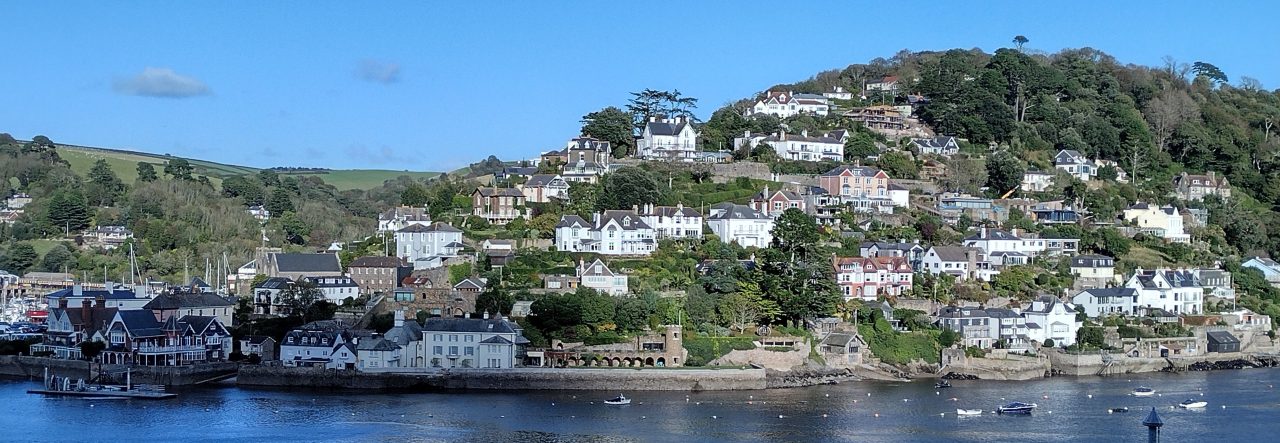
by Mike and Jan Trevorrow
Our house was built in 1908 and named – we think – after the town of Killiney at the foot of the Wicklow Hills in Ireland, near to Dublin. It is half of a pair of semi-detached houses and was first bought by a well-known and liked local man, Tom Casey. You may well have seen his name on the side of one of the car ferry floats because the Caseys owned the ferry from 1877 to 1925. The Caseys were big in Kingswear since they had the dairy; they also sold bread from their van. One of the Caseys was a builder but we have not yet been able to find out whether it was he who built the house for the family.
The house is very soundly constructed from semi-glazed red brick with yellow brick quoins and 4 window framings. I was very surprised to find out that it is built 5 with cavity walls at a time when most houses were still being built with solid, double-brick walls. The roof is a puzzle to us since it is of flat cement tiles with tarred underfelt underneath them. For the period of the house you would expect a Welsh slate roof and no felt, but it isn’t like that.
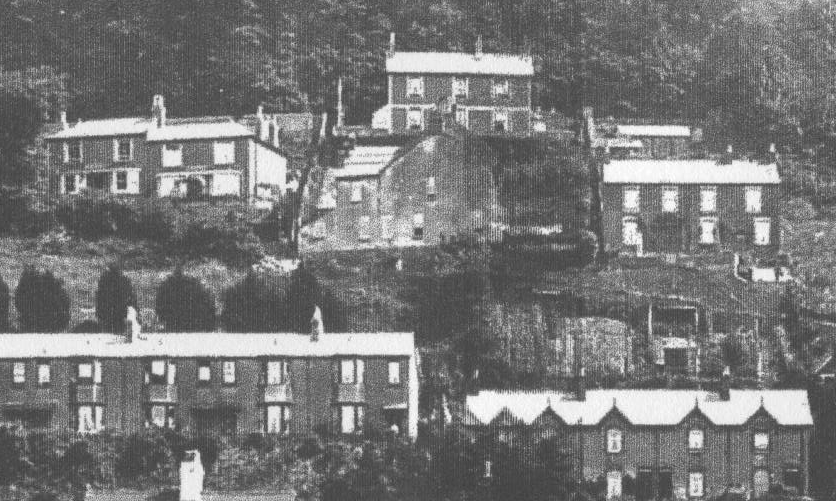
Using evidence from village archive photographs between the 1890s and about 1920 it is possible to plot the order in which the older houses around us were built. Using the photo of 1920, above, the side-on houses called Overhill (2) were the first to be built around 1890, then Hawarden Terrace (3) a few years later, followed in 1900 by the Beechcroft pair of semi’s (4) bordering Higher Contour Rd; semi-detached from Glenhurst (5), Killiney (1) completed the group in 1908 and couldn’t decide which road to adopt and so took both Wood Lane and Higher Contour Rd for its entrances.
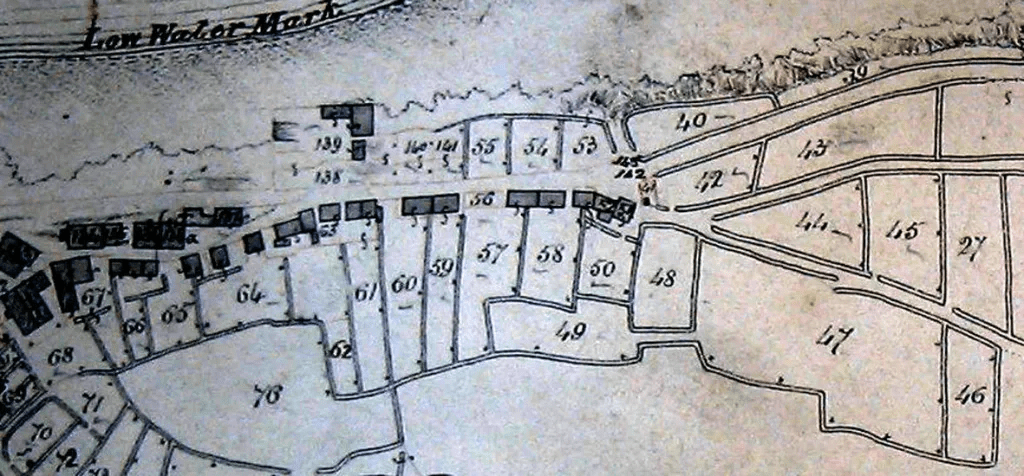
Using the old Tythe Maps of this area it seems that our house was built on the plot designated 46 and as defined as a garden; more information is not yet forthcoming in parish records and the Dartmouth Chronicles, but we’re still looking.
When old Mr Casey died in the late sixties aged almost 96, his daughter Kathleen took over the house with her husband Norman Davies, who used to work at the National Provincial Bank in Dartmouth. We think it was they who built a garage and workshop over old Mr Casey’s rhubarb patch, even though they never had a car! Kathleen died; after some years Norman Davies was planning to re-marry but died before this happened, so his partner Linda, distributed the very interesting ‘Casey Collection’ to three
appreciative local sources.
David and Moira Molloy then bought the house and made many changes, but kept the lovely Edwardian railings which we are so fond of (except when they need painting). The third resident owners were a family called Kinnair. Since then Jan and I have done a lot of re-planting and some re- modelling in the garden. Now Killiney is a very flexible, useful house for our purposes.
Stone Age to Domesday and Domesday to Dissolution by Trevor Miles
On 30th November, Trevor Miles presented to a ‘standing room only’ audience in the Lower Hall the first half of a review of the development of life on the Kingswear – Brixham peninsula, from the stone axes of paleolithic man through the Bronze and Iron ages to the Romans and Saxons and the arrival of the Normans. In the second half on 29th January, he explored the coverage of the rural population and holdings as recorded in the Domesday Book, the steady continuing growth in farming in the following century and the rise of small cottage industries in the expanding villages. Finally he discussed changes in the role and influence of the Church leading up to the dissolution of the monasteries. Inevitably it was not possible to deal fully with all the many factors at work during the centuries covered but, given the interest shown in the review, it is planned to hold some further meetings to look in more detail at some of them, such as Iron Age hill forts, the Viking raids, local castles, earthworks, abbeys and parish churches.
Totnes: Ancient Royal Borough and Market Town by John Risdon
John Risdon, on 26 February, took us with an array of splendid photographs up the Dart to our neighbour, Totnes, at the navigable head of the river and its lowest fordable point. The town dates
back 1300 years to its establishment as a fortified Saxon ‘burh’, one of several at strategic points in
the Kingdom of Wessex to protect against Viking raids. There is no doubt, however, that Phoenician
merchants were making their way up the river in much earlier times to trade for tin from Dartmoor.
Following the Norman invasion, William gave control of Totnes and surrounding manors to Judhael, one of his commanders in the campaign in the South West. He quickly set about the construction of a ‘motte’, a defensive mound, with a courtyard or ‘bailey’ at its foot protected by timber defences. He also founded the church of St Mary which became the Priory of Totnes until the Reformation. Though now a Norman town, trade grew steadily throughout the medieval period providing important markets for the local area. These gradually became specialised and eventually developed into markets such as the Butter Walk and the Poultry Walk. Three wells believed to have medicinal properties – ‘the leach wells’ – also helped attract visitors as well as local users.
By the mid 1500s, Totnes was four times wealthier than Dartmouth, thanks mainly to its trade in woollen cloth and tin and to rapid growth in a variety of local industries. During this long period of prosperity, wealthy merchants rebuilt many of their town houses in the attractive styles as they still appear today. Ownership of the Priory land was passed after the Reformation to the Town Council and was used to construct the Guildhall. By the early 1600s, however, the ‘good times’ began to give way to a decline in trade and the ‘Merchants town’ gradually changed to a ‘Gentlemen’s town’, although it The merchant warehouses now luxury remained the main market centre for this part of South Devon. apartments
Little now remains of the six former shipbuilding yards on the banks of the river and the recent closing of the Baltic Wharf has brought to an end the long history of commercial trade on the Dart. However, the High Street, the main street through the centre of the town since Saxon times and now in the shadow of the castle, still reflects the continuing busy life of Totnes.
 Kingswear Historians