Grade II Listed
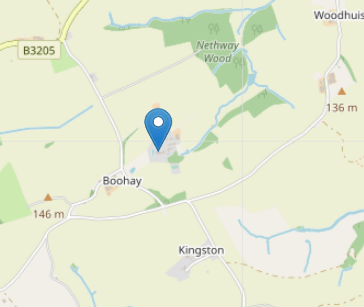
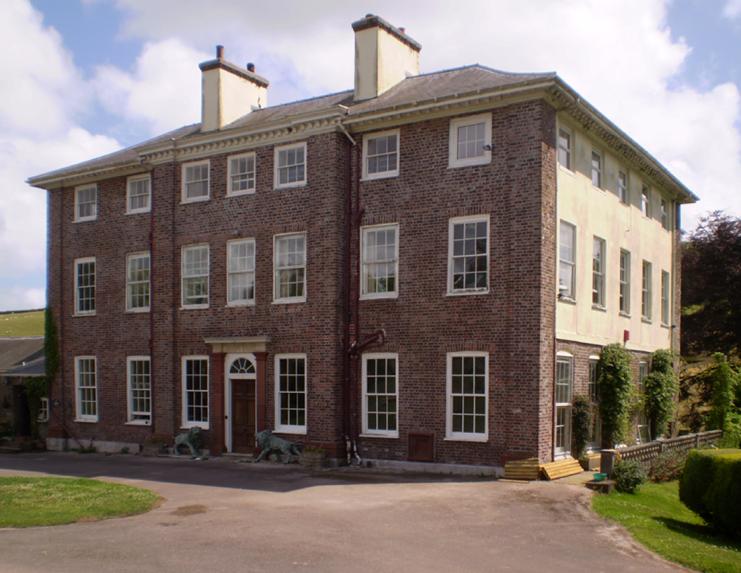
Official Description: Country house in small park. Dated 1699. Built for John Fownes. Red brick in Flemish bond. Bitumanised slate hipped roof with heavy moulded wooden modillion cornice. Giant corner pilasters in brick with moulded sandstone bases. Stone plinth. Double depthplan. Three storeys and cellars. 2:3:2 bays, centre three bays slightly advanced with giant pilasters and with eaves cornice breaking forward. Sash windows with glazing bars and cambered brick arches. Central doorway with red sandstone pilasters stone entablature, semi-circular fanlight and panelled door. Seven-bay rear elevation and five-storey side elevations, with rendered first and second floors. Four plain rendered chimney stacks symmetrical on ridge. Two-storey service wing to east, stone rubble, rendered south side with sash windows, now coverted into three cottages, probably originally stables. Good contemporary interior. The principal ground floor rooms have bolection moulded panelling with contemporary bolection or later C18 chimney
pieces and moulded plaster ceilings. The entrance hall has a fine plaster over-mantle with garlands and cartouche with helmet and putti. Stair hall at rear has massive open well stairs to first floor with moulded string, turned balusters and heavy moulded hand rail ramped up to large panelled square newel. Panelled
and pilastered dado, fine moulded plaster landing ceiling with oval and laurel branches with eagles and heavy cornice with acanthus leaves and eagles. Bedrooms, one is panelled, the others have moulded plaster cornices. One attic room has moulded plaster cornice. Secondary staircase on east side of house, full height, dog-leg with moulded string heavy moulded balusters and handrail and semi-circular newel said to be half a ship’s mast. Moulded square sandstone plaque to right hand of ground floor inscribed: ‘The Within House was built by John Fownes Esquire Anno Domini 1699’. Charles II is said to have visited Nethway in July 1671, so presumably there was an earlier house on the site.
Description by Mike Trevorrow
We were introduced to Nethway on 25 May by a short talk from the Historians giving a brief history of the finest house in our area.
Lynne Maurer was our very kind host, who provided a superb evening to about 55 members and friends.
Nethway is a ‘calendar house’: one chimney for each of the seasons, 52 windows for the 52 weeks of the year, 365 panes of glass (originally) and seven entrances/exits. It has a tunnel which is said to lead from underneath the front of the house to Boohay and Nethway Farms and then all the way down to Mansands. Within living memory this tunnel collapsed at Nethway Farm but previously it was used for heaven knows what purpose. We could supply some suggestions!
There is a resident ghost. A young girl who had been a servant, and who was seduced by one of the sons of the house, could not live with the shame and consequences of her resulting pregnancy and hurled herself to her death from the top of the roof. Both Lynne and her daughter have seen this girl; previous tenants record the same sightings. The house we see today is not the first house on the site; about the earlier house(s) we know nothing really, but certainly there was a Tudor house of some grandeur until it burnt down in 1696.
Nethway Front Entrance
The present house was built 1696 to 1699 by John Hody, who sold it before finishing to John Fownes who set in the front wall of the house a plaque commemorating the fact of his building. It is well-worn but still there today in its red sandstone. The earliest reference in print to Nethway is in 1192, and by 1380 there were seventeen different spellings of the name, including ‘Nethway-on-the-Hill’. The name means simply ‘by the way’, ‘near the way’ or ‘neath the way’, the way in question being the main road from Exeter to Dartmouth, which is about 700m away from the house.
From 1314 to 1435 Nethway was owned by the Cole family. There was a succession of John Coles but the earliest on record was a Devon Member of Parliament in 1417 and 1423. Two of the Coles became lords, two were mayors of Dartmouth, several went into the church and one daughter of a John Cole married the Lord Chief Justice of England in Richard II’s time. This august personage then became the first of the next family, the Hodys, to own Nethway. They became a very powerful family indeed, being resident from 1435 to 1699. During their tenancy it is written that Charles II stayed at the earlier Nethway on 23 July 1671 on his way from Dartmouth to Exeter. During the Hodys’ time, a font was dug up in the grounds and was said to be used for pig fodder but it is now the font in Kingswear church.
At our talk we had a descendant of the Hody family, a lady now called Gillian Huddie, who on the very evening of the talk told us her knowledge of her family. In 1747 Henry Fownes (17th generation!) married his cousin Margaret Luttrell of Dunster Castle taking the name Fownes-Luttrell. Their successive families lived in Nethway and Kittery but gradually moved to Dunster and their poor Kingswear houses fell into considerable disrepair.
The huge estate was sold by the Fownes-Luttrells in 1874, Llewellyn Llewellyn buying the Nethway portion. He set about improving the Nethway estate; it was no longer the 2000+ acre estate which John Fownes had accumulated, but was reduced to the house, its curtilage and Nethway and Boohay farms. Improvements were made to the farms as well as the house. During the Llewellyns’ residency in 1882 they lost a thirteen year old son who was drowned in the Dart and later suffered the death of twin girls at a couple of months old, and also their mother. The death of the son is commemorated in a window in Kingswear church.
It is notable that the school along the lane from Nethway was built by the Llewellyns; it is now the Dragon House. The Llewellyns stayed until selling in the late sixties to the McNeils, who ran some of the land as a market garden. They sold in 1978 to the Stewart-Bamms, who sold to the Corgatellis, who sold to the Smarts who made the swimming pool and tennis court, and they in turn sold to Lynne and her ex-husband in 1997.
The entrance hallway in Nethway House
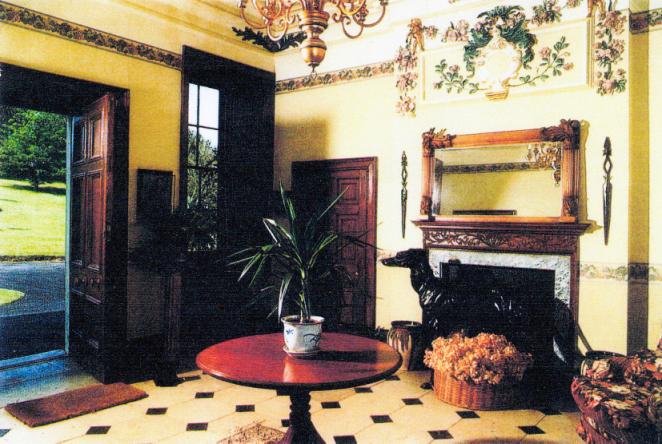
Over the years the house has changed relatively little inside, at least as far as the main rooms are concerned; it maintains quite a grand staircase in the middle of the house and a most unusual ‘semi-newel’ lesser staircase at the back. The small stairs have a huge former ship’s mast as their central support running fully forty feet from top to bottom and is very unusual in a house of this high status. The doors and panelling in pine are of good quality, original, and worthy of mention. Also of good quality is the plaster-work in the outer hall and on the landing where swags, flowers and eagles ennoble the place. We think the big change occurred to the building as a whole in the early twentieth century, well before the house was ‘listed’ as being of architectural importance in 1971.
The ground at the front was raised a little, thus ‘swallowing’ some of the steps leading up to the front door; then there was a raising of the ground level at the side of the house facing the drive on approach. This meant that the bottom storey of four was completely buried, so that now the house appears to be only three storeys, the old bricked-up windows of the original kitchen, servants’ quarters, etc. are now in the cellar. At the back of the house a built-up walkway was added which gave the house a terrace, previously lacking. Round about 1978 the roof was re-formed; this was done by simply building a new single-pitch roof over the old twin-pitch one.
At some earlier time (we presume) the cornice at the top of the house was removed, thus making the house much plainer, not quite so typical of its day. It is, however, still a handsome house with two royal connections: Charles II (mentioned earlier) and Prince George, son of Edward VII, who planted a tree in the garden on 2 November 1878 when he was thirteen years old. He was a cadet at Britannia Royal Naval College.
Editor’s comment: Nethway, 1698, is a brick-built house.
 Kingswear Historians