
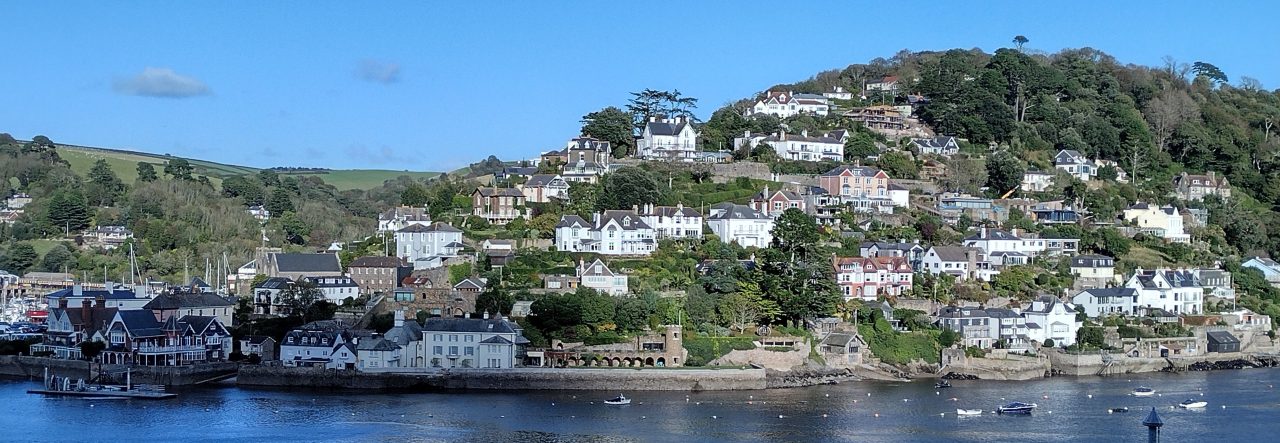
by Paul and Imogen Moynagh
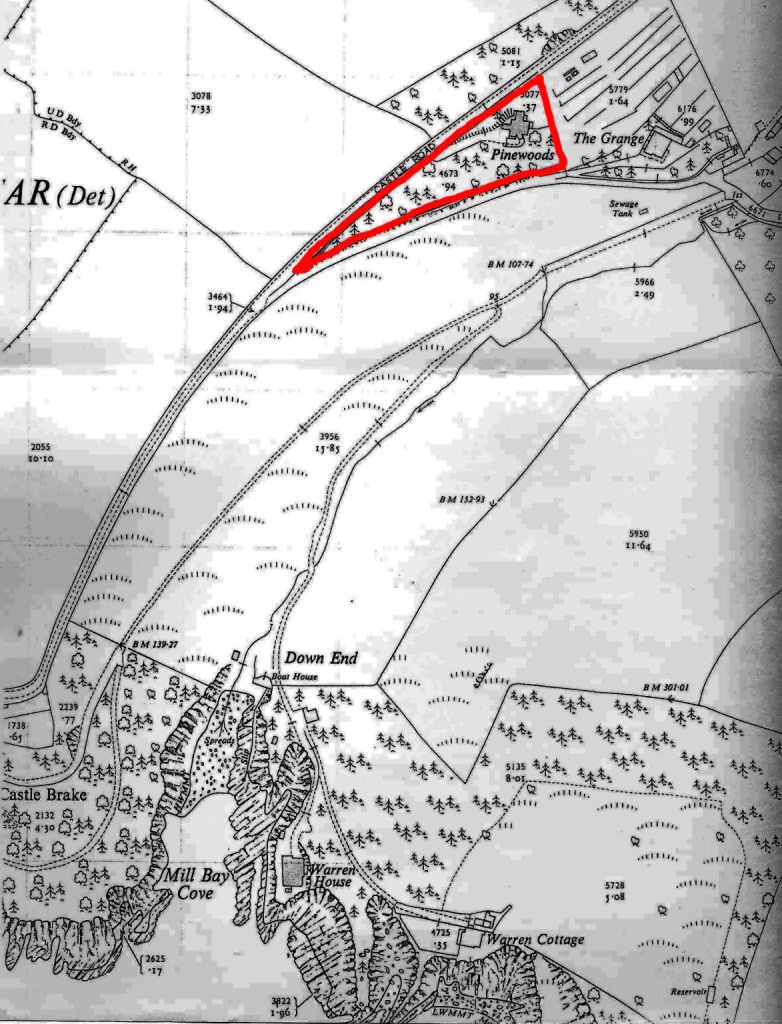
Follow the coastal path along Castle Road towards the river mouth for a mile and you come to a typical steep-sided Devon combe which falls towards the sea at Mill Bay Cove. Looking back from there half way up the valley are four houses, not all readily seen together. Nestling among trees to the left and highest is Pinewoods; lower and to its right stands The Grange, the childhood home of Herbert Jones VC; below this a cottage; and in the hollow by the stream sits Home Farm. 150 years ago none of these existed.
Brownstone, at the top of the east slope of the valley, was until then the only substantial building in the area. Owned by the Hayne/Seale-Hayne dynasty since the seventeenth century, in 1852 Brownstone was inherited by Dartmouth and Devon’s great entrepreneur, developer and benefactor, Charles Seale-Hayne MP.
Having first restored Kingswear Castle for his own residence, he built a good estate road (the continuation
of Castle Road towards Boohay, now usually called Back Lane) and from about 1864 started realising the
value of his real estate by building houses in this beautiful valley with its breathtaking views of the mouth
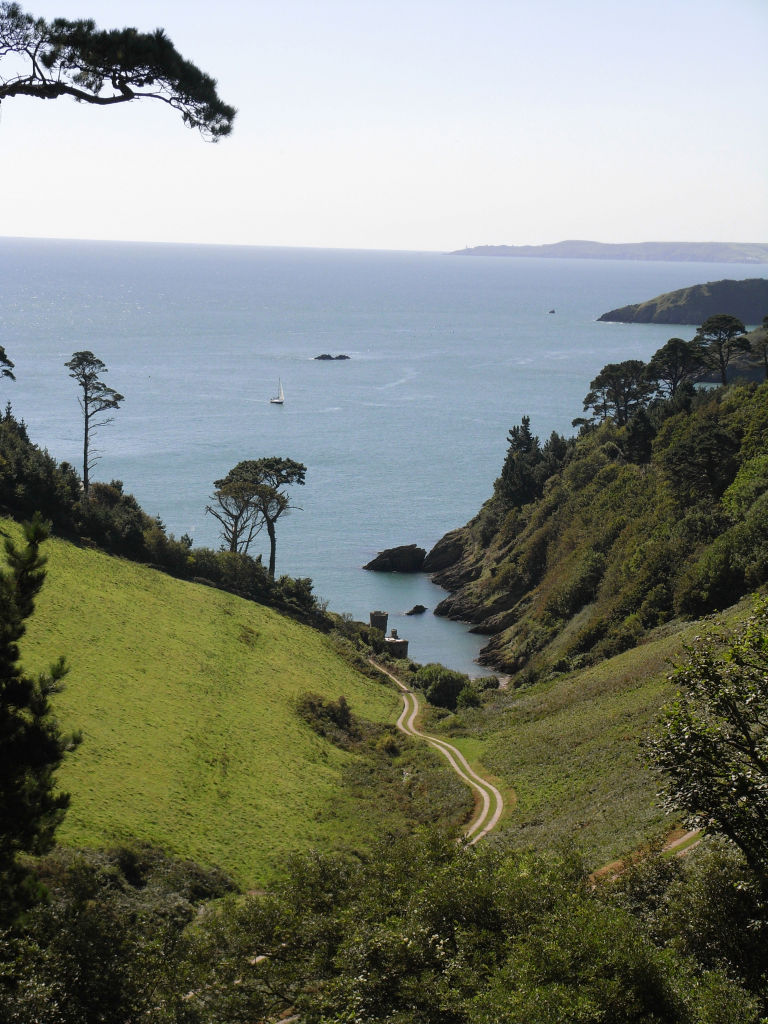
of the Dart and of Start Bay. Lower Brownstone (now Home Farm), Penang Villa (now The Grange), and Start Bay Villa (later named Coombeside before being renamed again as Pinewoods), were among the earliest of these. Start View Villa, later Kingscliffe (now White House), and Glenorleigh (now Kingswear Court), were others. It is said that only Seale-Hayne’s embroilment with politics and law suits distracted him View from Pinewoods from more thickly developing the area. All the properties were let, and remained in Seale-Hayne ownership until his death when in 1904 the estate
was sold off.
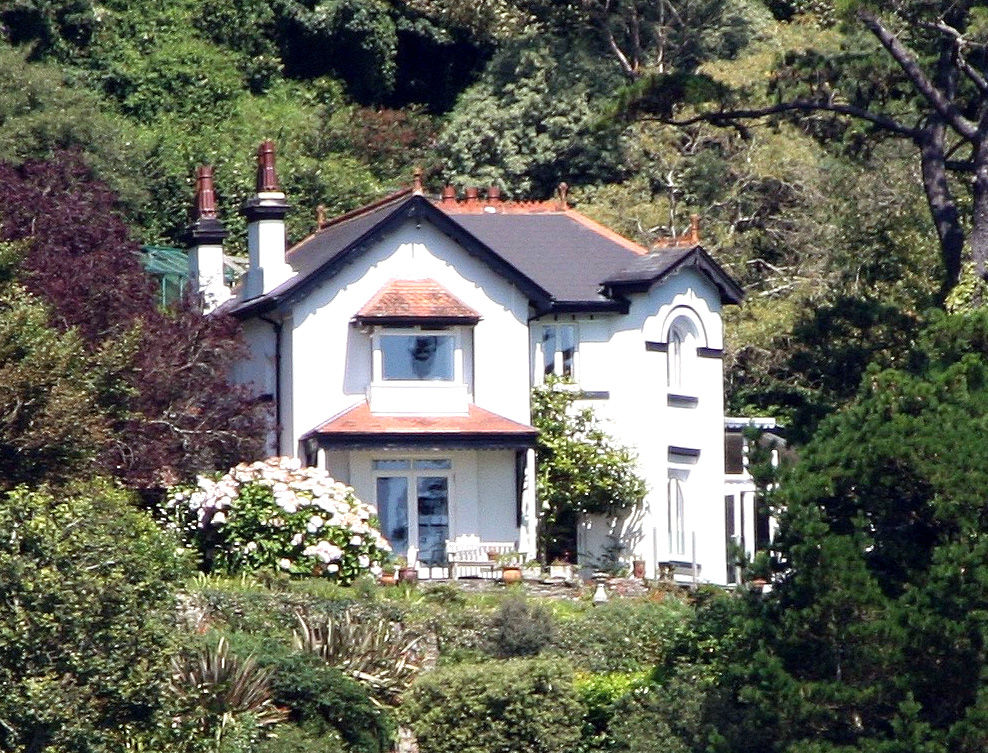
Dartmouth slate was quarried from beside the lane nearby to construct Start Bay Villa’s two foot thick stone walls whose thermal insulating property beats any modern cavity wall hollow. Initially probably just three bedrooms, it was enlarged around 1880, and had further extensions added in the 1920s. At some stage black painted mock Tudor timbers were added to the white painted walls; these were removed in 1987. The slate roof is graced with a number of decorated terracotta finials, a grand dragon over its porch, and a griffin with ball in beak above the dining room. As with so many Kingswear houses built on a steep slope, all three floors have an external door. The extensive lower round floor, originally the kitchen and servants quarters, has now reverted to more menial basement purposes (laundry, workshop, garden store etc, with still room enough for a billiard table). An outer hall, dining room, and lean-to sun room were added during the last century. Apart from modernisation and some internal rearrangements, there have been no recent major additions.
1865 owner Charles Seale-Hayne MP built Start Bay Villa
1889 – 1892 tenant Arthur H Enock (artist)
1904 tenant G.W. Rogers
1904 owner John Henry Hutchings
1904 owner S T Reed
1910 owner? H A Hood Daniel
1914 owner Miss Windsor, Coombeside renamed Pinewoods
1923 owner Miss Windsor
c 1939 owner Miss D K Whish
c 1943-6 tenant one of the authors of ‘Sexton Blake’ .
1947 owner Mrs Helen Mary Davidson
1959 owners Kenneth William and Nancy Jocelyn Abrey
1987 present owners Paul and Imogen Moynagh
Little is known about the early occupiers, many probably being short-term tenants, perhaps just for one summer. A tenant who lived there from 1889 to about 1892 was a widely respected artist, Arthur Henry Enock, known as ‘The Artist of the Dart’ for his atmospheric watercolours of the river. Although mostly of its higher Dartmoor reaches, some were of the tidal parts and Dartmouth. Before Coombeside, he lived at Inglewood, Lower Contour Road (once New Road).
Miss Windsor was a ‘character’ still fondly remembered by older natives. On the one hand very
definitely a ‘lady’ and driven everywhere by her chauffeur, she oversaw making Pinewoods what was
reputed to be a beautiful well cared for woodland garden. On the other hand she was a pipe-smoking,
cussing, and hard drinking woman – she and her chauffeur were once arrested in Paignton for being
drunk and disorderly. What is now Back Lane is still recalled by older villagers as Windsor’s Lane.
Mrs Abrey tells of a writer, name unrecalled, who rented Pinewoods in the 1940s and was one of the many contributors of Sexton Blake detective stories which were serialised, filmed and broadcast by radio over the first 70 years of the 20th century. At the end of the garden, with a grand view of the bay, are the ruins of a brick hut where he is said to have written his stories.
Kenneth Abrey was a well qualified Consulting Engineer who practised in Dartmouth. The detailed structural drawings of the house he made when he designed the central heating are more accurate than any ubsequent surveys. A keen horticulturist he grew orchids in a 50 foot heated green house which only recently had to be replaced. He died in 1986 and his widow moved the following year to a bungalow in Broadsands. A son and daughter still live in south Devon.
The 1990 great storm which decimated the trees in Warren Woods, mostly old pines, also felled most of Pinewoods’ Montereys; only six of the twenty-six we inherited in 1987 are still standing. In despair at the devastation, we were briefly tempted to revert the house name to Coombeside, but a grant prompted planting thirty replacements, most of which are now thriving.
Looking Back 150 Years to November 1857 Research by David Murphy The Dartmouth Chronicle of November 1857 was reporting: Transport for Dartmouth and Kingswear: The port was well served by maritime transport but the railway from Bristol had now reached as far as Torquay and the route had already been staked out by Mr Brunel’s engineers for the extension of the line to Paignton. However, a cautionary note had been sounded. Four shares of the Torbay and Dartmouth Railway originally purchased for £20 were now advertised for £7 10s.
For the discerning traveller by sea, there were ‘Steam Communications’. Steam ships boasting 100hp engines sailed between London and Bristol calling at Dartmouth, Falmouth and Penzance, offering the cheapest direct communications with superior accommodation for passengers, wind and weather permitting. An added bonus was that pilots and towing vessels were not necessary, so keeping the costs down.
In the Courts: Cleanliness was strongly supported by the Magistrates at the Petty Sessions in the Guild Hall. A Mr Gregory was charged with obstructing the Sanitary Inspector in his duties. No details were given, but Mr Gregory was fined 10s with costs. However, details in the case of Mr John Partridge were quite specific. He had left an amount of fish offal in the Market Place longer than was deemed necessary, constituting a public nuisance and was fined 2s 6p with costs. Public order was represented in the case of Mr Thomas Davis who was arrested for being drunk and disorderly and was fined 5s with 10s costs. It was pointed out to him that failing to pay the fine by the following Monday would result in him spending six hours in the stocks.
 Kingswear Historians