
Chain tower and blockhouse at Gommerock
The Tower is a scheduled ancient monument.
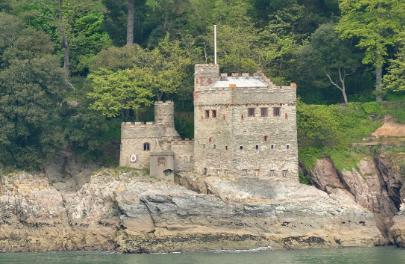
This monument includes a rock cut terrace representing the remains of a chain tower and associated blockhouse known as Gommerock Tower situated on a cliff overlooking the narrowest part of the mouth of the Dart Estuary. The chain tower survives as a rock cut platform with rock cut gullies and joist holes for a timber building with a pent-roof. This structure represents the eastern end of a chain which was raised to prevent access to Dartmouth Harbour. The second tower, which originally contained the lifting machinery, is at Dartmouth Castle which is Listed Grade I building and a scheduled monument. The blockhouse stands a short distance upslope from the terrace and was built to protect the chain from sabotage. The blockhouse is polygonal in plan, measures up to 13m long by 8m wide internally; its walls are up to 5m high and up to 1.8m thick. On the ground floor is a rock cut terrace enclosed by walls on three sides, roughly rectangular in plan. At first floor level the building is polygonal with the north east end forming a point. A rampart walk and parapet top the walls.
The chain defences at Dartmouth are known to have been in existence by 1462 when Edward IV made an annual grant for the provision, amongst other things, for a defensive chain, cables, and “pulleys” at Dartmouth. In 1481 a further grant was made for building towers with a chain. The surviving structures are therefore likely to be of late 15th century date.
Subsequently, the terrace was reused as an artillery battery and the blockhouse as a fortified house. The blockhouse was ruined in about 1643 and appears in a 1734 engraving as a roofless shell. It formed part of the Kittery Court estate.
 Kingswear Historians