The Kingswear childhood of Col. H Jones VC
Herbert (H) Jones VC disliked being called Herbert and preferred to be known as H. His father, also named Herbert, was a wealthy American while his mother, Olwen, came from North Wales of a more modest background. H was born in London on the 14th May 1940.
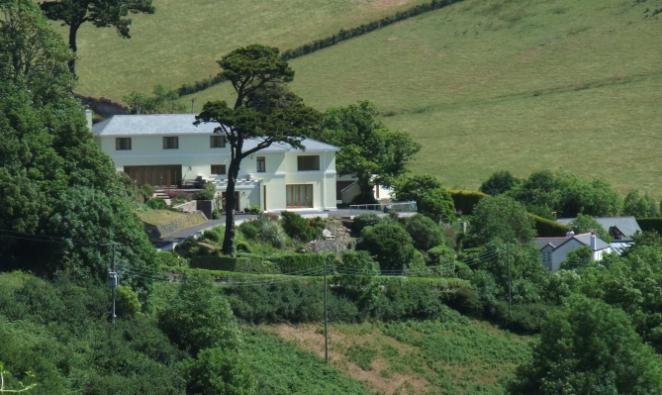
The elder Herbert had owned a yacht in the 1930s, which was based first on the Clyde and then in the Solent. During this period he had sailed extensively around the United Kingdom and during one summer he cruised along the South Devon coast and decided that the River Dart area was wonderful. When he married Olwen in 1938 they were living in a flat in London, but decided that the Dart area was where they wanted to be. They spent a great deal of time looking at houses and it wasn’t until 1940, 2 weeks after Herbert the younger was born that they moved into The Grange in Kingswear. Herbert the elder was too old for military service (he was 52 in 1940) and was anyway still an American citizen,
so he was not called up.
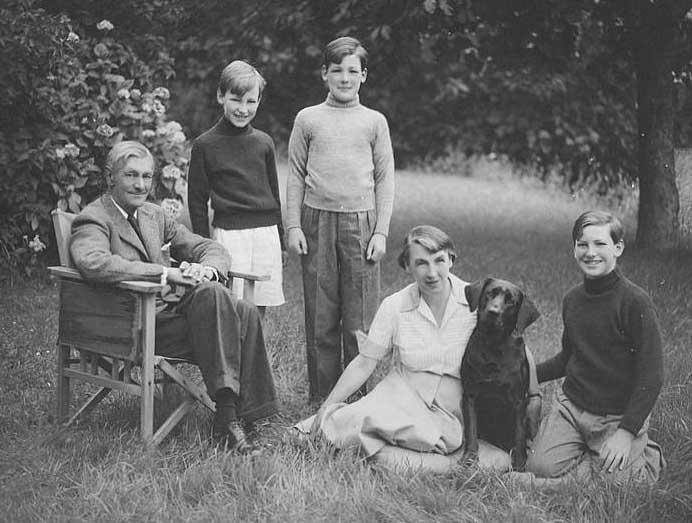
H had two brothers: Tim (born 11 February 1942) and Bill (born 16 February 1945). The photograph shows Mr and Mrs Herbert Jones with Bill, Tim, their dog Jimmy and H (kneeling). Because their father was not in the Armed Forces, the family enjoyed his presence throughout the war when many other fathers were away. Equally this was a great joy to the elder Herbert who had had a difficult previous marriage and was delighted to be around as the children grew up.
Herbert continued his interest in sailing when they moved to Devon and he was elected as a member of the Royal Dart Yacht Club in Kingswear on the 4th November 1940. Herbert does not seem to have been a very active member as there is no record of attendance at any general meeting of the club but he did propose someone for membership in 1946 and seconded another person for membership in 1956.
Herbert did not stand aside from the war effort and was a member of the local Home Guard, though it had taken a great deal of time and effort to overcome the bureaucracy to allow an American to join. He owned two 2.2 rifles, which he obtained from America, and which were used by the Home Guard for practice. As he was the only one to have a car he used this to transport the Home Guard around the area for which he would have been granted as extra allocation of wartime petrol coupons. Mrs Jones was a member of the Kingswear Women’s Institute, joining in October 1941, and regularly attended the village church, St. Thomas of Canterbury. One of her friends was Norah Wiggins who lived at Foxhole in Beacon Road.
Some of the older residents maintain that there was quite a class divide between those with large houses facing southwest, the river and benefiting from the afternoon sun and those in smaller houses of more modest means who lived round the corner facing north and Waterhead Creek. In previous times several notables lived along this side although their work was across the water in Dartmouth. These included the local Dartmouth MP, their mayor and the Governor of Dartmouth Castle.
H’s father Herbert Jones was a great anglophile and was granted British nationality in June 1947. He wanted the very best for his children and so his sons did not go to the primary school in the village but to a private school, Tower House School, across the river at Townstal Pathfields in Dartmouth. During the war a large number of evacuees had come to Kingswear together with two teachers so there may have been no room in the village school.
Herbert’s open top Austin 8 tourer (the same one as had been roped in for Home Guard use) took the two older Jones boys across on the ferry to the school. Sometimes the car was driven by Herbert himself and some times by his chauffer Colin Armstrong. Transport was provided for other local children going to the same school. For a time it was Tobin and Jonathan Duke, later Sally Sanderson and her brother.
Towards the end of the war, in about 1944, the Duke family moved into the nearby Grange Cottage (now called Home Cottage). Col. Duke was away in the army on active service. The two boys, Tobin and Jonathan, were about the same age as H and Tim. The boys got on well and although the Dukes moved away in 1946, they remained friends and continued to visit each other over the years. The two Duke boys were accepted as honorary members of the Jones family. H tended to dominate the group but was very protective of the others if they got into trouble. The group do not appear to have had much contact with the other children in the village a mile away. Inevitable they had a number of scrapes. One involved a couple of dinghies being secured incorrectly at low water and then becoming trapped under the quay as the tide rose. Subsequently H and Tobin joined the army and Tim and Jonathan joined the navy.
When H was eight years old he was sent to a boarding preparatory school, St Peter’s in Seaford, Sussex. There, when he put his mind to it, he excelled academically. The school was a feeder school for Eton where he went in September 1953. His academic performance at Eton was undistinguished, but he was able, with the help of a crammer in London to pass the army entrance exam and in 1958 he went to Sandhurst from where he graduated on 23 July 1960.
From an early age H was determined and strong willed. He was keen to do well and to succeed, at first as a result of a lack of experience, this energy was sometimes misdirected and this could and did lead him into trouble on occasions. As he gained experience and judgement he was able much better to harness this energy and the results were clear in his many successful jobs in the Army.
Several people remember the Jones family.
Barry Westacott lived with his parents at Grange Cottage for a time and his mother worked at the main house as cook and housekeeper. “During the war we had to walk every day to school. If the high road was closed by the Army, when the AA guns were being used, we had to go via Mill Bay where there was a small mine field. We use to like playing near Mill Bay until my mother found out. Sometimes we had to go with an army escort from The White House to the Post Office”. Grange Cottage used to house the generator that fed electricity to the house but was converted to a dwelling when mains electricity arrived.
Sally Hindley (nee Sanderson) who lived at Brookhill, recalls “My younger brother, Richard, and myself used to be picked up by H’s father (who I remember as a much older man than my father) in what H used to call the ‘home guard car’ I think because it was a metal grey colour and a convertible. When the weather was fine and the car roof was down and the three sat high on the back in apparent danger of falling. If it wasn’t the ‘home guard car’ then it was ‘Nippy’ which was a smaller car, painted bright yellow and blue, which took us across over on the car ferry to Tower House School, which was on the road past the Royal Naval College (I believe the school no longer exists). During the holidays we often used to get together in the grounds of Brookhill and play cowboys and indians. The grounds extended out to the point and there was an old castle in the woods. We used to go carol singing.”
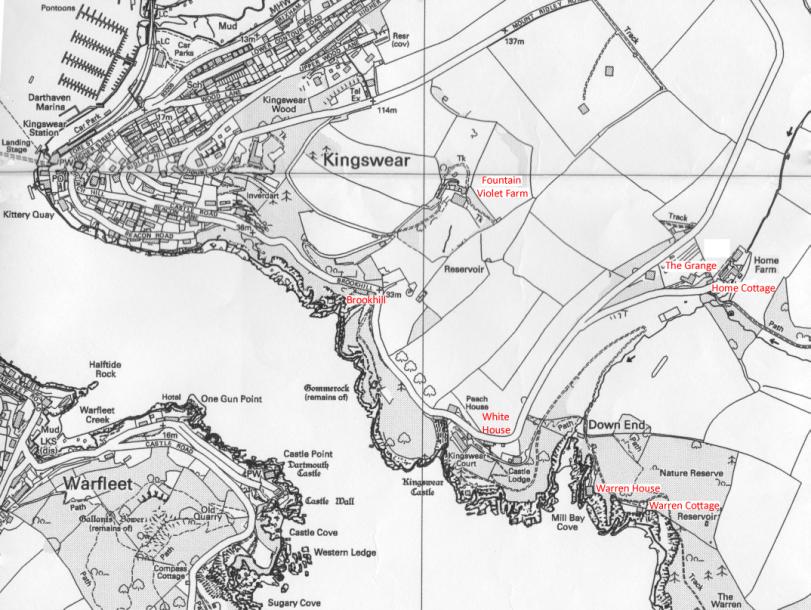
May was particularly friendly with Colin and Julie Armstrong who worked for the Jones family. Julie was a very lively Irish girl, who was both a domestic help and a nanny to the children and who had come to Devon in about 1946. Colin had worked as a boatman in Dartmouth, married Julie and later also came to work at the Grange as chauffeur, boatman and general factotum from about 1948. They lived in Wood Lane in the village.
Reg Little, who sang in the church choir, recalls that a group of village children went carol singing each year to the big houses including The Grange. The Jones family were always very friendly and gave them drinks and mince pies.
May Crisp (now May Watts and living in Australia) was a young girl living at Warren House near The Grange. She recalls that in the autumn of 1948 Herbert Jones had purchased an American Dory of the type used during the war by larger American vessels to ferry men ashore. The boat had been moored in nearby Mill Bay on rather a short line for the approaching spring high tide. The boat was beginning to be pulled down at the bow as the tide
rose. Her father told May to ring The Grange and tell Mr Jones. However he could not get there in time to stop the boat submerging. A reward of £100 was offered to recover the boat and several local groups, including May’s father and brother made unsuccessful attempts. It took a professional diver, Mr Distin, with the proper equipment to get the boat afloat again.
It is not surprising that some locals would have seen the Jones family as distant, particularly as the elder Herbert was somewhat retiring by nature. However in their quiet way they did quite a lot for the village. When the roadway at Inverdart fell away in about 1950 and no local firm was prepared to rebuild it, it was Herbert Jones the elder who led and coordinated the arrangements to get a national firm, Costains, to do the work. Many years later, in the early 1990s, when there was a problem about Rights of Way one of the older residents remarked to Tim that his father would be turning in his grave, since he would have been only too happy to allow local people to use it.
Herbert the elder was seriously ill from about 1956 and died aged 69 in 1957. His wife Olwen was very much involved in caring for her husband in the last couple of years of her husband’s life. After her husband’s death she continued to live at The Grange until the mid 1980s when ill health required her to live in a more sheltered environment. She died in 1990, aged 89.
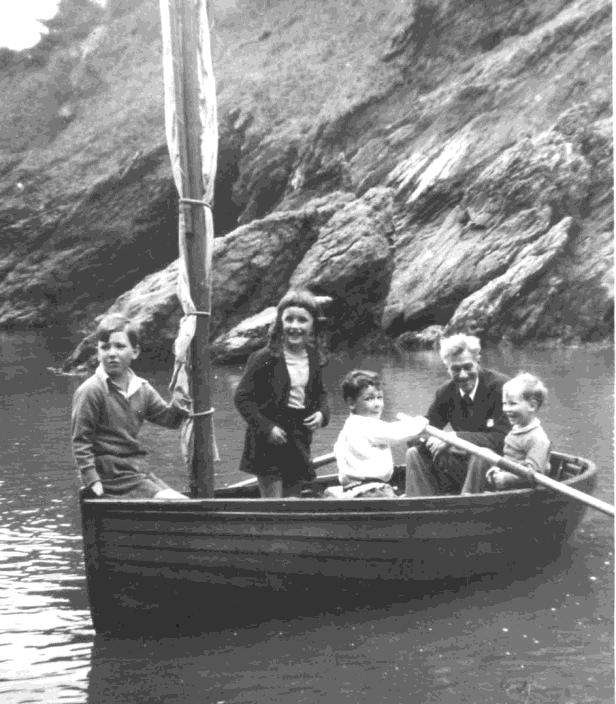
After the demise of the Dory, Herbert the elder acquired a motor-boat and she in turn was replaced in the early 1950s by a yacht called Duckling. There were also dinghies to sail and both H and Tim developed a great interest in sailing, using the wonderful opportunities that the River Dart provides. This interest continued for the rest of H’s life and he did a considerable amount of sailing
with his family in his adult life. The photograph shows the three boys with their father, the girl is Perdita Hutchison whose grandfather is thought to be Dr Corbett, a family friend.
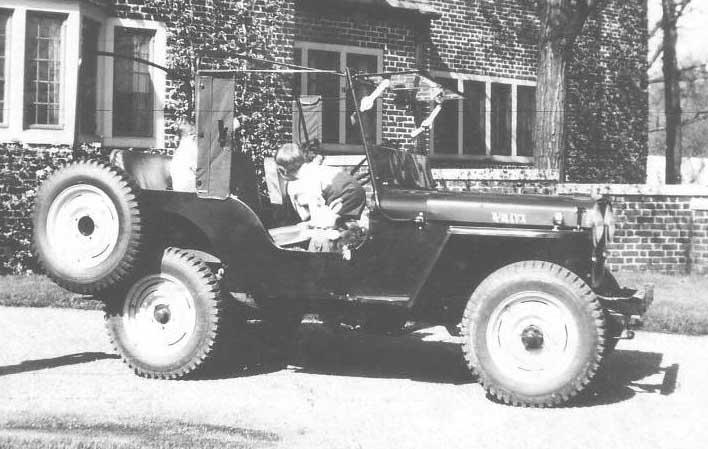
H reached the age of 17 in 1957 and his interest then spread to cars. As a result of the possibility of petrol rationing consequent upon the closure of the Suez Canal in 1956, learner drivers were allowed to drive unsupervised, including in a red American Jeep that his father had acquired. H’s driving in the early stage was remarkable more for his enthusiasm than his skill and this led to a number of accidents, fortunately none of which were serious. The fact that his father was very ill at the time and his mother was concentrating on looking after him, meant that he probably didn’t get the level of parental control that was required of a lively teenager. H subsequently developed into a very good driver and in his twenties did quite a bit of motor racing in a Lotus Seven and then an Elan, until it became clear that he couldn’t do this successfully as well as following his Army career. Both the Lotus and the Elan had been bought in kit form and assembled by Colin Armstrong in a garage that was part of Grange Cottage. H took great pleasure in driving a 1930s Bentley that he had inherited from his father. On another occasion, H was involved in an incident where the Bentley came into contact with a bus from Hillhead to Kingswear and the Bentley came off worst.
He was shy as a child and this shyness tended to continue in his early adult life in social situations with people he didn’t know. But this shyness reduced over the years and this was helped considerably after he married Sara de Uphaugh, who has great charm. This encouraged him to be more outgoing in all social circumstances.
After Sandhurst, H served in Cyprus, Plymouth, British Guiana, Aldershot, Northern Ireland, Germany and other places around the world. He married Sara in 1964 and they had two children David and Rupert. The family moved around the country and the world as H’s postings changed. But for H and for his family The Grange, where his mother had continued to live, was always their long term home. They came back there on many of his leaves and that was where the focus was. He even brought his Platoon and later his Company down to Kingswear to train. His intention was always that The Grange should be his permanent home when he retired from the Army.
In 1954 Mrs Olwen Jones bought Fountain Violet Farm near to The Grange. When John Vallance who lived there retired, Edward Jones, H’s nephew and son of his brother Tim took it over. Edward and his wife, Emma, contribute much to the village particularly to the benefit of the village school.
The Grange was sold after Olwen died in 1990. The Jones family still have a cottage near The Grange and take holidays there, so at least some of H’s passion for the place has born fruit.
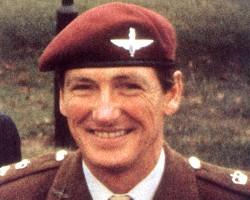
The 1972 census shows H Jones staying with his mother Olwin Jones at The Grange presumably on leave from the army. Unfortunately his long term ambitions over Kingswear were never realised because he was killed on the 28th May 1982 at Goose Green in the Falkland Islands and was awarded the VC posthumously.
Of his brothers, Tim spent 30 years in the Navy and now lives in Winchester. Bill went to Australia and then to France before returning to Wales in the 1990s where he still lives.
Michael Stevens Kingswear June 2011

The assistance of Tim Jones with the preparation of this paper is gratefully acknowledged.
───────────────────────────────────────────────────────────────────────────
With the opening of the railway in August 1864 Kingswear was transformed from an isolated area to somewhere easily accessible from anywhere in the country. A local land owner, Charles Seale Hayne, extended Castle Road to provide access to his Brownstone estate and built The Grange (then called Penang Villa), Home Farm (Lower Brownstone Farm), Warren Cottage, Start Bay Villa (Coombeside then Pinewoods), and several other properties in the area.
 Kingswear Historians