
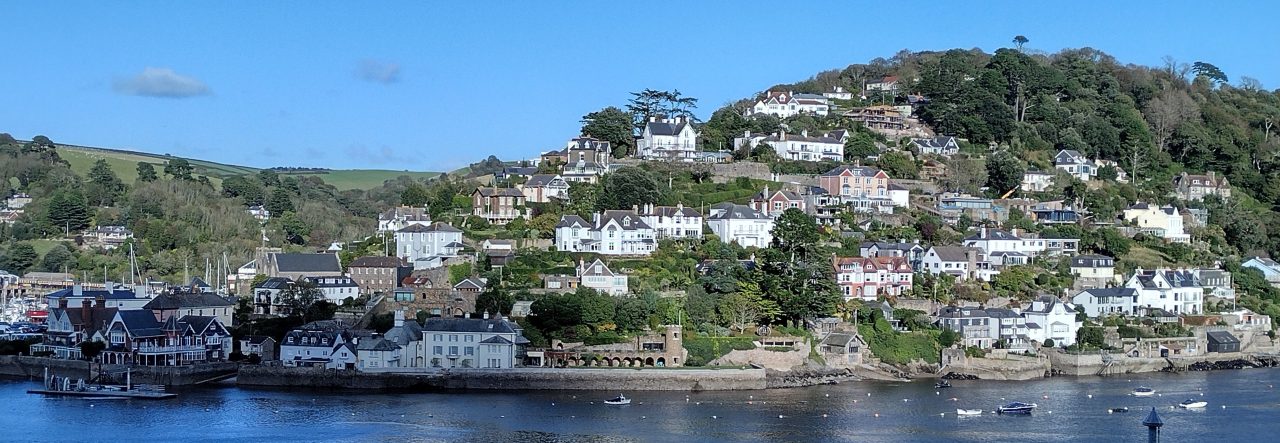
By Tony Read (Tony and his wife live in Plympton but have close links with Kingswear).
We thank Tony for sharing his memories with us and are sure you will enjoy them.
My father was in the navy and we all lived in Plymouth. Every time he came home on leave it was usually to the remains of our house and a reduced family. Before he returned to his ship he had usually fixed us up with digs in some distant town, hoping that Hitler didn’t find out. We lived in Falmouth, Ilfracombe, Launceston, Penryn and a few other places the names of which escape me. The last place, and the happiest place, was Kingswear, and my big bruvver Pete and myself settled in till the war ended.
We were placed in one of a row of three-storey houses which, according to the rough map in front of me was at the end of Lower Contour (or could it be Higher Contour) Road. The far house was lived in by Frank and Granny Knapman who took us into their home and hearts, and it seemed as if we slept for the first time. Grandad Knapman was a porter on Kingswear station, Granny Knapman’s family lived next door and their daughter was called Myra (I think) who had three children. Monica was the eldest, then Lizzie and then Brian, who got up to all sorts of mischief and always had grazed knees and torn trousers. At the far end lived the Beerman family. Mr Beerman drove the small ferry boat. Their daughter was called Brenda. I only had one toy in the world, and it was a tattered wooden scooter that my Dad made for me out of odd bits of wood. It worked wonders for my image and increased my esteem and popularity; the equivalent to owning an E-Type Jag for pulling the dollies.
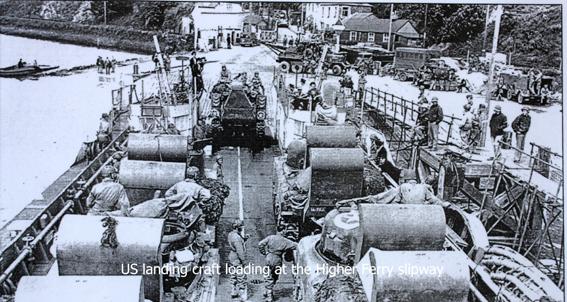
US landing craft loading at the Higher Ferry slipway
Behind these houses lived the Pollard family. They were all boys older than myself, and they were my heroes. They knew all the things that needed knowing: where the best trees to climb were, the nearest place to scrump apples, etc. They also did exciting things. Once they found a box of live 303 rifle ammunition. They drilled a hole through their gatepost that was a tight fit for the bullets and then put a six-inch nail against the end of the cartridge and hit it with a hammer. There was an almighty bang and the business end of the bullet whizzed and flew across the valley. They were always in trouble. They were my heroes, the Pollards.
My big bruvver, Pete, went to the grammar school over at Dartmouth and I went to the junior school just up from the station. We had a very elegant lady teacher once called Miss Matt-Souki and we bad-mannered little horrors used to drive her mad by pretending we couldn’t pronounce it and called her Miss Matooky. She hated us.
My father was sent to Ridley House after receiving injuries on his MTB (Motor Torpedo Boat). They used to sail from Falmouth and go across the channel to sort out the German ships, and then tear back home like scalded cats, and go straight down the pub.
The steep gardens of the cottages led down to a road which we called Lower Road; its real name was Brixham Rd. We all used to scamper down there to a bungalow and ask Mrs Bunn if John could come out to play. We thought they must be pretty rich because it was rumoured that they had a car. Nobody had a car then. One of my greatest delights was to have a ride on The Mew – that beautiful Great Western Railway steamer that was kept in permanent steam with the sole purpose of completing the last two hundred yards of the trip to Dartmouth for anyone who bought a rail ticket to that town. It must have cost a fortune to run, but for me it was paradise. I soon grovelled my way into the skipper’s good books and was allowed below decks in the engine room to watch the magnificent triple-expansion, reciprocating steam engine come to life and almost silently push the ship gently across the river. In that engine room it was the first time that a little boy had shed tears of happiness for quite some time. But me being a nasty little horror I showed my gratitude by carving my name on the taffrail at the stern of the ship. Years later, when I heard that The Mew was in Demelweeks scrapyard waiting to be broken up, I headed there and pointed to my name and thus my shameful vandalism, bunged the man a tenner, and said, ’Save me that piece’. He nodded and pocketed the tenner. I think you know the end of the story…… serves me right.
In the summer time we all used to go down to Lighthouse Beach (for beach read rocks) and although the water was almost always at minus 95⁰ Centigrade we loved it. The very active sewage outfall pipe didn’t seem to worry us (there was no `elf and Safety’ then) but we most likely picked up a hatful of immunities that saved our lives many times since.
If we were off for the whole day it could mean a trip round to Millbay Beach and that had real sand. Cor heck! More than once I saw aeroplanes flying down over the river, these were usually Spitfires identified by the heavenly sound of their Rolls Royce Merlin V12 engines. They might well have been chasing enemy planes, but I never saw any. That didn’t stop me from telling my spellbound mates back home that the whole Battle of Britain was fought here – ‘and I saw it all happen, so there’!
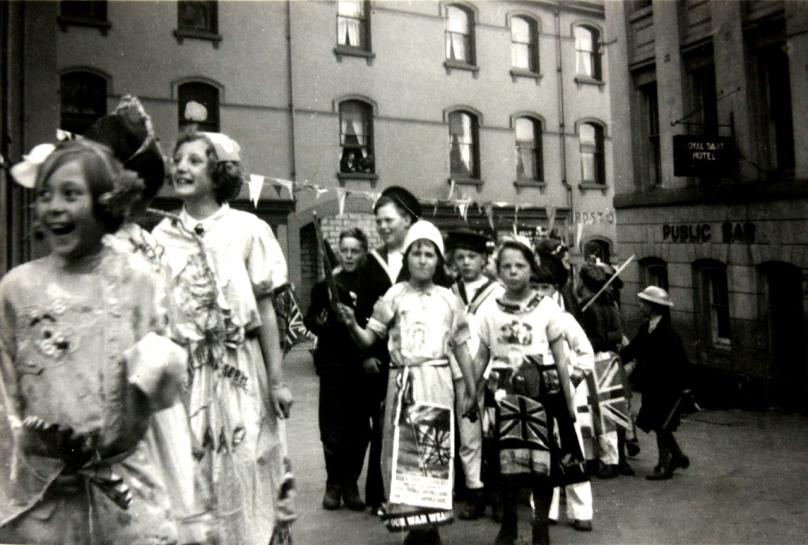
Evacuee girls in The Square Kingswear, VE celebration
Eventually our house had a new roof, walls, windows and doors and it was time to go home. For me being in Kingswear was a magical time and I lived among some wonderful people.
My big bruvver, Pete, joined the RAF and died with his crew, flying a Wellington bomber in 1951.
I joined the Merchant Navy and terrified the passengers on Union Castle liners before they threw me out.
I often think of the Kingswear people and wonder how many are still around. They will always be alive in my memories.
 Kingswear Historians